Miguel Cordon · · 2 min read
Eneos teams up with deep-tech firm to speed up discovery of new materials
Japanese energy major Eneos and emerging tech firm Preferred Networks (PFN) announced a joint venture that aims to provide a high-speed universal atomistic simulator to accelerate the discovery of new materials.
An atomistic simulation is the theoretical and computational modeling of what happens at an atomic scale in solids, liquids, molecules, and plasmas.
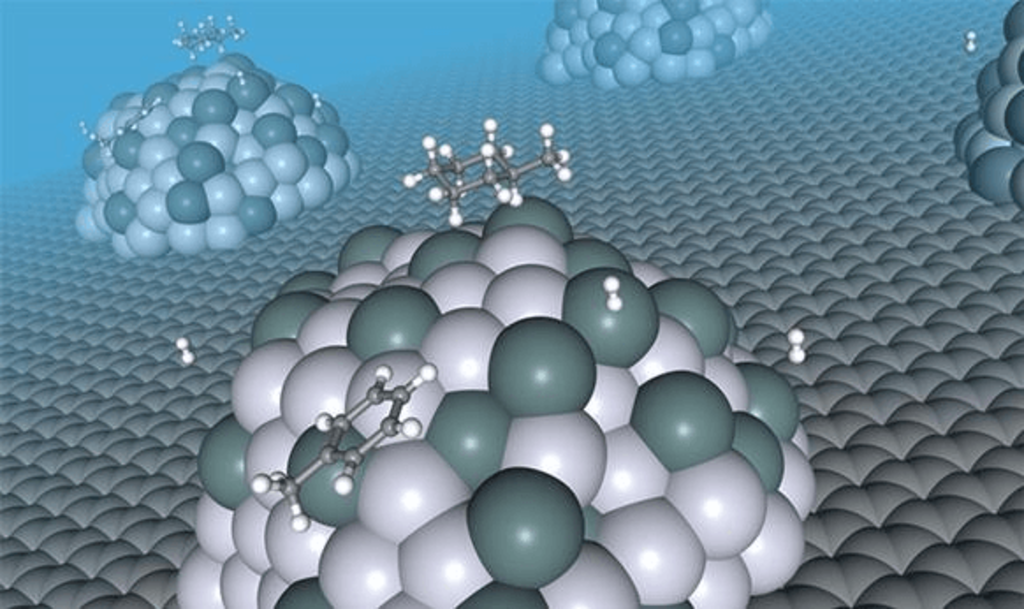
Example of a catalyst surface that is computable with the new atomistic simulator / Photo credit: Preferred Networks
Combining the expertise of Eneos and PFN, the simulator will be able to show properties of new materials at an atomic level, according to a statement. To achieve this, the two companies have incorporated a deep learning model into a conventional physical simulator, training the model with a vast amount of atomic structure data.
The joint venture comes as a result of a strategic partnership formed in 2019, under which the two firms planned to launch an innovative materials informatics business that takes advantage of deep tech.
PFN was established in 2014 with the aim to develop real-world applications of deep learning tech and robotics. It has since developed an open-source deep learning framework, Chainer, and a supercomputer called MN-3 for deep learning work.
The collaboration also aims to support the United Nations’ Sustainable Development Goals, including its efforts to build resilient infrastructure, promote inclusive and sustainable industrialization, and foster innovation.
The new venture, which has yet to be named, will be led by PFN co-founder and chief operations officer Daisuke Okanohara and is set to be established on June 1 this year in Japan. PFN will hold 51% of the venture, while Eneos will hold the rest.
Editing by Collin Furtado
(And yes, we’re serious about ethics and transparency. More information here.)





Stay updated on the go with our mobile app.
Get latest insights with smoother, more personalized experience through TIA mobile app.