 Colin Moreshead · · 6 min read
Land of the setting sun? Japan’s tech stars worry the country is being forgotten
We all like to feel good about where we are and what we’re doing. Entrepreneurship, after all, is a feel-good kind of game – innovating, building, selling, transforming. But isn’t there some danger of everyone getting a little too carried away by the glut of positivity in the tech ecosystem? Aren’t there some hard truths about ourselves and those around us that we should face up to in the interest of staying sharp?
Today at Tech in Asia Tokyo 2015, five stars of Japan’s tech scene weighed in on its current state of affairs in a session called Panel Without Fear. Representing venture capital, government, and startup giants in Japan, the panelists offered up some invaluable wisdom from a range of positions. These are all people who have staked their careers on Japan – everything they say comes from a place of tough love.
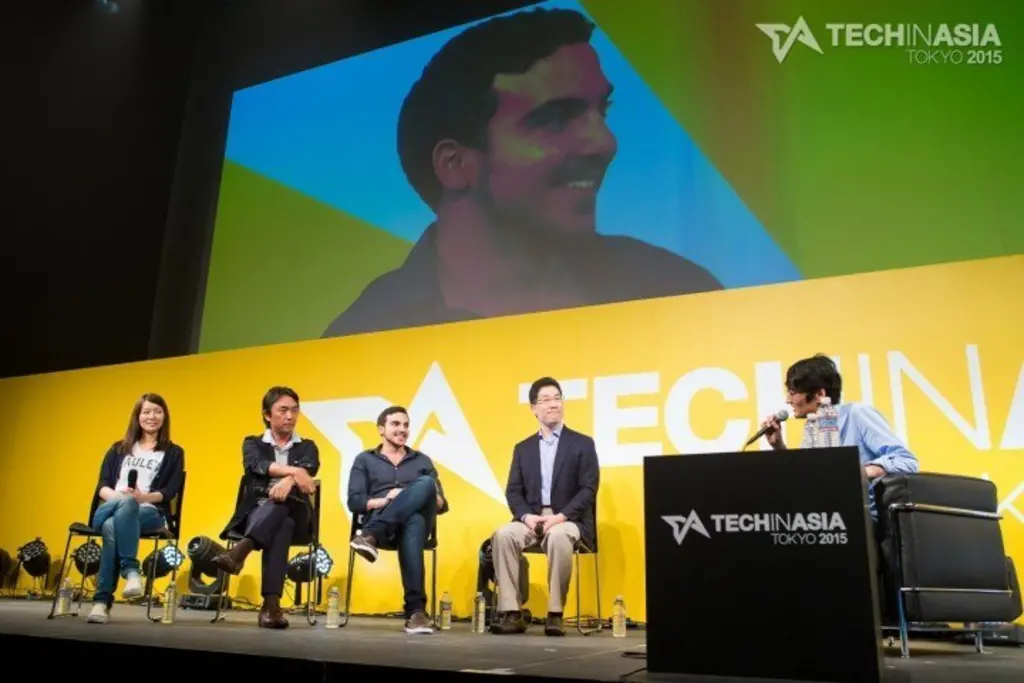
Left to right: Akiko Naka, Gen Isayama, James Riney, William Saito, Akio Tanaka.
The five panelists – Akio Tanaka, Gen Isayama, Akiko Naka, James Riney, and William Saito – concluded five bold things:
- Japan is in danger of being forgotten as a major player in the startup scene.
- Japanese startups tend to lose the innovative spark after early success.
- Japan lacks the capital and language ability to scale effectively.
- The domestic market just won’t cut it anymore – this ain’t China or India.
- It may take an economic catastrophe to get Japan to embrace entrepreneurship.
Here’s a summary of what they said:
On fear
Saito: “People forget that failure and fear are part of the basis for innovation. So this fear of failure is holding Japan back. If we can get past that, maybe we can make something real.”
Isayama: “Living in Silicon Valley as a Japanese, I fear that Japan is being forgotten. We hear about ‘Japan Passing,’ but it feels more like ‘Japan Nothing.’ People say bad things about China, but at least people are still paying attention. You hear them asking, ‘Is Sony a Chinese brand?’”
Naka: “As the only [panelist] here today running a startup in Japan, my biggest fear is that we stop being innovative. I saw this with my team – at the beginning, everyone was willing to be innovative and do really cool stuff, but as the company grew more stable, they stopped caring as much about innovation and just wanted to do their work.”
How does Japan measure up?
Tanaka: “When people think about tech hubs, they’re thinking of Silicon Valley, Beijing, cities like that. What we’re starting to see really is ‘Japan Nothing.’ In China, with the communist government, they still allow Airbnb and Uber-like businesses to flourish. In the meantime, in Japan, which is a democracy – last time I checked – and a capitalist nation, we try a little experiment in Fukuoka and get shut down immediately. You know, if it really is ‘Japan Nothing,’ maybe Tech in Asia shouldn’t be holding this conference.”
Saito: “Everyone is here because there are a lot of good things. We still have a great education system in technology, but the issue that we face is that very few companies go global. People forget that the global language isn’t English – it’s broken English, and a conference like this should be done in English. Not only is information not coming in, but people here who are doing great things are having trouble getting that message out.”
Riney: “What I think is missing [from Japan] is two things. One is lack of capital. You can’t expect entrepreneurs to be able to grow companies with only US$1 billion invested in startups per year, compared with about US$75 billion in the US. The other part is language, and I don’t just mean English. Study abroad rates are down, and that has long-term negative effects.”
Saito: “I have to interrupt, because it’s not a capital problem, it’s a smart capital problem. What Japan needs is smart capital.”
Riney: “Would anyone here admit to being ‘dumb capital?’”
Tanaka: “I think what Saito-san is saying is that it’s easy to get small money, but not big money. Scaling is difficult.”
Diversity and branding
Isayama: “I think it’s hard for Japan to embrace capital because there simply aren’t enough entrepreneurs. The greatest thing about Silicon Valley is its diversity. Do we see any foreign CEOs in the Japanese ecosystem? Maybe a few, but I would say that 90 percent of Japanese startups are run by Japanese who speak the Japanese language and have never been to the US.”
Tanaka: “But look at China and India – their startups are run by Chinese and Indians, so is that really a problem?”
Isayama: “Sure, but they have huge domestic markets. Japan used to look like that in the 1980s, but we’re not living in that kind of hyper economy, so we need to think differently. Japan still has a huge market and now with the weak yen, it’s not as expensive to do business here as it used to be, but I think the government needs to do more branding… if we leave it off for 10 to 20 years, we won’t be in a position to have this conversation.”

Tokyo (Photo by Moyan Brenn)
Naka: “The funding scene has been improving really well for the past two years. The problem from my perspective is that Japanese startups are too focused on the domestic market. Even big companies like Gree or even Rakuten have been very successful, but their portfolios consist of domestic businesses. None have really made it internationally except Line.”
Policy, demographics, death
Saito: “The first thing that we need to do is to make it easier to fire people, because it’s ridiculously difficult to do here. If you’re a tiny startup that really needs to fire someone, you’re screwed. The other thing is bankruptcy. You have a real company, it goes bust, but whatever – you can start over.”
Isayama: “The reason that Silicon Valley is so great is that people come and go at will. You’re always going to feel bad about firing people, but the fact that you can fire someone tomorrow if they aren’t working makes startups lean and efficient. You can focus on business. And bankruptcy. In the US, you can just shut a company down, but here, people panic over how to help a company to survive. It’s living dead, and there’s no rational reason to justify keeping it alive.”
Saito: “The Sharps and the Toshibas have to fail, but the government has to let them fail. Then Japan will wake up and go, “Oh shit.” So, Japan hasn’t had its ‘oh shit’ moment yet. Isayama-san had a great point about diversity, and Japan is the second least-diverse country in the world. How can we work with immigration if we can’t work with our youth and our women?”
Isayama: “Part of this country needs to die. Why do we need five computer or automotive companies making the same thing? Some of them need to die in a healthy way, such that we’re freed up for more entrepreneurship.”
Riney: “Cut out the cancer.”
Panellist bios
Here’s more info on the five tech luminaries who took part in the discussion.
Akio Tanaka
Tanaka is a co-founder and managing partner of Infinity Venture Partners. He has a strong record in the Asian investment sphere, previously running venture for Adobe in Asia and serving as CTO at Macromedia Japan.
Gen Isayama
Isayama is co-founder and CEO of World Innovation Lab. In addition to his years of experience in venture capital and risk management, he also shares his opinions on business and entrepreneurship in columns for the Nikkei Shimbun and the Toyo Keizai Shimbun.
Akiko Naka
Naka is the founder and CEO of Japan’s premiere social recruiting platform, Wantedly, which she started in 2011 at the age of 26. After only a few years between Goldman Sachs and Facebook, she built her startup into a major player.
James Riney
Until recently, Riney served as the principal investor at DeNA. He wowed the crowd today with a surprise announcement that he would take over as leader of 500 Startups’ new Japan fund.
William Saito
Saito currently serves as a special advisor on science, technology and IT policy to Japanese Prime Minister Shinzo Abe’s Cabinet. He began his career as the founder of I/O Software in 1991, but since selling it in 2004, Saito has been engaged in academia, venture capitalism, and writing bestsellers.
Stay updated on the go with our mobile app.
Get latest insights with smoother, more personalized experience through TIA mobile app.
Recommended reads
 For our loved ones who are never mentioned in our pitch decks
 Mastering the art of virtual pitching at our TIA Live event
 Founders, we’re looking for more potential ESG unicorns
 Can Sociolla’s supporting features take center stage?
 Did you get a good deal on 9.9?
 SEA tech: scaling up or cutting back?
 Unpacking this SG firm’s dubious $583m valuation
 The official unofficial tier list of priorities for expansion in Asia
 Profit now (and later) for BillEase
 25 and living the startup dream





Editing by Steven Millward
(And yes, we’re serious about ethics and transparency. More information here.)



📅 Upcoming Events
22 October 2026
Payoneer x CSPN Summit 2026