 John Amari · · 3 min read
The keys to the future of Japan’s developer corps? APIs and better English skills
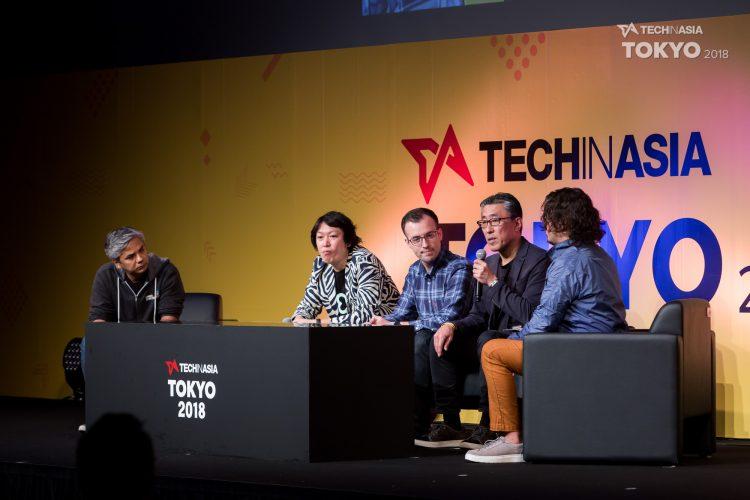
From L to R: Kani Munidasa, co-founder & CEO, Code Chrysalis; Shinichiro Isago, manager, developer relations team, Line; Daniel Heffernan, Japan CEO, Stripe; Yasufumi Hirai, group executive vice president, Rakuten; and Daishi Kakinoki, tech lead & product manager, SpaceMarket. / Photo credit: Tech in Asia / Michael Holmes
With the rise of software as a driver of innovation across virtually all industries and economies, companies are increasingly becoming tech-driven enterprises – and that’s regardless of the nature of their business.
At the core of such enterprises are engineers. But Japan may not be doing the best it can in developing and attracting the talent needed to fully embrace this revolution.
For a start, Japanese companies haven’t been as effective as their counterparts in other countries at collaborating globally, said Shinichiro Isago, manager of the developer relations team and technical evangelist at Line, speaking on stage at Tech in Asia Tokyo 2018.
Isago’s co-panellist Daniel Heffernan, CEO of Stripe Japan, suggested that developers seeking to take a product overseas need to think about writing the right abstractions when making a model, rather than just relying on rules.
When Stripe entered Japan four years ago, all the software manuals were in English, he noted. Developers trying to localize for Japan were initially of the view that the language shouldn’t be changed. Though this may have restricted opportunities to collaborate internationally at first, the situation also encouraged local developers to learn more English.
Similarly, Japanese companies seeking entry into markets overseas have to get used to catering to other languages, cultures, and business models, as well as new ideas, he said.
Fellow panellist Daishi Kakinoki, tech lead and product manager at SpaceMarket, agreed. For Kakinoki, engineers in Japanese startups didn’t think at all about communicating in English five years ago. That’s changing, he said.
Rakuten, for its part, adopted English as its official language seven years ago, said panelist Yasufumi Hirai, group executive vice president at Rakuten. In the internet company’s technology division, around 60 percent of employees are non-Japanese, he added.
In fact, when the English-only policy first kicked in, the company had difficulty employing local workers, he added. The company looked overseas and hired engineers who showed a keen desire to work in Japan, even if they had had little or no experience of the country.
Update in progress
It’s not just language capabilities that have shifted Japan’s developer community in recent years. The process of software development itself has also changed, said Kakinoki.
In the past, engineers used a “waterfall system” of software development – in other words, flowing in one direction from conception through to deployment and maintenance – which tends to have fewer iterations and less flexibility, he explained.
Today at Spacemarket, the first step when developing new software is to create a plan, then a mock-up is made as a user interface, which is then moved to a sandbox for testing.
This “agile” approach is iterated any number of times, but the idea is to create something tangible and then to put it through feedback loops, he added.
Better out than in





Stay updated on the go with our mobile app.
Get latest insights with smoother, more personalized experience through TIA mobile app.








📅 Upcoming Events
22 October 2026
Payoneer x CSPN Summit 2026