 On multiple occasions this week, Japan’s mobile carriers have publicly addressed a looming problem: networks are not prepared for the smartphone revolution (see here and here, subscription required). Smartphones still only comprise a small fraction of the mobile phones in Japan, but compared to so-called ‘feature phones’, smartphones use 10 to 20 times more data. By the year 2015 data traffic from smartphones is expected to increase 18-fold. Koji Tanaka, the president of Japan’s second largest carrier, KDDI (33.5 million subscribers), has admitted that without change the KDDI network will become overloaded.
Network overload due to smartphone data consumption is a problem many countries are facing. In mid 2010 AT&T buckled under extreme data usage and eventually had to eliminate its flat rate data plan. Instead of an all-you-can-use plan AT&T shifted to a tiered system charging users based on their consumption. Just a few months ago in June, Verizon came to the same decision and killed off its unlimited data plan.
No carrier in Japan wants to be the first to eliminate the flat rate data plan. Doing so translate to a rate hike for many users. Whichever carrier suspends its unlimited data plan first will be vulnerable to losing customers. This is even more true today as carriers have begun unlocking phones, an act which allows smartphone users to take their phones to another carrier. Instead of doing away with the flat rate plan Japan’s carriers are taking a different approach.
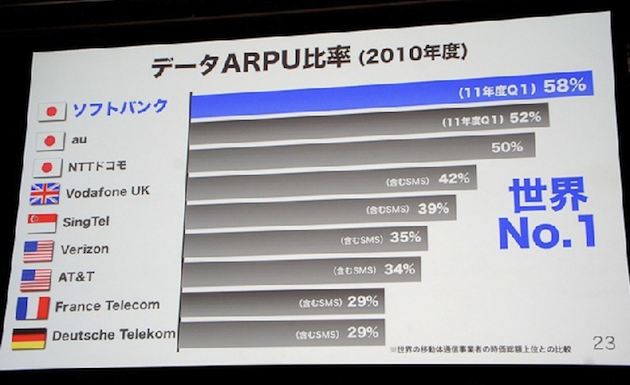
Japan already leads the world in data ARPU
This week KDDI announced it will begin limiting data throughput speeds of smartphone users exceeding a data cap. This is an effort to combat an overall network slowing due to a handful of heavy data consumers (see Japanese press release). Beginning in October, smartphone users under KDDI that exceed three million packets (approx. 366MB) of data transfer during three consecutive days will have their data speeds limited on the fourth day. The speed limitations apply for 24 hours and are only expected to affect the top 3-4 percent of data consumers. NTT Docomo, Japan’s largest carrier (58.6 million subscribers) already has a near-identical system in place to combat overextending its network.
In addition to slowing subscribers that exceed data caps, carriers are being proactive in unloading smartphone users elsewhere. Instead of burdening cellular networks, the carriers are expanding Wi-Fi hotspots. KDDI aims to have 100,000 spots up and running by April 2012. LTE services are also being fast-tracked to handle the overload. NTT Docomo is adjusting its budget to allocate more money towards the expansion of its Xi network. Docomo also has four smartphones in the pipeline that can make use of this network.
By focusing efforts on future technologies, subscribers stand to benefit in the long term. However, in the near future this speed capping solution is just a band-aid on an ever-worsening wound. Whether the carriers can keep the networks up to speed long enough for their efforts to pay off is yet to be seen. Either way the balancing may act as a helpful experiment for nations facing this problem in the future.
[Photo credits: topics.or.jp, journal.mycom.co.jp]





Stay updated on the go with our mobile app.
Get latest insights with smoother, more personalized experience through TIA mobile app.






📅 Upcoming Events
22 October 2026
Payoneer x CSPN Summit 2026