J.T. Quigley · · 7 min read
Lessons learned in Silicon Valley helped this Japanese startup become an international hit

Nota CEO Isshu Rakusai at his startup’s Kyoto headquarters.
Isshu Rakusai, 32, was always something of a computer prodigy. He taught himself to program at the age of 12 and launched his first startup, Kamilabo, when he was still a high school student in Kyoto. Its service, Kamicopi, “was like Evernote but before the cloud,” he tells Tech in Asia.
By his second year of university, Rakusai licensed Kamicopi to a Japanese software company, where it generated JPY 300 million (US$2.5 million) in total sales – of which Rakusai pocketed a percentage.
In addition to attracting his first big business deal, Rakusai’s early success also caught the attention of the Mito Project, a Japanese government-led initiative that provides financial support to young IT geniuses. Project manager Toshiyuki Masui, then at Sony Computer Science Laboratories, became Rakusai’s mentor. Masui was himself a star in the corporate tech world as the inventor of Sony’s predictive text input system for cellular phones. On a Japanese 10-key keyboard, his system is what suggests full phrases and kanji based on typing the first character or two associated with it (i.e. when you type “よろ,” it suggests “よろしく” and “宜しく”).
After completing his master’s degree in 2007, Rakusai relocated to Palo Alto, California, determined to start another venture. Kamicopi had been a hit in Japan, but he “wanted to make tools that would nurture creativity for global users.” He enlisted two developers back in Japan and got to work building new products as the CEO of the newly-formed Nota Inc.
It just so happened that Masui had also relocated to Silicon Valley around the same time, to take a job at Apple. There, he was in charge of developing the Japanese input system for the iPhone and its own predictive text function. Still in contact, Rakusai actually lived with his former mentor for his first two months in California while house hunting with his wife. Masui joined the budding startup as a technical advisor.
Keep it simple
Over the next three years, Nota had some small successes, one in slideshow creation app Photo Peach (which Rakusai says is still bringing in money). But the startup struck gold in 2010 after Rakusai returned to Japan, with the lessons he learned in the US in tow.
“In Silicon Valley, I learned the importance of keeping a product simple, so literally everyone from every culture can understand it,” Rakusai says. “That’s a problem in Japan, and something we should [teach] more here. Japanese products are often made for Japanese only.”
That October, Nota unveiled Gyazo, a cloud-powered screenshot app that would become the startup’s flagship offering. It allows users to share screenshots more seamlessly by instantly copying a custom URL to the user’s clipboard. The image link can then be pasted into an email, chat, social network, or elsewhere on the web.
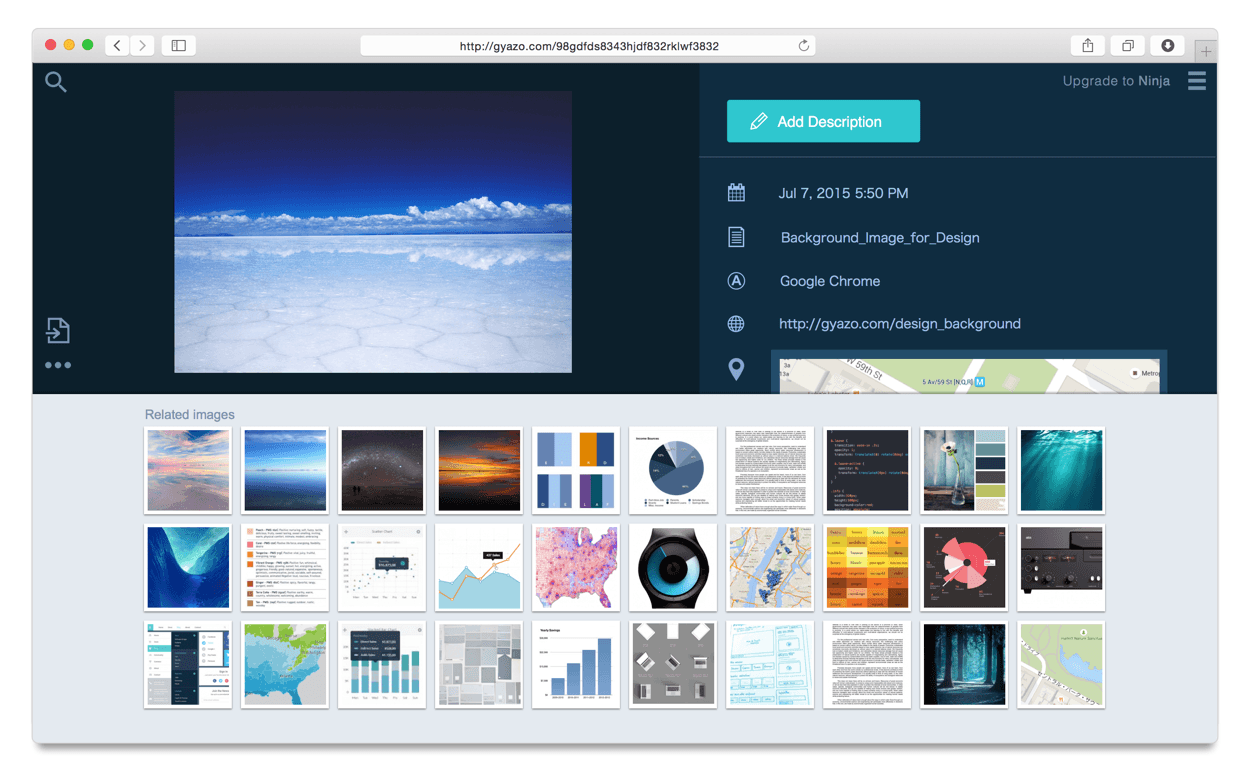
Users are brought to their online library of Gyazo screenshots after capturing an image.
Rakusai approached Gyazo’s launch with a take-over-the-world mindset that was honed in California. Instead of launching in Japanese first, he insisted on launching an English version at the same time.
“I knew that just translating the Japanese version to English wouldn’t work, so we made two completely different versions,” he explains. “We had a lot of discussions about making the copy and descriptions better. Our press release drafts were written by Masui, then cleaned up by a marketer we hired in the US, then discussed again. There were, and are, always many iterations when we put together a release or and update.”
Gyazo had its big break later in 2010 when celebrity developer Paul Irish name-dropped the service on his personal blog. Irish, an American, is considered a world leader in front-end web development, particularly for Google Chrome. Rakusai’s product wasn’t rocket science, but it worked – and users started pouring in.
Human memory meets search
Truly global
Kyoto hero





Stay updated on the go with our mobile app.
Get latest insights with smoother, more personalized experience through TIA mobile app.