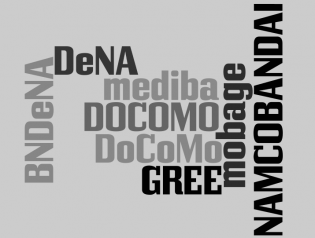
So yesterday it was announced that the joint venture between Japanese social gaming company DeNA and Namco Bandai, previously called BDNA, would be rebranded as BNDeNA. Putting the companies and their respective businesses aside for a moment, this is a truly atrocious name. I mean, capitalizing all letters in a company name is bad enough by itself. But look at that poor little ‘e’ in the middle!
I shouldn’t single out this example, as strange capitalization of company names seems almost epidemic in the Japanese tech space. Take for example Docomo, which refers to itself as ‘DOCOMO’ in all its press materials. This is perhaps not as bad as the camel-cased ‘DoCoMo’ which I (thankfully) don’t see written in the press as often as I used to. But there are lots of others too: Japan’s other social giant GREE (although this is short enough that it almost looks like an acronym), fashion startup COODE, and even the afore-mentioned Namco Bandai refers to itself as NAMCO BANDAI in its English press materials.
Here’s some food for thought from UX Movement:
When is it okay to use all caps? All caps are fine in contexts that don’t involve reading, such as logos and acronyms. But when your message involves reading, don’t force users to read it with bad shape contrast. The caps lock key is a key that designers should rarely use. In emails, using all caps is a sign of bad manners. In design, using all caps is a sign of bad readability.
And then there are companies who go all lower case. Take ad company ‘mediba’ for example, which never capitalizes its name. From an editor’s point of view this is a bit of a dilemma when you want to start a sentence with ‘mediba.’ It was also the case with DeNA’s ‘mobage,’ although I see now that the company itself now will use ‘Mobage’ in press materials.
Normally here on this blog, we’ll try to ‘normalize’ things if at all possible. In English after all, writing in caps often corresponds to shouting on the internet. And we’d prefer not to throw such jarring text at our readers if we can help it.
But of course, weird capitalization of company names is not unique to Japan. I can think of a few examples like eBay or iPhone off the top of my head. And don’t get me started on punctuation in a company name (I’m looking at you, Yahoo!). But while we write about companies the world over, Japanese companies are the only ones who we receive mail from, often insisting that a strange all/no caps name be adhered to in accordance with their wishes. Of course, most of them understand our dilemma when we explain it, and are pretty understanding about it.
Perhaps I’m making too much of this, and maybe there’s some good reason that I’m missing why many of these Japanese companies feel the need to be referred to consistently in all caps or no caps. If you’re a company with no aspirations of business outside of Japan, maybe it’s perfectly fine. But now that more and more companies are looking abroad, this is a minor (but important) style point that I hope aspiring startups will consider when promoting their brand.





Stay updated on the go with our mobile app.
Get latest insights with smoother, more personalized experience through TIA mobile app.