 Edith C. · · 5 min read
This startup is revolutionizing proptech with security and operation automation

In 2014, the murder of a young Chinese engineering major near the University of Southern California (USC) made headlines and alarmed the student population in the state. It was the third such case in the area involving a Chinese student in three years.
“It was a huge shock to the Chinese student community,” recalls Xing Zhong, co-founder of security and operation solutions provider Turing Video. At the time, he was studying at the University of California, Los Angeles (UCLA), which is just a few miles away from USC.
Building “The Terminator” for proptech
Xing and his co-founder, Song Cao – a USC alumni – were deeply troubled by the murder. “Cameras captured the footage of the Chinese student being attacked [in real time], but nothing happened,” says Xing.
Despite the millions of dollars that universities spend on expensive cameras and frequent patrols by campus police, safety on school grounds still can’t be guaranteed.
The pair concluded that the problem was that human-based security solutions were not scalable. “There are millions of cameras out there, but you simply can’t have enough money to hire as many security guards as possible to sit behind the screen and check the footage all the time,” Xing points out.
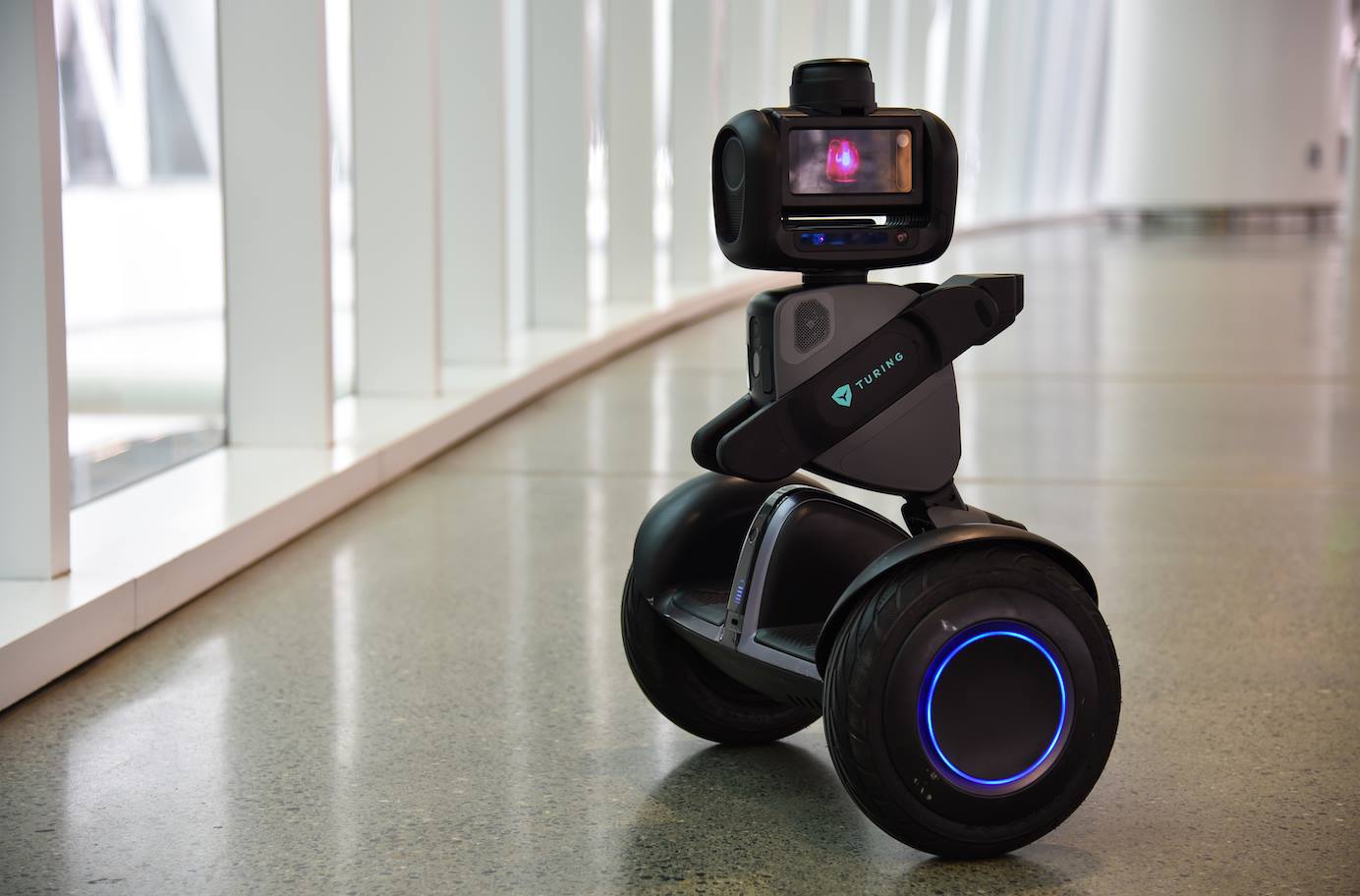
Photo credit: Turing Video
The co-founders’ vision was to merge computer vision and robotics so that, like human beings, patrolling robots can analyze what they see. Xing likened the initial idea to the titular character from The Terminator franchise: a robot with an intelligent mind.
Their vision finally became reality in March 2017, when the entrepreneurs received their first round of institutional funding in the Bay Area to begin work on a security and operation automation solution.
This sparked the development of Nimbo, an AI-powered security robot for video analytics and autonomous patrol. The robot can recognize over 80 categories of things with the capability to react automatically to events with customized responses. Soon after, the US-based startup launched AI Video Platform, a plug-and-play intelligent video-monitoring tool powered by deep learning software and cloud storage.
Finding product-market fit
Despite having a good idea, Turing Video’s founders were not sure about product-market fit. For a year, Xing did his research and spoke to many potential customers to figure out which sector the company could best operate in.
Finally, Xing and Song decided to target the real estate space, where customers were most willing to pay for their service. Early adopters there were already actively looking for integrative solutions.
But what helped Turing Video develop its property tech proposition rapidly was the relentless expectations of its Chinese customers.
Xing, who was in charge of driving the firm’s business in China, found that enterprises in the country were the most eager to push for the technology’s development, providing specific product requests and giving feedback on existing features. On the other hand, customers from the US expected a more complete and professional solution off the bat.
In early 2018, the company had only started to deploy its initial product in malls in China and collected feedback after several months. Its early pilot projects also took a long time as it worked with large enterprises, who often had longer onboarding processes.
By winter, however, customers were seeing Turing Video’s value: security guards could stay in command centers and robots did the patrolling.
Turing Video then clinched contracts with customers after successful proofs-of-concept, helping the firm realize a 10x increase in revenue in 2019. All the effort that the company had put in to laid the groundwork the year before finally paid off.
Accelerating proptech solutions
2019 was a pivotal year for Turing Video, as it took part in China’s first corporate proptech accelerator. Called UrbanLab (城越), the program lasted for three months and was co-launched by real estate services firms Jones Lang Lasalle (JLL), Swire Properties, and Ping An Urban Tech. A friend recommended that Xing and Song participate in the accelerator, so they decided to give it a shot.
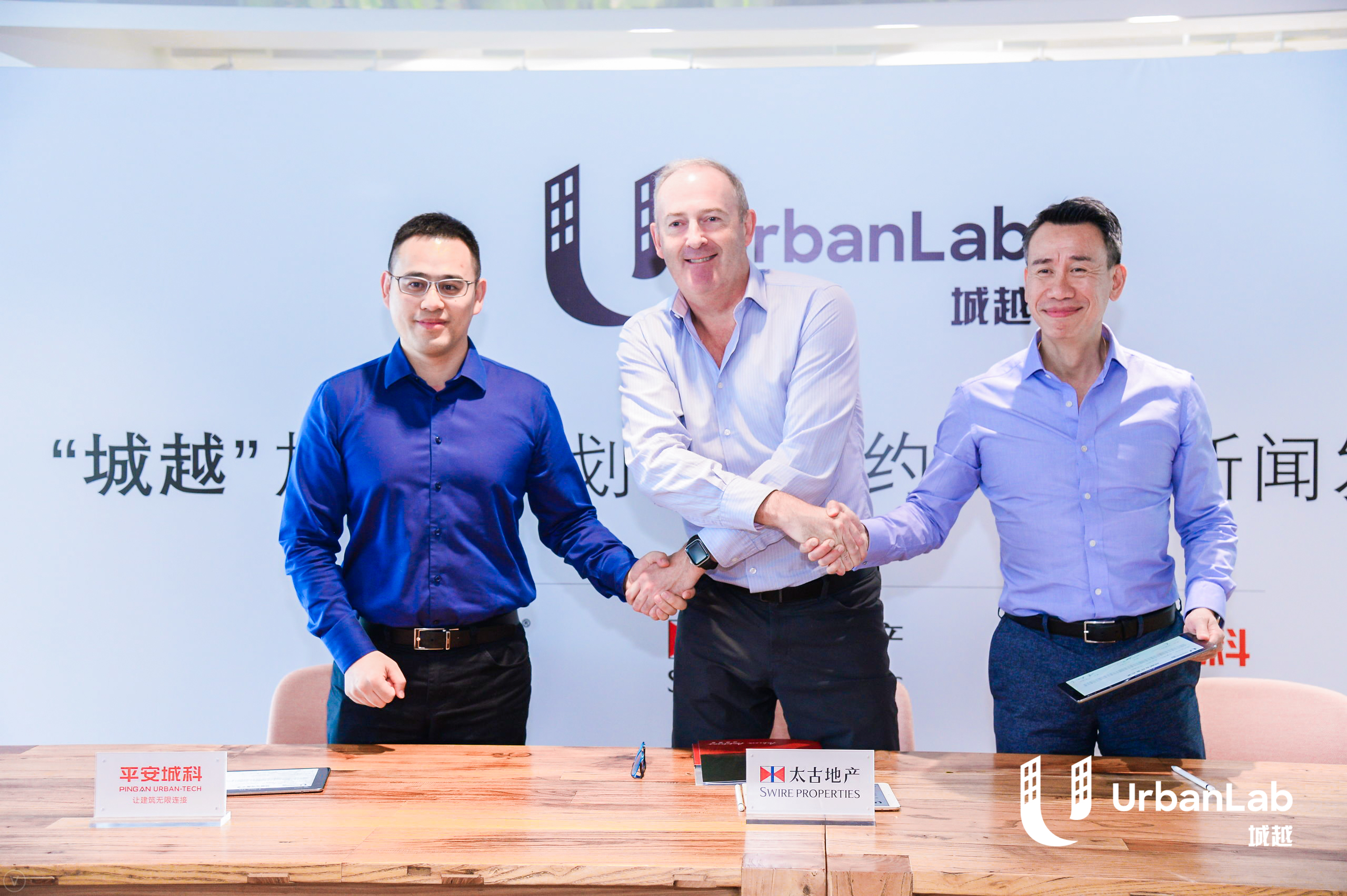
Ping An Urban Tech chief technology officer Wei Baison, Swire Properties CEO Guy Bradley, and JLL CEO for Greater China KK Fung at the UrbanLab launch ceremony. / Photo credit: UrbanLab
Turing Video was one of the 12 startups selected out of the 300 companies that participated in China. It’s an accomplishment that Xing attributes to the team’s focus on proptech, marquee clients and its unique ability to combine computer vision and robotics.
“All our customers are big names in the real estate industry,” claims Xing. One such example is Dalian Wanda, which is recognized as one of the world’s biggest commercial property developers and conglomerates. Turing Video has been deployed in all of the firm’s 300 shopping malls.
“This name already says something for us: We are not just tech on a PowerPoint but a realized technology,” says Xing.
The accelerator opened up a strategic partnership and proof-of-concept opportunity for Turing Video to test its products with properties under JLL Asia Pacific’s portfolio, saving the startup a lot of precious business development time. The move also enabled Turing Video to dive right into solving security and operation problems in property management.
Market issues
Turing Video serves both US and Chinese customers, and as with all cross-border businesses, meeting users’ expectations was a challenge.
One difficulty it faced was localizing its user interface, as Western and Chinese audiences have very different preferences. But adapting its sales strategies for the Chinese market was the bigger challenge.
“One reality we have to face is that in the US, people are willing to pay monthly,” Xing shares. “The subscription business model is widely accepted. For instance, people subscribe to Netflix.”
On the other hand, business-to-business startups in China need to remain flexible around payment options. “Chinese enterprises have a budgeting process, where a certain amount of money is assigned to projects, and they can only give that amount away,” he observes.
Private enterprises also tend to buy entire systems – both software and hardware – and pay maintenance fees every year, rather than adopt enterprise solutions like Turing Video by subscribing to them.
Still, Xing says some Chinese enterprises are changing and are surprisingly willing to try the subscription or software-as-a-service model.
Going beyond
This year, its flywheel effect begins, thanks to its new contracts. “We can expand our product to over 1,000 commercial real estate properties and triple deployment this year,” he says.
Now in charge of the startup’s Asia-Pacific business, Xing is working with partners in Japan, Singapore, and Australia.
After gaining a foothold in commercial real estate, Turing Video is setting its sights on the bigger residential real estate market.
Ultimately, Xing feels that Turing Video has already made a positive impact on the use of artificial intelligence for proptech.
“Many technologies were still premature in the past. For instance, an algorithm that is 50% right will give false alarms all the time, so customers would stop using the solution,” he explains. “But our algorithms can be accurate over 90% of the time, so out of 10 alerts, we are only wrong once.”
JLL is a leading professional services firm that specializes in property and investment management. It brings real estate to life through technology and innovation, connecting people and processes to prepare their businesses for the future.
Learn more about JLL on its website.
Stay updated on the go with our mobile app.
Get latest insights with smoother, more personalized experience through TIA mobile app.
Recommended reads
 Life’s a game, and AI agents are Animoca’s new play
 Indonesian AI startup goes global
 Forrest Li on scaling Sea, building smarter bots, and founder grit
 An AI assistant that joins sales calls and scores team skills
 Beyond the check: Why VCs need more than capital
 SGX’s CEO says it doesn’t need a unicorn to win
 SMEs want AI too, but not the kind Big Tech is selling
 Oatside’s alt-milk rise hits a profitable gear
 Alibaba’s financial health in 12 charts
 Asia’s telcos bundle AI into mobile plans. Will it pay off?





Editing by Nathaniel Fetalvero, Jaclyn Teng, and Eileen C. Ang
(And yes, we’re serious about ethics and transparency. More information here.)





