
With some of the fastest internet speeds and one of the biggest tech-savvy populations in the world, South Korea is at the forefront of the digital revolution. In 2021, the country topped Bloomberg’s Innovation Index thanks to intensive investments in research and development and a much-lauded “top-down” innovation system that encourages “close collaboration between government, industry, and the academic community.”

Photo credit: aomami / 123RF
Despite its well-established reputation as a major technology hub, more than half of the country’s US$900 million software-as-a-service (SaaS) market is dominated by global brands like Amazon, Microsoft, and Google. But that’s set to change thanks to local firms that are determined to push the global expansion of South Korea’s SaaS startups.
Naver Cloud is one of them. The cloud services arm of South Korean tech giant Naver is working toward accelerating its business globally and expanding into Southeast Asia with the opening of its new virtual private cloud services and availability zones in Singapore in December 2021.
As part of this effort, it’s collaborating with South Korea’s Ministry of SMEs and Startups, the Korean Foundation for Cooperation of Large and Small Business, Rural Affairs, as well as the Korea Software Industry Association, to develop local SaaS startups through a program that’s targeted to bring these SMEs to Southeast Asia.
This initiative also serves to enable small and medium-sized SaaS startups to gain access to a whole suite of services from the organizations’ wide network of corporate connections.
Here are some of the companies that are leveraging the program to expand their businesses.
Building a patient-centric approach to healthcare
LemonHealthcare was founded in 2017 in an attempt to reimagine the smart healthcare ecosystem to become more patient-centric, convenient, and efficient. According to LemonHealthcare chief operating officer Tony Lim, the company pivoted from its consulting business when it discovered a strong need for a service that would “relieve patients’ discomfort” as they move through the hospital system.

Tony Lim, chief operating officer of LemonHealthcare / Photo credit: LemonHealthcare
Many of the existing problems in the healthcare system stem from the lack of coordination between medical centers, insurers, and pharmacies, leading to long waiting times and stressful experiences for patients.
The startup’s LemonCare solution, a customized platform that manages everything from making appointments, submitting medical insurance claims, to transferring e-prescriptions, was designed to alleviate pain points by digitalizing a patient’s hospital journey from end to end.
“If you can manage the entire process of paying medical bills or claiming insurance on our platform, the medical experience will be pleasant for both patients and hospitals,” says Lim. “Patients can focus on their treatments, while hospitals can minimize waiting times and problems related to it.”
LemonHealthcare was also able to use a scaled down version of this platform to help the patients and staff of small hospitals that had limited access to digital solutions.
The LemonCare platform has since found success in South Korea, catering to more than 70 general hospitals in the country thanks to its mobile, cloud-based approach. Lim says the entire platform depends on cloud technology that enables the company to scale up or scale down its platform to the needs of each hospital.
Naver Cloud supports the company’s ambitions by providing the reliable infrastructure and network it needed to be mobile-first and reach hospitals throughout the peninsula. In doing so, the cloud platform frees LemonHealthcare’s staff from some of the burdens of running a company, such as marketing and promotion, especially as the startup looks to expand abroad.
“For a startup like us, it takes a lot of resources to directly promote our service to the global market,” he says. “It is not easy to do so with the limited number of people on our team.”
Helping low-tech sales teams
In the case of Salesinsight, a company providing cloud-based customer relationship management (CRM) solutions, the issue was about outdated systems.
According to the startup’s chief executive, Ko Myung Sik, there are very few specialized tools for sales teams despite the prevalence of enterprise resource planning (ERP) software and collaborative tech throughout the business world. As a result, most teams end up relying on low-tech, inefficient systems.

Ko Myung Sik, chief executive of Salesinsight / Photo credit: Salesinsight
With that in mind, Ko created Salesinsight, a cloud-based CRM platform that helps sales teams automate processes, allowing them to focus on work that matters.
Now, more than 18 years since its launch, Salesinsight is looking to expand abroad. However, it struggled with marketing itself to overseas customers.
“Though [our software] has been optimized and developed as a global solution, the marketing strategy was daunting because each country has different characteristics and preferences,” Ko says.
This is where Naver Cloud’s services and connections came in handy. Through their program and Naver Cloud’s robust infrastructure, Salesinsight was able to benefit from a number of training seminars that helped it strengthen its solution. Naver Cloud’s wide network also made it easier for Salesinsight to focus on their core offering by streamlining processes for the company, such as API registration, and by providing it with cloud services.
On top of this, Naver Cloud’s global network was extremely important for the startup to market itself to overseas clients.
“From the beginning, there was interest in overseas expansion, but it was a difficult project because there was no contact point at all,” Ko says. “Now, all preparations for overseas expansion have been completed and we are looking forward to the opportunity to meet our partner customers.”
Crossing the communications gap
For more than a decade, UCWare has been involved in what’s known as “unified communications,” which is essentially an approach that integrates all kinds of communications technologies – from voice and video calls to instant messaging, emails, and file sharing.
The company’s chief executive, Park In Koo, says the platform was designed to be a “business version” of social messaging platforms and that it would improve productivity and internal communications by empowering employees to connect across any platform or device.
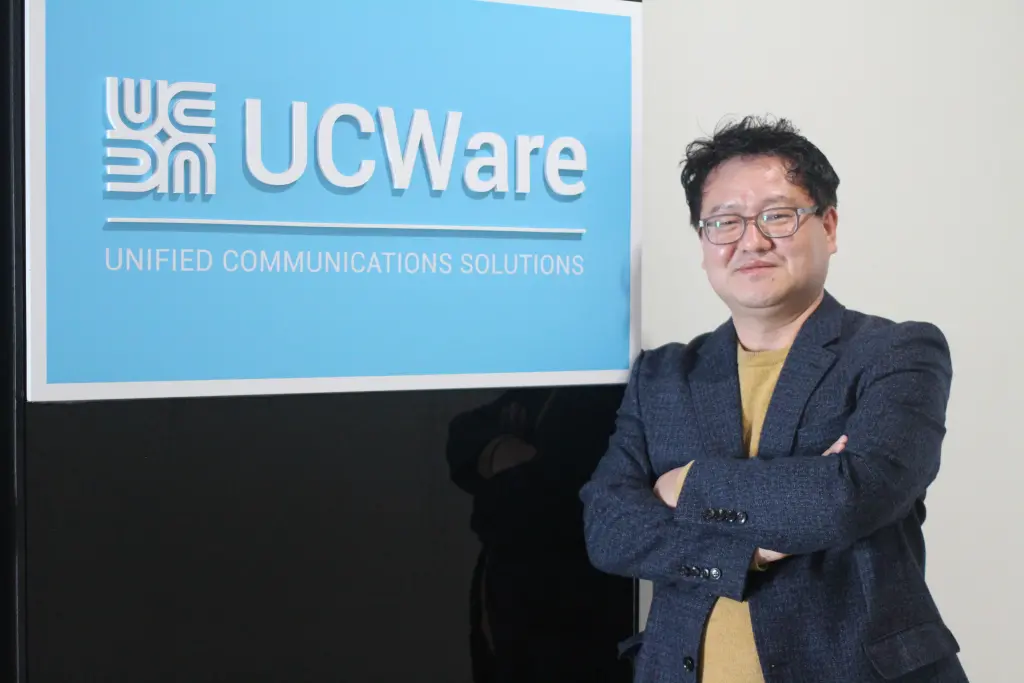
Park In Koo, chief executive of UCWare / Photo credit: UCware
Since its establishment in 2007, UCWare has served over 1,000 organizations, spanning both public and private organizations, and is used by more than 1 million daily users. Over time, the company has moved more and more of its services online, now offering both on-premise and cloud-based solutions.
UCWare began working with Naver Cloud because of the latter’s brand reputation as the company behind the Line messaging platform, as well as its resources and partner networks.
“With Naver Cloud’s technical consultation on security operation and management, we obtained a stable network service – not to mention their marketing support in the global market,” Park says. “We were able to expand our global partnership through Naver Cloud, which was something that would have been really difficult for us to do by ourselves.”
As a result of its partnership with Naver Cloud, UCWare’s plans for next year are shaping up well, Park says. As part of its goals, the company aims to expand its opportunities in the Thai and Japanese markets and work toward claiming 5% of the global unified communications market.
High potential, high rewards
Looking ahead, all three startups express an immense amount of hope for South Korea’s SaaS startup scene. UCWare’s Park predicts that the rapid growth of the SaaS industry will only continue, especially in communication and collaborative software for the government and financial sectors.
“The potential for development is limitless,” says Salesinsight’s Ko, adding that the industry is set to transform as more SaaS versions are introduced.
For LemonHealthcare, it expects major growth for SaaS solutions in the mobile ecosystem, which would enable users to access any service at any time, regardless of location. LemonHealthcare’s Lim says the expansion of cloud-based services will lead to the rapid development of South Korea’s healthcare environment and make the case for the company’s particular patient-first approach as it expands in overseas markets.
The road ahead is certainly promising for South Korea’s SaaS startups, and more local companies will likely emerge onto the global stage in the years to come.
Naver Cloud operates the global IT infrastructure and enterprise solution service for South Korean tech giant Naver and its subsidiaries while providing its public cloud service, Naver Cloud Platform, to a myriad of companies and organizations in diverse industries.
Find out how you can scale your business overseas with the power of Naver Cloud by visiting its website.
This content was produced by Tech in Asia Studios, which connects brands with Asia’s tech community. Learn more about partnering with Tech in Asia Studios.
Stay updated on the go with our mobile app.
Get latest insights with smoother, more personalized experience through TIA mobile app.
Recommended reads
 AI firm touts fix for AI-data privacy issue: small-scale LLMs
 Will cars drive the future of AI? This Chinese company thinks so
 Mbodi AI wants to help robots adapt as fast as workers
 Engineering the future of banking across ASEAN
 TiDB is engineering the infrastructure for AI’s agentic future
 How an ex-OpenAI lead views the shift from software to robots
 How Speechify justifies spending more on AI tokens than salaries
 Making AI work in the real world, not just on paper
 Inside OpenAI’s public-first bet on medical AI
 Startup takes on Sri Lanka’s out-of-pocket healthcare problem




Editing by Nathaniel Fetalvero, Jaclyn Teng, and Stefanie Yeo
(And yes, we’re serious about ethics and transparency. More information here.)







📅 Upcoming Events
22 October 2026
Payoneer x CSPN Summit 2026