Kylee McIntyre · · 4 min read
His smart home gadget failed. A year later, he’s launching another startup

Yash Kotak, co-founder of Fundamine
Fresh off failed Internet-of-Things startup Lumos, founder Yash Kotak is back again – this time with some good news.
He has teamed up with Tarkeshwar Singh, also a co-founder of Lumos and a fellow Indian Institute of Technology alum, as founder of a new company that launches today. Fundamine, based in Bangalore, offers an annotation tool for blogs that allows readers to leave inline comments and highlights on content. The service, which works on both desktop and mobile, comes in form of a code that can embed into website content or a WordPress plugin.
Fundamine has a Tweetshots feature that allows a reader to share screenshots of text from Twitter in two clicks. Fundamine’s analytics show that they get more engagement than normal screenshots. When I ask Yash why, he says that they take more real estate on Twitter and, in his opinion, they just look better.
Users can either use the service for free with embedded ads in the Fundamine comment boxes (much like Disqus does ads) or pay a monthly fee based on the blog size and traffic. The money made from the ads is split with a portion going to the website host. The company claims that the file size is small, under 50KB, and won’t affect site loading time.
Yash tells Tech in Asia that the idea came from blogging site Medium, which has the same service. Fundamine hopes to allow other sites to provide the same type of engagement that Medium does.
Try, try again
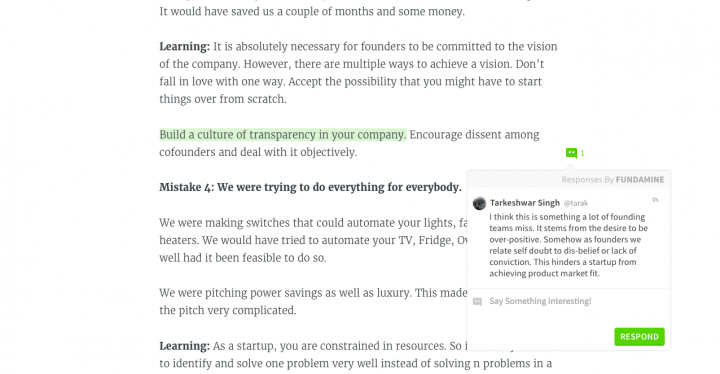
Fundamine allows users to annotate pages on websites with comments and highlights.
The last time we talked to Yash, Fundamine was already in the works as a communication community for professionals. Its launch today marks the next step in Yash’s rather public journey through the difficulties of the startup world. He not only told us about his new project but also wrote about his previous experience at Lumos, spinning it in good sport as a “what not to do.”
Fundamine, in many ways, is an answer to the things he identified as going wrong with Lumos. It has a more direct approach, for one, and it’s bringing Yash back to what he knows.
“We figured out that [Internet of Things] wasn’t the right sector for us to be in because we were not really experts in that domain,” Yash explains. “It was more like we were attracted by the hope there, so we decided we should build a product.”
The content sector, he came to realize, was a place in which he had worked before and therefore understood. In a cool turn of events, it was his enthusiasm for startups in general that gave him his next idea.
“We used to read a lot about startups and product management and product design and things like that. We really understood [the space] – and we used to write blogs,” he says.
Working with Medium showed him how helpful in-article annotation can be for both reader engagement and working professionals – they can share their opinions and put parts of the article into context that can be helpful for others reading it.
A new leaf





Stay updated on the go with our mobile app.
Get latest insights with smoother, more personalized experience through TIA mobile app.