Malavika Velayanikal · · 6 min read
Tagalys wins Indian leg of Tech in Asia Tour with intelligent search as a service for ecommerce
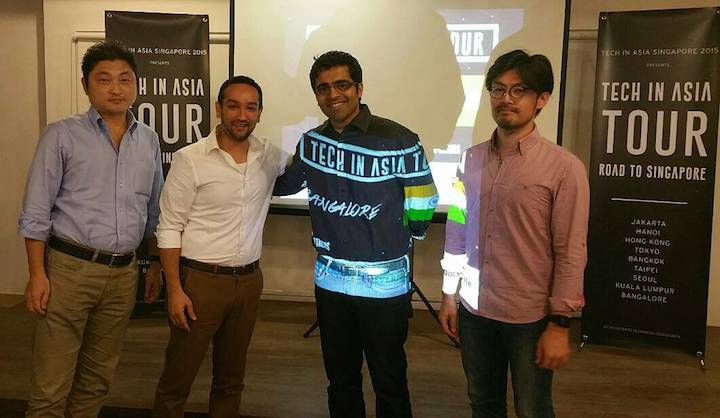
India is the world’s fastest growing startup ecosystem, according to a recent Nasscom report, and Bangalore is its premier tech hub. So it was an apt setting for Tech in Asia’s first pitching event in India at TechHub in Bangalore. This was the last leg of a nine-city Tech in Asia Tour to pick the coolest startups from all over Asia for our flagship conference, Tech in Asia Singapore 2015 on May 6-7.
Six startups, shortlisted from nearly 200 applicants, went up on stage to make their pitches to a multi-national panel of judges: Takeshi Ebihara of Rebright Partners, Japan; Yasuhiro Seo of IMJ Investment Partners, Indonesia; and Sid Talwar of Lightbox VC, India. At the end of more than an hour of pitching and questions, the judges put their heads together to agree on a winner who would get an all-expenses paid trip to Tech in Asia Singapore 2015. And the winner is…
Tagalys
Ecommerce is booming in India, and this Chennai-based startup has an intelligent search tool for online retail sites. It helps drive revenues with product recommendations and analytics. Co-founder and CEO Antony Kattukaran said Tagalys already has five paying customers and three more have signed up for a trial. Currently bootstrapped, Tagalys charges clients based on usage. Right now, the gang of four at Tagalys is focused on product development.
“We are offering Search as a Service. The market for this is as big as US$2 billion to $4 billion, and it’s growing,” Kattukaran said.
The judges found the idea compelling enough as search is the biggest problem for every ecommerce company or website. But they also had some pointed questions. “Why would ecommerce companies outsource this core problem to somebody else? Why are you better at search compared to ecommerce companies who are your clients?” Takeshi Ebihara asked. Kattukaran was confident that the Tagalys technology with its results-based payment model would be a draw for the mid-sized ecommerce segment, which is the startup’s target base. While some of the biggest ecommerce sites would invest in their own tools, many others would welcome “search as a service” to keep up with tech.
Tydy
A close contender was Tydy from Bangalore. It has developed a new content system tailored for mobile devices. It aims to take the pain out of trying to use Excel or Powerpoint on mobile. It puts together images, video, and text to create and share interactive mobile documents. The five-man Tydy team has already validated the product with over 250 users in India and is poised to scale up globally to serve the mobile generation. Currently in the enterprise space, Tydy charges its clients – small and medium-sized businesses – US$10 per month.
Our judge Sid Talwar was puzzled why Tydy positioned itself as a B2B product. “You should go after consumers like me and you. Work on your user interface, push it out as a B2C product, and offer it free for users,” Talwar told Kiran Menon, co-founder of Tydy.
“I think what you are attempting is huge. The opportunity is so huge that if you guys succeed in delivering your service to consumers, it will completely change the experience of mobile users,” Yasuhiro Seo added.
Stockal
Another strong contender, also from Bangalore, was Stockal. It aims to give an analytics edge to stock traders, with a system that draws intelligence from a plethora of data: SEC filings, FDA filings, lawsuit alerts, patent filings, product launches, social media posts, discussion forums, blogs, news websites, geopolitical events, and historic correlation of sentiments with stock prices. Stockal draws insights from all this mostly unstructured data and converts them into alerts for traders on web and mobile apps.
“We are trying to democratize knowledge. We aggregate intelligent data, analyze it, measure social velocity, and so on, to provide simple signals to traders,” said Sitashwa Srivastava, Stockal’s co-founder, who used to be a senior business analyst with Cognizant Technology Solutions.
Day traders and swing traders, hedge funds and equity research companies, investor relations teams and high-frequency trading systems are potential users.
Yasuhiro Seo advised the Stockal team to have a clearer target audience, while Takeshi Ebihara had a more fundamental query: “As a fund manager, providing a judgment solution for an investment is very rare. Is it legal? And if qualitative data is relevant to these decisions, show us evidence of traders using it to beat the market.”
But in essence, Sid Talwar was quite taken with it: “I like the idea, and because of the tech credentials of your team, I think the algorithm must be good.”
Wazzat
Next in line was a contender from Hyderabad. Wazzat is a cloud-based and mobile-friendly image recognition and visual search platform. “Our flagship product Wazzat Fashion is adding eyes to fashion ecommerce stores. Consumers can download our partner retailer’s app or visit their website to snap or select the photo of an apparel and instantly search for similar clothes. It also automatically learns the consumer’s style preferences and offers recommendations,” pitched Mauktik Kulkarni, co-founder of Wazzat Labs.
The Wazzat Fashion widget is currently live on US-based retailer Target’s website. It is also in pilot stage on a couple of Indian ecommerce stores. It had a top three finish at last year’s MIT Global Startup Labs India accelerator program and recently graduated from the Target accelerator program.
Our judges felt it would be hard to differentiate with such a core technology solution. “Most of the large ecommerce companies are using something along these lines,” pointed out Ebihara. “You need to grow very fast so that nobody can catch up with you,” added Yasuhiro Seo.
Talview
A new hiring tool, Talview is a video interview system which helps organizations screen and select talent efficiently. “Our technology enables high quality video interactions at low internet speeds across multiple devices, and automates a significant amount of recruitment process flow. This will reduce the time to hire drastically,” said Sanjoe Tom Jose, co-founder of Talview.
This Bangalore-based startup was founded by four engineers: Sanjoe Tom Jose, Tom Jose, Subramanian ‘Mani’ K, and Jobin Jose. Sanjoe and Mani graduated from the Indian Institute of Technology, Bombay, in 2011.
Talview is funded by Mayfield, a VC fund in Silicon Valley, and Venture Nursery in Mumbai. It has more than 60 large enterprise clients, as well as 1,000 small and medium business clients acquired through inside sales model.
Ebihara wanted to know if Talview is customizable, and Jose said the entire work-flow is configurable.
Yasuhiro offered a new idea: “You might want to integrate this tech for the consumer market, such as in helping people find jobs on a job matching portal.”
Foreclosure India
A foreclosure happens when a bank takes over a mortgaged property and auctions it if the owner fails to keep up with loan repayments. Foreclosures happen all over India, but potential buyers often don’t find out in time. Banks are required by law to publicise the auctions in a regional language newspaper as well as an English one, but those public notices rarely reach people in other cities.
Foreclosure India is changing this by collecting information from banks and posting lists online of the properties available on sale through bank auctions.
The judges felt it’s a cool idea because everyone wants a good bargain. But how easy would it be to replicate this, they wondered. Tech savvy real estate portals like Housing or CommonFloor could start posting these auctions too, couldn’t they?
Naveen Kumar, founder of Foreclosure India, explained that it takes time to build relationships with banks to get the required information. But Ebihara wasn’t convinced: “The pitch wasn’t clear enough. Why do you have more access to foreclosure deals than others?”
The evening then wound down with the motley crowd of entrepreneurs networking informally with the three judges. It started drizzling outside, providing relief from the early summer heat of Bangalore, and adding to the cool factor of the TechHub.
And so, after screening 549 applications and visiting nine cities in four weeks, Tech in Asia Tour: Road to Singapore 2015 is a wrap.
Stay updated on the go with our mobile app.
Get latest insights with smoother, more personalized experience through TIA mobile app.
Recommended reads
 🇮🇳 Roundup: GlobalBees buys fitness brand Reach, more
 Flipkart co-founder’s startup banks $25m in series A money
 Surge pours $2m in first accelerator participant from MY
 Nykaa’s financial health in 5 charts
 SG blockchain-backed fintech firm secures $2.2m in pre-series A
 The 2026 Prediction Bingo update: half right, fully accountable
 Uncover tomorrow’s tech titans at the Saigon Summit Startup Showcase
 Indian no-code digibank enabler secures $26m
 Temasek pours $85m into Indian real-time PCR testing startup
 Indonesian jobs platform names ex-Traveloka exec as co-founder





Editing by Steven Millward and Paul Bischoff
(And yes, we’re serious about ethics and transparency. More information here.)