 Yukari Mitsuhashi · · 9 min read
CUUSOO’s Founder on Product Development and Tapping Public Opinion
 Building products based on user feedback — Thanks to the internet and social media, this concept of product development is no longer new. However, its execution can be far more difficult than imagined. Cuusoo.com (Cuusoo is a Japanese word that translates as ‘imaginary’ or ‘wish’) was launched in 1997. Essentially, it is a platform that collects product ideas directly from users, based on what kinds of goods they would like to see produced.
The company currently manages two platforms, Cuusoo MUJI and Lego Cuusoo. There are about 340,000 active users and 90 percent of Lego Cuusoo users come from overseas. To find out more exactly what these platforms do, we chatted with the founder of Cuusoo, now the chairman of Elephant Design Inc., Kohei Nishiyama.
Kohei talks about being active in seeking out developers and often meeting up with talented people surrounding startups. As he looks back on the time when he launched Cuusoo, he spoke about how startups should be launched:
Don’t start something just because you think there is a market. When you’re building a product for the first time, you yourself need to be the biggest customer and fan. It is too difficult to build something based on what other people say. So a shortcut to build a successful product is to make something you would use, to make something you want. It’s okay to get users’ opinions and then afterwards structure your service around that. It’s risky to make things while listening to people’s opinions during your launch. I think you should startup with the idea that you are your own customer without listening to others during this time.
Cuusoo, Lego Cuusoo, and Cuusoo Muji
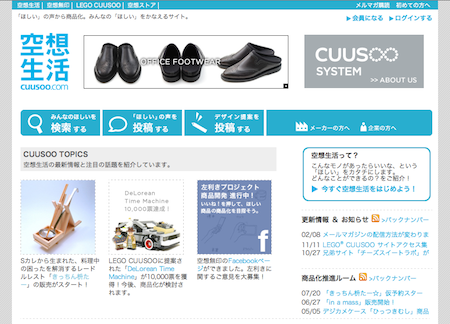
There are about 340,000 active users of Lego Cuusoo and Cuusoo Muji. The concept of Cuusoo.com is to make a product that people actually want. Cuusoo.com has a long list of people’s wishes that have been accumulated over the past 15 years. Kohei would pick up interesting ideas with huge demand from the list and create the actual product with help from smaller companies with technology. An example of such a product is the Window Radiator developed by Morinaga. The product stops cold air coming in from windows, and it also increases heating efficiency resulting in less condensation on glass windows. The product is made of elastic in order to adjust to all sizes of windows.
Other popular products include a “smart wallet” (a wallet that never gets bulky) and office footwear that looks like dress shoes from the front but are actually comfortable sandals. All of these products were commercialized based on the opinions of users.
Cuusoo Muji is an online community that lets users submit ideas for products they want the retailer Muji to make. Currently, there is a project aimed at making life easier for the world’s left-handed people, which is a good example of what the crowdsourced ideas come up with. The biggest hit product of all is a sofa made of beads released by Muji back in 2002.
Lego Cuusoo is jointly managed by Lego and Cuusoo.com. Only six percent of the users are Japanese, and 94 percent from overseas, with Americans accounting for 46 percent.
Lego fans make their ideal Lego creations and submit them to Lego Cuusoo. If an idea gathers over 10,000 supporters, the project is passed on to Lego staff and the project then heads toward production. Candidates for commercialization appear at a pace of about one per week. If all problems such as rights issues are properly addressed, the product is released in about four months. The creative team at Lego can only come up with a certain amount of ideas, so the Lego Cuusoo platform allows Lego to create more products by feeding on the ideas of true fans.





Stay updated on the go with our mobile app.
Get latest insights with smoother, more personalized experience through TIA mobile app.









📅 Upcoming Events
22 October 2026
Payoneer x CSPN Summit 2026