 Samantha Cheh · · 5 min read
Insiders spill secrets to building a career in the cloud

As the saying goes, a rising tide lifts all boats. But in the case of AI, it is more akin to a surging wave of development that’s taking the cloud computing industry beyond high water.
As the tech advances and its adoption surges, cloud providers are increasing their infrastructure spending to meet demand. That’s a good sign for tech workers looking to enter the cloud computing sector – companies are more than willing and ready to welcome new joiners.

Happy to show newcomers the ropes / Photo credit: AWS
Still, it’s important to note that it’s not only the big, eye-catching roles that are worth considering. In an industry this huge, there are plenty of other equally critical positions.
“Most engineers or people who majored in computer science consider cloud engineering to be a developer-type role and focused on coding, rather than something more supportive,” says Iori Kudo, a recruiting manager for the AWS Support Engineering, Enterprise Support, and Customer Services teams.
With this in mind, cloud providers like AWS are looking to shed some light on both data center and support engineering jobs and help potential hires answer a critical question: What does it take to bag one of these coveted roles?
Essential skills
In uncovering what cloud computing roles are truly like, we’ve got to go back to basics.
In other words: core technical skills.
In its data centers, for instance, AWS needs technicians to maintain internal servers and network devices to keep business data flowing if errors occur. For this position, it’s great if candidates have technical proficiency with servers, networks, and other related equipment, explains Tejasvi Kochar, recruiting manager for the Amazon Web Services (AWS) Asia Pacific and Japan outposts.

(Right) Tejasvi Kochar, recruiting manager for the AWS Asia Pacific and Japan outposts / Photo credit: AWS
“Troubleshooting skills and a foundational understanding of IT systems are essential, with proficiency in Linux being a valuable asset,” she says.
There are also data center engineers, who monitor and maintain the facility as a whole. People in these roles – or looking to apply for one – have to be knowledgeable about the mechanical systems that underlie the data center building, such as electricity, air conditioning, heat pumps, generators, plumbing, and duct systems.
“If a failure occurs with the equipment and an alarm rings, a data engineer has to conduct a field investigation and immediately respond with recovery work,” says Kochar. “We also require experience in operating and maintaining infrastructure equipment in critical facilities such as operational factories, substations, and hospitals.”
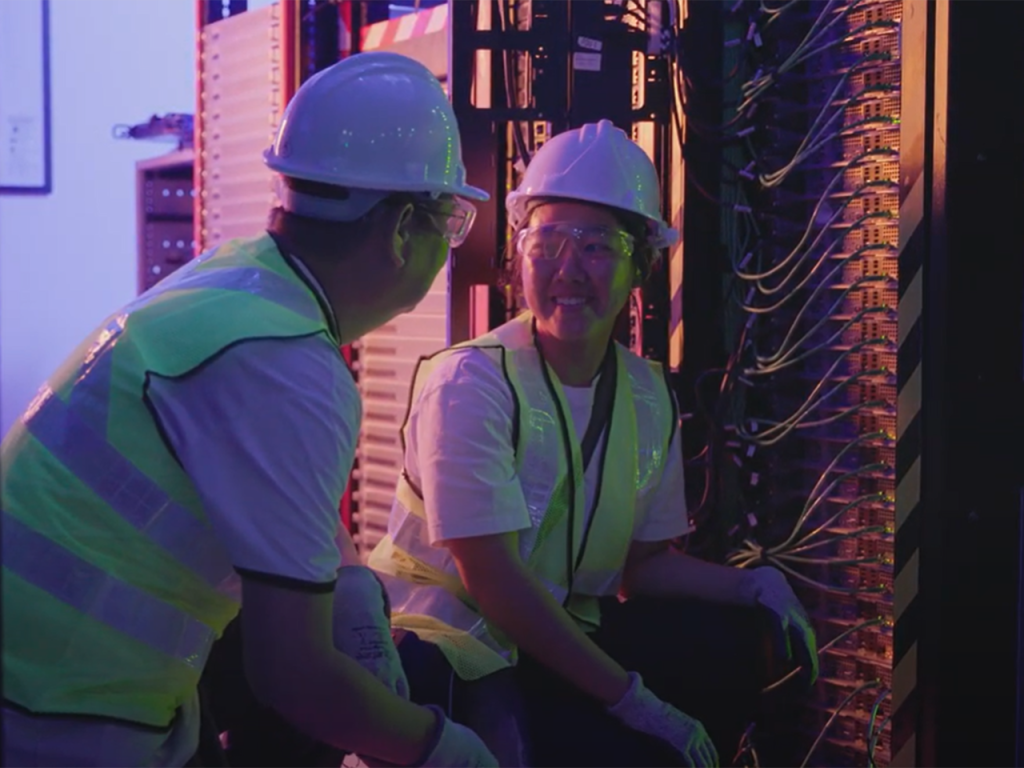
Up close and personal with data center equipment / Photo credit: AWS
Meanwhile, those looking to score a support engineer role usually have a good understanding of operating systems, virtualization services, and networking concepts such as TCP/IP and DHCP.
However, soft skills are also essential, says Kudo, especially since support engineering is a people-centric position that requires lots of communication and collaboration with other teams or customers.
“These engineers will often have to ensure that the full scope of the cloud solutions’ capabilities can be conveyed clearly to customers, allowing users to make the most out of it,” she points out.
According to Kochar, soft skills are valuable in data centers too, given the need for attention to detail and precision to ensure error-free operations. For example, data center workers often need to have a strong sense of ownership in an individual and team setting, given that there’s tons of complex systems that they deal with daily.
Telling your story
Understanding what’s needed for cloud computing roles is just one part of the equation, since there’s the application process too.
According to Kochar, the interview process is an opportunity for candidates to present themselves holistically. At AWS, this is done by using behavior-based questions based on Amazon’s Leadership Principles.
“We delve into your past experience and how you’ve navigated challenges to understand how you would respond to problems as they crop up,” she says. “We want to know how you figured out what the problem was and how you planned your response. How did you learn and grow?”
To help potential hires, Kudo points to the tried-and-true Star method as an example of a great way to highlight technical skills and experiences – including their impact – in a data-driven manner.

Iori Kudo, recruiting manager for the AWS Support Engineering, Enterprise Support, and Customer Services teams / Photo credit: AWS
Further, candidates should look to highlight how their experiences and thinking process can be replicated in a cloud computing environment.
“Consider how complex your achievements were and present data to demonstrate the size of your impact,” she says. “Even if it’s not a success story, we’re keen to understand how and why applicants make certain decisions.”
For candidates who lack certain skills or experiences, Kudo recommends them to make use of online resources to improve.
In some cases, data center operators may provide specialized training programs to help new workers get up to speed. For example, AWS offers a special traineeship to build up a talent pipeline.
“Over the course of six to 12 months, trainees can receive classroom and on-the-job training covering every facet of our data center operations,” explains Kochar. “At the end of the program, we’ll see if they have what it takes to become a member of our expanding team.”
Moving with the times
As most, if not all, of the business world increases its reliance on online infrastructure and applications, talent shortages will continue to be a key concern in the cloud computing sector. Cloud skills will remain a key priority for business spending throughout 2024 and beyond, which bodes well for potential applicants.
Yet, as with any industry, the cloud computing industry will continue to change in response to emerging trends such as multi-cloud operating models and decentralization of data centers. As such, it’s essential that candidates keep learning to grow their skill sets and gain the specialized expertise that are needed to manage and operate these facilities.
“We are looking for someone passionate about helping our customers grow their business through technical advice,” says Kudo. “Someone who enjoys learning new technologies to brush up their technical skills.”
“Career paths vary for each person, but the most important thing is making a positive difference to users.”
Amazon Web Services (AWS) is a global leader in cloud technologies that are helping organizations and individuals to build real solutions with the best talent in the industry. From early-career starters to seasoned professionals, AWS invests in local talent to learn and grow.
To find out more about how to start building your career at AWS, follow this link.
This content was produced by Tech in Asia Studios, which connects brands with Asia’s tech community. Learn more about partnering with Tech in Asia Studios.
Stay updated on the go with our mobile app.
Get latest insights with smoother, more personalized experience through TIA mobile app.
Recommended reads
 Building a human capital operating system for students
 AppLovin CPO on how renting AI can be a waiting game
 AI startup Acceler8 lands backing from A16z Speedrun
 The real reason AI adoption falls short
 When skills beat degrees in an AI economy
 The myth of the set and forget AI agent
 Why AI is hiring problem, not just a technology one
 Escaping the LLM bubble: AMI Labs goes the physical AI route
 An AI interviewer being built on interview data, not CVs





Editing by Jonathan Chew, Winston Zhang, and Eileen C. Ang
(And yes, we’re serious about ethics and transparency. More information here.)






📅 Upcoming Events
22 October 2026
Payoneer x CSPN Summit 2026