Steven Millward · · 4 min read
China’s startup funding is still booming, $37b ploughed in during first half of year
It’s hot, steamy, and sometimes stormy right now in China as rainy season segues into summer – and the nation’s tech industry is feeling pretty much the same way as more money than ever is flooding into its startups.
Investors put a record US$37.2 billion into China’s young tech firms in the first six months of the year, shows the Tech in Asia Database. That’s just over double the tally in the same period last year.
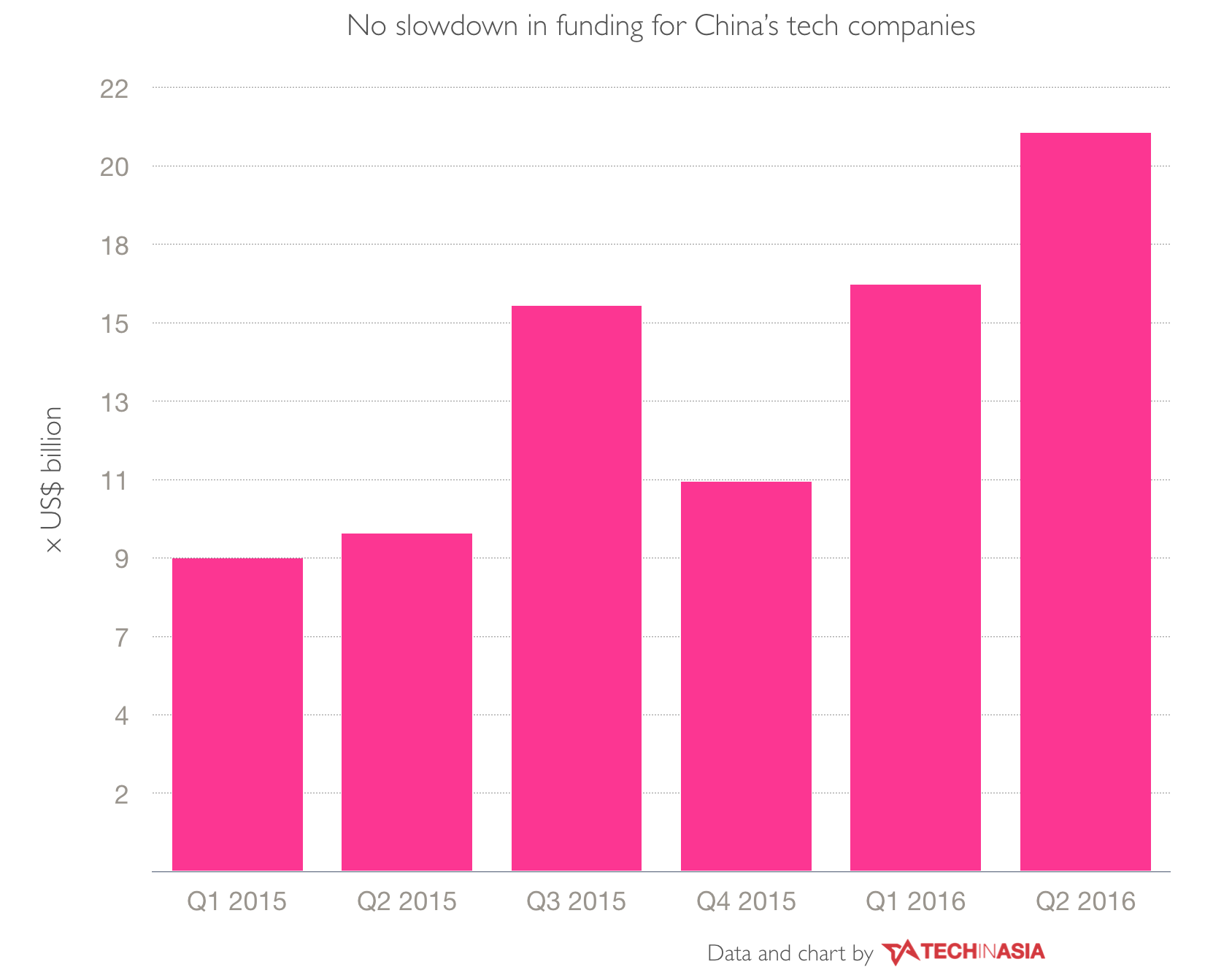
The flood of money comes despite concerns in some quarters that Chinese startups are overvalued – see the ease with which Uber arch-rival Didi Chuxing pulls in multi-billion-dollar funding rounds every couple of months so far this year. That creates a situation in which it’s tough for institutional investors to make returns on their inputs.
“Rising tide raises all boats – so in this situation, even winners have to raise more capital in order to ward off losers,” says Kay-Mok Ku, a partner at Shanghai-Based Gobi Ventures. And so even the losing startups “now have access to competitive capital which may not have been available before.”
Beyond series D, it’s profitability, IPO, or bust.
Despite all that extra cash flying around, the experienced VC sees it as simply part of the ebb and flow of the economy.
“The global macro environment is in a period of enhanced liquidity so any asset class that has the promise of generating potentially attractive returns will draw in investors,” Kay-Mok says. “Startup investment is probably in that situation although we have no way of knowing if we are in a bubble until after the fact.”
Tech giant’s huge wallet
The Tech in Asia Database shows that the number of investment deals dropped slightly in Q2 of this year compared to the year prior (441 versus 490), giving a clear indicator that the average funding round is a lot bigger right now.
In that time period, the most active investor was IDG Capital Partners. The fact that Chinese giant Tencent, maker of the hugely popular WeChat, was in second place points to corporate investment in China beginning to rival institutional investors.

The wallet section of WeChat, Tencent’s widely-used messaging app, shown after being used to pay for coffee. Didi Chuxing’s ride-hailing is baked into the “Order Taxi” section of WeChat.
Tencent threw cash at a number of Chinese consumer tech startups, including several that are partners to the localized services offered inside WeChat, such as ride-hailing app Didi Chuxing and ticketing service WePiao. Both those are baked into the Wallet section of WeChat.
Time to grow up
The most alarming change seen in our last report on China data persists – late-stage startup funding is drying up.





Stay updated on the go with our mobile app.
Get latest insights with smoother, more personalized experience through TIA mobile app.