
Pokemon Go’s success has annoyed some long-time Ingress players (both games are made by the same company, Niantic).
To them, Pokemon Go is an inferior game that succeeded because it rode on Nintendo’s intellectual property. This meme spreading around social media expresses the sentiment best:
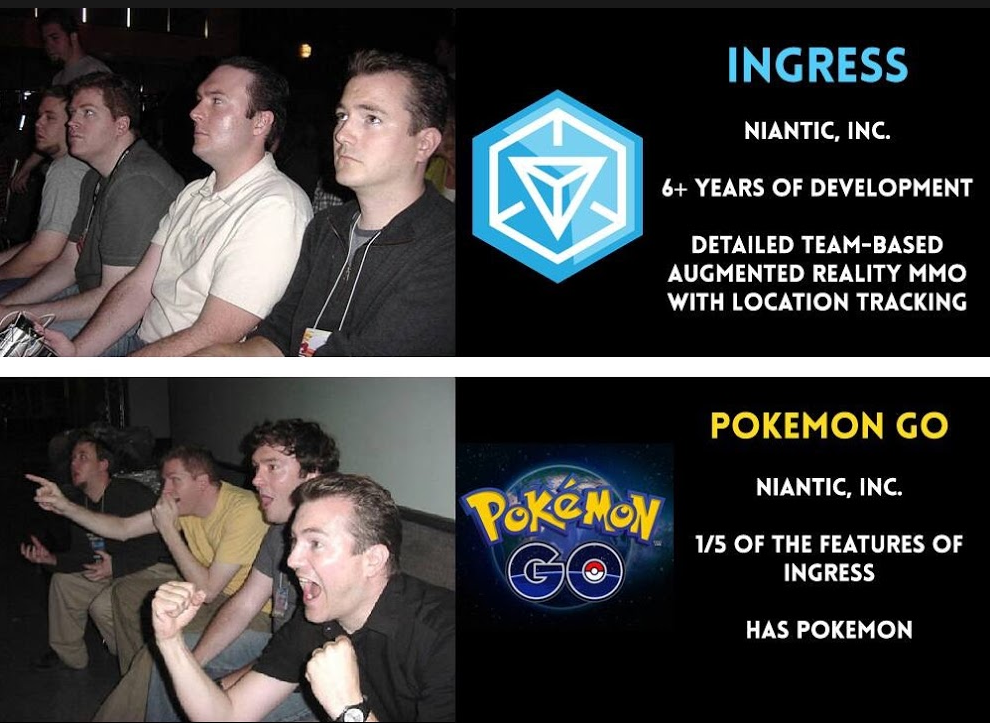
But this thinking disparages the engineering ingenuity required to make such a massive game work. It overlooks the decades of expertise possessed by John Hanke, the founder of Niantic.
Despite launching in only 39 countries out of the planned 200, the game already has more daily active users than Twitter in a couple of weeks after its launch. Think about the nightmare of scaling the game up so quickly!
Critics also forget that Ingress served as a proof of concept for Niantic’s real plan, that of creating a platform to help customers build their own geolocated games.
Ingress was never the destination.
Pokemon Go is an example of experimental innovation, in which ground-breaking ideas are produced through trial and error.
The game wasn’t a bolt from the blue. It started as an April Fools’ joke, which evolved into a full-fledged game that saw some success. Its final evolution? Pokemon Go.
Here lies a valuable lesson: our lives are a series of dress rehearsals and dry runs, all leading towards our Greatest Work, our Magnum Opus.
The painting that captivated the world
Leonardo da Vinci’s Mona Lisa had a long journey to completion. The artist began painting it in 1503, and worked on it intermittently. He finished it only in 1519.
In between, he experimented with various techniques. Critics derided him for wasting time instead of focusing on finishing his paintings. Yet these experiments made its way into the Mona Lisa. Historian William Pannapacker explains:





Stay updated on the go with our mobile app.
Get latest insights with smoother, more personalized experience through TIA mobile app.