 Jia Xin Lim · · 3 min read
Innovate with Shell to co-create the future of accelerator programs
[Update on 2 March, 2:30pm] Panelists for the event have been added in.
Collaborations between startups and corporates are commonplace, and it’s not surprising to see why. Unilever Foundry, Samsung’s Strategy and Innovation Center, as well as GE Ventures are just some examples of companies who’ve delved into the world of startups by investing their resources and expertise to help startups flourish while meeting their own innovation agendas, which may face structural, cognitive, and behavioral challenges.
Unilever Foundry predicts that by 2022, startup partnerships will become a necessity for corporates, with 79 percent of corporates and 78 percent of startups surveyed anticipating more collaborative work in the future.
Beyond startup-corporate collaborations, other stakeholders such as government agencies, investors, and startup accelerators also contribute to a thriving startup ecosystem.
In Singapore, the government has taken a supportive role in jump-starting the ecosystem and helping businesses grow, with initiatives such as JTC LaunchPad, Startup SG and SGInnovate. Singapore-based investors such as Jungle Ventures and Quest Ventures have also aided in scaling startups and providing them with connections; while accelerators and incubators abound in the city-state, with organizations such as Wavemaker Partners, Startupbootcamp Fintech and AIRmaker joining the fray.
Benefits and challenges that lie ahead
Clearly, startups benefit by having well-established organizations that lend them credibility, opportunities and resources that would not be otherwise accessible. These gains are not just limited to startups, as incentives are also present for other involved parties. With startups best known for their agility to pivot fast in light of changing user needs, organizations are able to gain speed and serve their customers better by working closely with these disruptive technologies.
While there are clear advantages partnering with the different key players in the ecosystem to create value for all involved, it’s not all a bed of roses. Problems arise when startups and other organizations have misaligned goals. In a study, close to 45 percent of respondents cited strategic fit as the most important factor in success or failure of a startup relationship.
Additionally, different working styles and cultures may present itself as a challenge. While early-stage innovators are comfortable with taking high risks, corporates and governments are often known to be more risk-averse. In addition, 70 percent of startups find difficulty adjusting to internal processes within larger organizations when collaborating with them.
While such startup programs comes with its own unique set of opportunities and challenges, such collaborations are still set to stay, with 82 percent of corporates viewing interactions with startups as “somewhat important” to “very important” to their objectives. Additionally, the local government has encouraged companies to work with startups to come up with innovative ways to disrupt traditional business models.
Join Shell in a discussion to co-create the future of accelerator programmes
Though the road to forming beneficial partnerships may be somewhat intimidating, the rewards can be substantial. Shell believes that progress in this aspect can be powered by having various groups in the ecosystem come together to discuss and create possibilities for future collaboration.
Last year, the energy behemoth launched its own corporate accelerator program, #IdeaRefinery. The 20-week curriculum focuses on energy-related startups and aims to help build a vibrant startup ecosystem in new energy solutions.
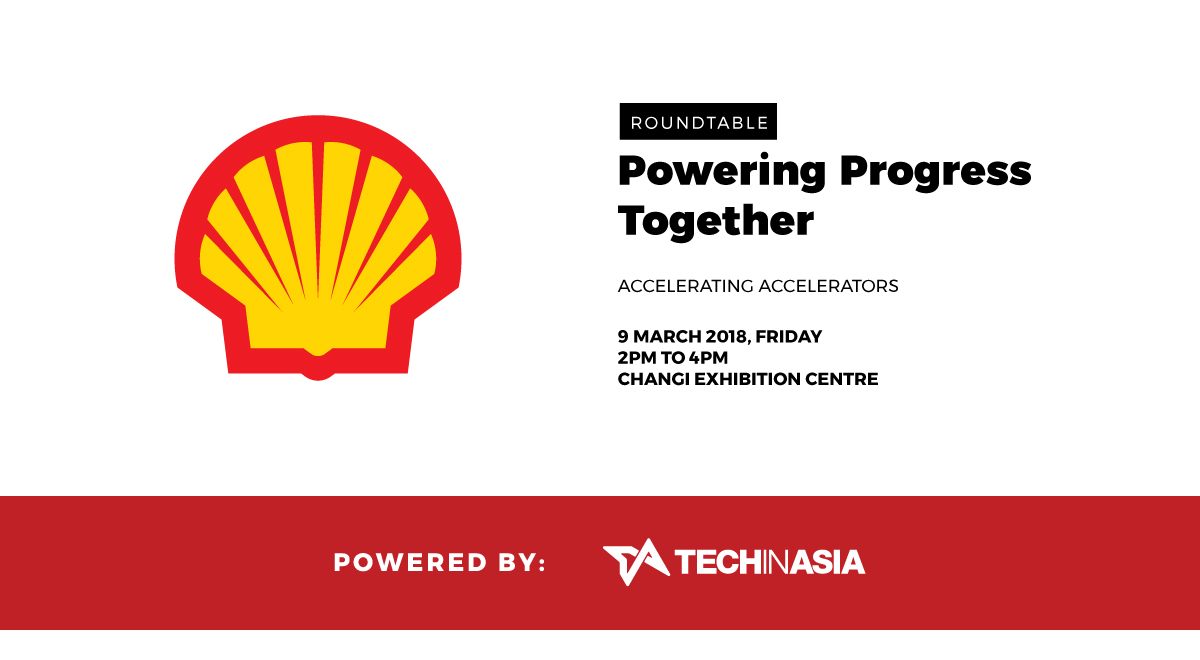
On 9 March, Shell will be facilitating a discussion on how ecosystem players – startups, corporates, government, investors, universities, and more – can power the progress of startups together, as well as how Singapore and the broader society will be able to benefit from a collaborative accelerator space.
Participants are also invited to raise issues and suggest solutions, so look forward to an insightful two-way discussion with key learning points such as how stakeholders in the startup community may contribute to and gain from an improved accelerator space, challenges faced by accelerator programs, as well as potential solutions to overcome these obstacles.
Register your interest below by 5 March to secure your seats. As this is an invite-only event, successful applicants will be notified via email. Refreshments will be provided as well.
Panelists
Geert van de Wouw, Managing Director, Shell Technology Ventures
Arnaud Bonzom, Venture Partner, 500 Startups
Nimantha Baranasuriya, CEO, Ackcio
Moderated by Imran Khan, Head of Agency Relations, Tech in Asia
Event Details
Date: 9 March 2018 (Friday)
Time: 1:30pm – 4:00pm
Venue: Changi Exhibition Centre, 9 Aviation Park Road, 498760
Stay updated on the go with our mobile app.
Get latest insights with smoother, more personalized experience through TIA mobile app.
Recommended reads
 Mastering the art of virtual pitching at our TIA Live event
 1337 Ventures opens applications for 43rd cohort of digital accelerator
 These startups are scaling successfully with Huawei’s help
 Social finance platform Ethis relaunches angel investor group
 India-based VC debuts seed fund with $100m corpus
 GoTo, Xendit backer launches second batch of climate crisis program
 The Aspiring Founders Program – Fall 2022
 How Asia’s family offices could be a $1.9t play for tech startups
 Singapore prime minister clarifies details on new work pass for global tech talent
 Xend founder launches Philippine proptech venture builder





Editing by Cheong Hui Min
(And yes, we’re serious about ethics and transparency. More information here.)




