 Steven Millward · · 3 min read
As Social Network Kaixin Loses 65% of Traffic, How Did it Lose its Groove?
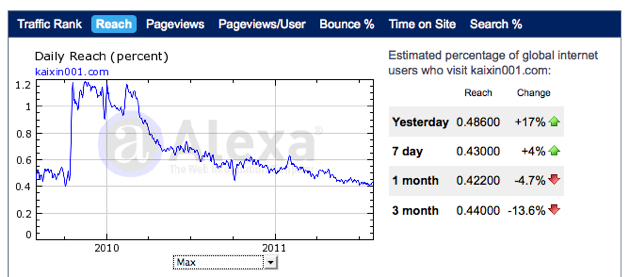
The web traffic stats site Alexa reveals that China’s former top social networking site Kaixin001.com has lost 65 percent of its traffic in the past 12 months (see the graph above).
In another blow to Kaixin, a gauge of Chinese netizens interest in the site measured by Baidu Index, has hit the rocks. Today’s ‘user interest level’ for the Kaixin site is rated at 1,500 (see the graph below), which is its lowest ebb since March 2009, before the social network really took off.
The Alexa and Baidu Index measures point to a trend towards Twitter-like microblogging platforms, pulling people away from the ‘one stop shop’ approach of China’s early Facebook clones.
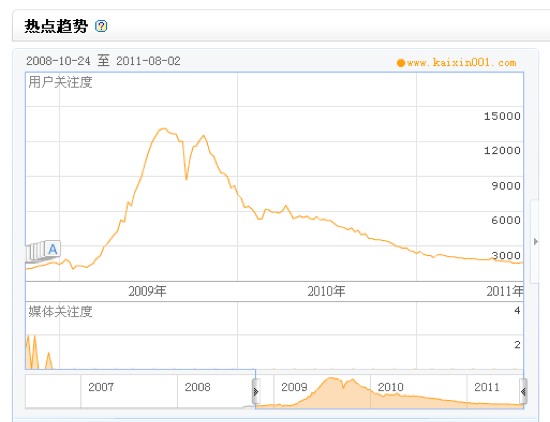
A measure of 'user interest level' by Baidu Index (index.baidu.com) shows Kaixin001.com at the same level it was at back in March 2009.
A greater plurality of ways to share news and keep in touch with friends is also hurting Kaixin’s traffic. Note that traffic figures are not an indication of user numbers, and might not be taking into account sessions on mobile apps.
While Renren’s (NYSE: RENN) traffic is holding up for now, it’s interesting to ponder how China’s first web 2.0 sites now seem to have been superseded.
Back in 2009, smartphones were not so common, so a lot of Chinese casual game fans then had fewer channels for a bit of light gaming. Now, millions more people have iPhones and Android smartphones – and social games can now be found on nearly every Chinese web platform…
A little less conversation, a little more gaming please
Although Kaixin has plenty of games on it, such as the social game Happy Farm – and more involved multiplayer ones too, such as Shanda’s soon-to-launch Legend of Immortals – the casual gaming market has changed a lot in the past few years. It was back in 2008 that Kaixin’s great rivalry with Renren began, when Kaixin was full of advertiser-friendly white collar workers, and Renren.com was just packed with ramen-slurping college students.
In terms of games, Tencent is growing stronger across both its QQ and Pengyou.com platforms. Just last week China’s SNS giant scored a coup, getting an exclusive on Zynga’s CityVille. Sina, meanwhile, last month added a games portal and a virtual currency to its popular Weibo platform.
So it seems blogging has metamorphosed into microblogging, and along the way a number of China’s major portals – such as Sina and NetEase – got their groove back as they jumped on the 140-character bandwagon, while the indie social networks didn’t innovate so much. It is believed that Sina Weibo now has some of China’s most engaged and wealthy social media users.
End of the American IPO dream?





Stay updated on the go with our mobile app.
Get latest insights with smoother, more personalized experience through TIA mobile app.









📅 Upcoming Events
22 October 2026
Payoneer x CSPN Summit 2026