Jack Ellis · · 5 min read
‘Airbnb for satellite antennae’ lifts off with $7.3m funding from Airbus and Sony
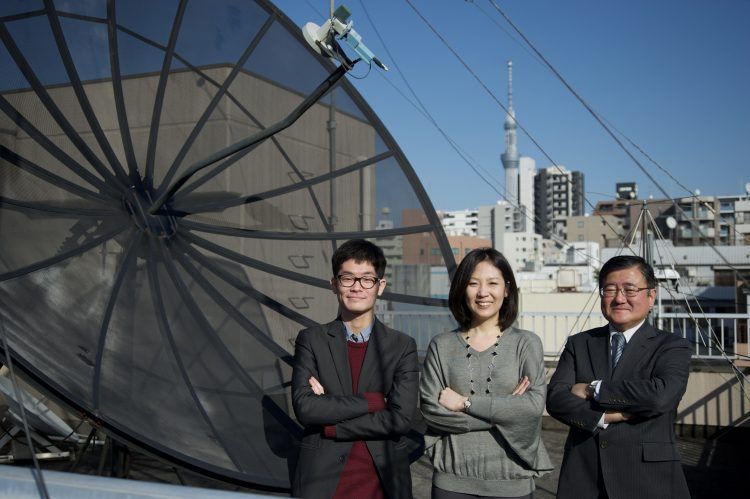
Infostellar’s co-founders – COO Kazuo Ishigame (L), CEO Naomi Kurahara (M), and Toshio Totsuka (R). Photo credit: Infostellar.
Japanese commercial space startup Infostellar has just closed a series A fundraising worth US$7.3 million. Airbus Ventures led the round, with Weru Investment, D4V, and Sony Innovation Fund also taking part. Additional investment came from existing Infostellar backers 500 Startups Japan and FreakOut Holdings.
“When we first met [co-founders] Kurahara-san and Ishigame-san, all they had was a slide deck and a crazy idea to build an ‘Airbnb for satellite antennas’,” James Riney, head partner at 500 Startups Japan, tells Tech in Asia. “It’s amazing to see how far they’ve come.”
That “crazy idea” was enough to win Tech in Asia‘s Tour of Japan pitch contest for Infostellar co-founders Naomi Kurahara – now the company’s CEO – and Kazuo Ishigame – now COO – last year.
There is a major disconnect between satellite operators on the one hand, and antenna holders on the other.
The space exploration industry is diversifying, with private companies like Elon Musk’s SpaceX treading into territory that was previously the preserve of government-funded national agencies. A whole startup scene has sprouted around building satellites, as well as antennae back here on Earth, that can be used by third parties for an increasingly wide range of research and communications purposes.
Tokyo-based Infostellar is riding this wave, though it isn’t building satellites or launch vehicles. In fact, it remains very much Earth-bound – for the time being, at least. But its team of 11 – comprising software developers, radio engineers, and compliance experts navigating a complex web of telecom and airspace regulations – have their eyes turned squarely skyward.
Cosmic inefficiency
Satellites orbit Earth several times a day and typically pair with a single antenna located on the planet’s surface to transmit information. This means that there is only a short window during a satellite’s circumnavigation when it is in range of its partner antenna. Often, this is a matter of only about 10 minutes for each orbit a satellite completes – so for one that can do four orbits per day, there’s a maximum of around 40 minutes’ communication possible in a total 24 hour period. For much of the rest of the time, the antenna remains unused.
This is where Infostellar wants to step in. It has developed a cloud-based satellite antenna sharing platform – named StellarStation – which connects satellite operators with antenna operators around the world. This way, free time at idle antennae located at different points on Earth can be shared in order to increase the overall communication period between orbiting satellites and the surface.
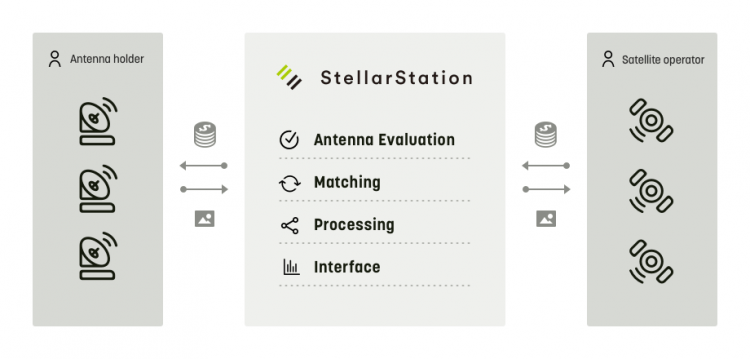
StellarStation is a cloud-based platform that connects satellite operators with idle antennae. Image credit: Infostellar.
“At the moment, there is a major disconnect between satellite operators on the one hand, and antenna holders on the other, because each is working with different protocols and modulation types,” Ishigame tells Tech in Asia. “We provide processing and matching so that satellite operators and antenna holders using different protocols can connect with one another.”
Aerospace, IP expertise
To infinity, and beyond





Stay updated on the go with our mobile app.
Get latest insights with smoother, more personalized experience through TIA mobile app.