Paul Bischoff · · 6 min read
Korean entrepreneur went from translating K-Pop tweets to selling language data to web giants
We first covered South Korean startup Flitto in September 2013 when it came out of beta at Techcrunch Disrupt. The crowdsourced translation app already had 2 million users under its belt.

Today, Flitto CEO Simon Lee tells Tech in Asia the app has grown to 3.7 million users worldwide, about one-tenth of those using the app on a daily basis. On the flipside, Flitto has almost 700,000 translators. Lee says Flitto is onboarding new users at a rate of 10,000 to 20,000 per day.
“Right now we are making around US$100,000 a month. It is two times more revenue compared to the revenue three to four months ago,” Lee says.
Machine translations services like Google Translate, which one might presume to be Flitto’s biggest competitors, are actually Flitto’s biggest customers. Google and Naver, the parent company of messaging app Line, use data collected by Flitto to validate the translations used in their own systems. Lee says this makes up about 90 percent of the company’s revenue.
(Update on February 3 @11:00: After the article was published, Flitto and Google reached out to Tech in Asia to say the two companies are still in a discussion and testing phase, and no monetary transactions have yet taken place between them.)
“They actually buy our translation data sets to make their machine translation more accurate,” he says. “Even before I started the company, I believed that machine translation services would buy data sets of translations done manually, but at that time no one believed me. Everyone thought that technology would advance much more quickly, but it hasn’t.”
Despite heavy skepticism from investors, Lee has proven that Flitto’s core business model works. He says uptake has been strong in Southeast Asia, especially Indonesia. That’s because speaking multiple languages is common in the region, and the cash rewards for translating are higher relative to cost of living.
Lee says Korean pop music has been a driver of growth since the beginning of Flitto, as fans around the world want to know what their favorite singers have to say. “Indonesians are very active socially already, so using a social translation tool like Flitto has many benefits. They can stay up to date with their K-Pop idols, add to the K-Pop community, and earn money at the same time,” he says.
He says, she says
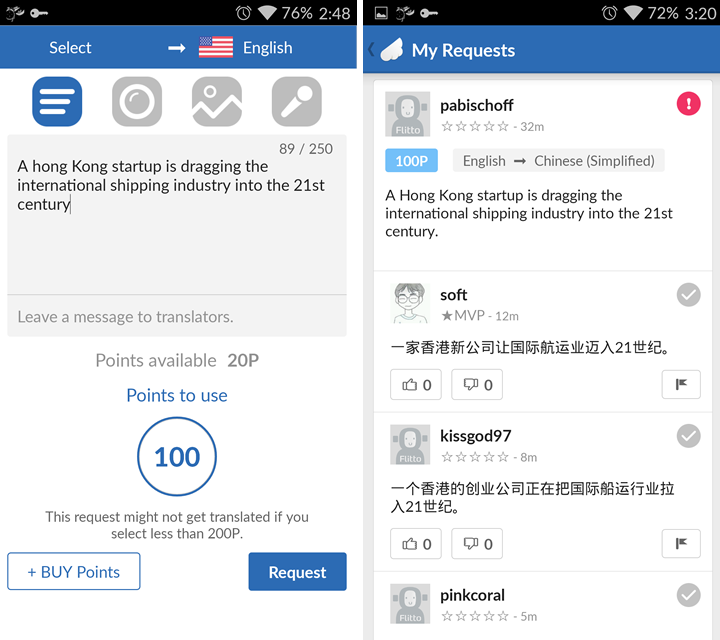
For the uninitiated, Flitto allows users to request translations from other users. Flitto is typically used for short snippets of text rather than long form documents or articles (leave those to services like Gengo). I tested out the app to translate one of my tweets into Chinese. I just enter it into Flitto and set the number of points I wish to pay (US$1 = 1,000 points). Flitto quotes a suggestion for how much I should offer.
Dear China
What’s on the menu
An interpreter in the palm of your hand
The Korean edge





Stay updated on the go with our mobile app.
Get latest insights with smoother, more personalized experience through TIA mobile app.