Terence Lee · · 6 min read
There’s a hidden battle for indoor drone dominance – and this startup is at the forefront
Junyang Woon was as far away from the tech industry as you can imagine. An officer in the Singapore Navy for seven years, Woon inhabited a world of strict regimentation and uniformed discipline. Yet he was also surrounded by technology; he had a chance to work with drones while on the high seas.
That foreshadowed his new phase of life as a startup founder. The idea for his project came out of a simple dinner with friends at a local restaurant. They simply could not get a waiter to serve them as the restaurant did not have enough staff.
What Woon experienced was fast becoming commonplace in Singapore. After the ruling party’s worst electoral showing ever in 2011, it tightened the flow of foreign labor into the country. Unemployment in Singapore was low, which meant Singaporeans could be choosy when picking jobs. Serving fussy customers didn’t strike them as a fulfilling career.
“It’s a problem that won’t go away […] the hours are long, you’ve got to stand, and you’ve got to be patient with your customers. It’s a tough industry to work in, and the pay is not exactly fantastic. That’s when I thought, why not improve productivity by using unmanned vehicles in restaurants?”
Sensing an opportunity, Wong left the Navy in 2013, rounded up a few like-minded acquaintances, and started Infinium Robotics, a company specializing in indoor drone technology. The startup introduced itself with a bang: partnering with local restaurant and bar chain Timbre to pilot a robotic waitering system called Infinium-Serve. It will become fully operational at five eateries by the end of the year.
Drones at your service
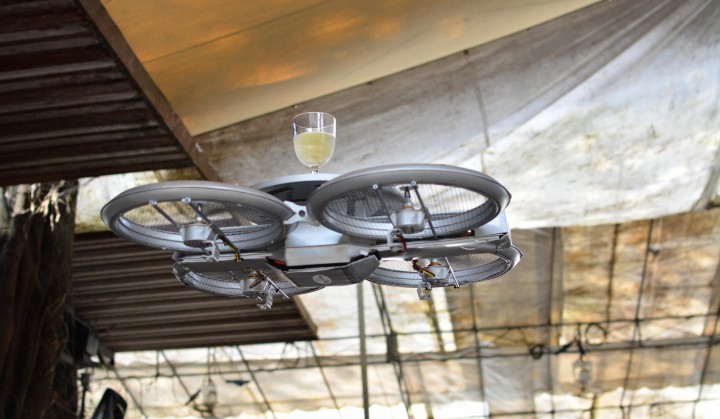
While Infinium’s tech has outdoor applications, it’s developing an expertise to operate drones within the confines of the four walls. Take its drone waiter system as an example. It brings food from the kitchen to a nearby station. Waiters then pick up the food and serve it to customers. The drones can of course serve food directly to customers, but restaurants told Infinium they want to retain the human touch.
While Wong considered using ground robots at first, his customers didn’t like it: they’d obstruct customers and staff, making them a potential safety hazard and productivity killer. Aerial drones, which utilize previously untapped ceiling space, were considered a superior option.
The drone system has several features that make it usable in confined spaces. The blades are shielded by a wire mesh, preventing them from hurting people. Woon adds that the drones are stable enough to self-correct if it gets tilted – though the quadcopter design is useless without an electronic stabilizer. The system also includes collision avoidance sensors of the sonar, infrared, and stereo vision variety.
While these features are run-of-the-mill in the industry, Infinium’s engineering edge lies in its swarm tech, consisting of a proprietary flight controller and algorithms which allow multiple drones to coordinate their movements even within centimeters of each other. This is crucial because it needs the drones to negotiate tight spaces.
The work is far from complete. Because GPS only works outdoors, it isn’t ready for entirely indoor environments like shopping malls yet – Timbre’s establishments operate al fresco style. To fix that, it’s working on an indoor positioning system that uses cameras to track the location of drones.
Infinium is also exploring various ways to eliminate the distracting whirs from the drone blades – crucial for restaurants to maintain their ambience. It’s researching what’s called active noise cancellation, a technology that produces a sound that cancels out the drone’s din. The R&D is still in the early phase, though.





Stay updated on the go with our mobile app.
Get latest insights with smoother, more personalized experience through TIA mobile app.