Nathaniel Fetalvero · · 6 min read
Competitors turn collaborators to accelerate e-payments adoption in Singapore

Go to any mom and pop shop or hawker center in Singapore and you’re likely to see a bright pink logo indicating that e-wallet FavePay is an accepted payment method for anybody without cash on hand.
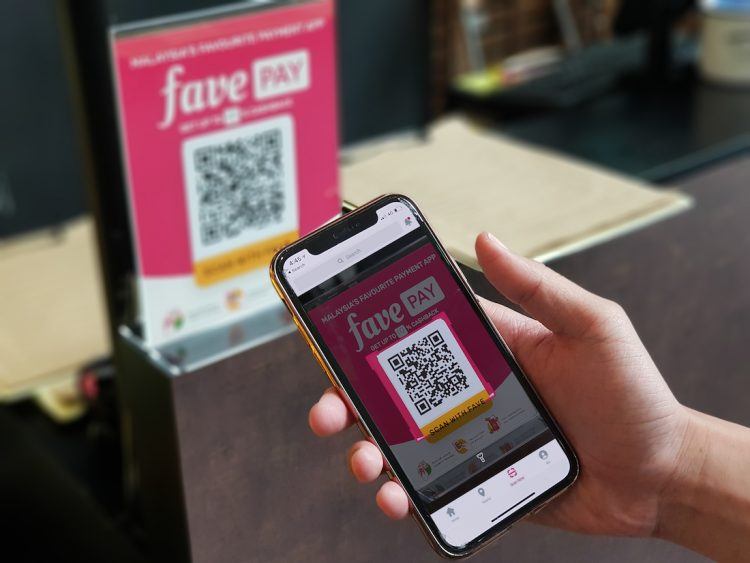
Photo credit: Fave
The e-wallet burst onto the scene in 2017, after some founding members of Fave – which had primarily dealt in the online rewards vouchers business in the past – took a trip to China.
“A few of us went to China [in 2016] to understand the tech scene there,” says Ng Aik-Phong, Fave’s managing director in Singapore. “And when the team came back [to Singapore], we thought, ‘Oh my God, payments is going to be huge.’”
Fave founder Joel Neoh had noticed the ubiquity of cashless payment options in China. Knowing that the Southeast Asian tech scene was only a few years behind the country’s growth trajectory, the two guessed that the same phenomenon would soon take place in areas like Singapore.
Revolutionizing rewards vouchers with payments
Upon their return to Singapore, Ng, Neoh, and the team put their heads together to come up with ideas on how to launch a payments platform for Fave.
Then, there was a breakthrough: The pair realized how payments could potentially fill a gap in the rewards voucher scene, which at the time involved a largely manual process. Among other things, users had to scan physical receipts into an app for proof of purchase so they could be granted the appropriate vouchers based on how much they’d spent.
By adding a payments capability to its suite of solutions, the startup was in a unique position to become a leading player in the rewards scene, Ng recalls.
“The reason why you had to scan receipts to get rewards points was because loyalty apps didn’t have the last mile, which is payments,” he explains. “In addition, merchants that we interviewed wanted a loyalty solution to compliment their deals on Fave. We thought that if we could actually provide payment, then we’d know what the consumers purchase. And with that purchase amount, we’d know how much rewards can be given.”
The team then got to work developing FavePay, which quickly gained traction among consumers. Within nine months of its launch, it had processed over a million transactions on its platform and was an accepted payment method at more than 5,000 locations across Singapore, Malaysia, and Indonesia. A 2019 report by iPrice Group consistently ranked the e-wallet as the third top e-wallet in Singapore from Q4 2017 to Q3 2019.

Ng (second from left) presenting Fave’s 10 millionth user with S$200 worth of Fave credits in February 2020. / Photo credit: Fave
Partnering with other payments players
FavePay was one of the earlier players in the local e-wallet scene, Ng says. Soon after its launch, other companies started rolling out e-wallets in the city-state. Ride-hailing giant Grab, for instance, announced the launch of its GrabPay e-wallet in hawker stalls, restaurants, and shops at the end of 2017.
Another payments platform that had been around at the time was Singapore-headquartered DBS Bank’s PayLah payment app. The app launched in Q2 2017 – ahead of FavePay – and was the first initiative by a bank to facilitate QR code payments in the city-state. It has since expanded beyond payments to allow users to pay for ride-hailing services, meals, online purchases, and even their bills.
In 2018, a year after FavePay was launched, PayLah was already an accepted payment mode that was used by 1.5 million users in Singapore – this was the reach Fave needed to scale and expand faster.
So the team struck a deal with DBS’ PayLah to establish what Ng calls a “co-opposition model,” where PayLah users would be able to scan FavePay QR codes, allowing the two e-wallets to scale user acquisition at a much faster rate.
“DBS is the biggest bank in Singapore, and we have a healthy respect for PayLah,” Ng says, explaining the decision to partner with the app. Rather than compete against each other, the two e-wallets worked toward battling a common enemy: cash.
By working together, they were able to expand the e-payment pie to both companies’ benefit. According to Ng, 25% of new FavePay customers were attributed to PayLah. And since users didn’t need a credit card to use the DBS e-wallet, they were also squarely in FavePay’s target consumer segment, opening up a whole new pool of potential customers. Fave was also able to leverage DBS’ intelligent banking capabilities, which allow its merchant partners to better understand their customers and enhance engagement through data analytics and AI-powered insights.

DBS’ intelligent banking capabilities provided Fave users with an additional boon. / Photo credit: DBS
“It was really a compounded exponential growth,” he says. “It opened up a huge market for both parties.”
Ng adds that he was surprised by the bank’s forward-looking approach to innovation.
“They were really open and they have this understanding that being partners is always better and faster for everyone to scale,” he muses. “It totally surprised me that they saw our vision and value proposition and saw what we were trying to create for merchants and consumers and that they were on board with the mutual benefits we would get.”
On top of being on the forefront of digital payments innovation, DBS is constantly looking at the future needs of merchants and consumers when developing its digital services. Anthony Seow, who heads payments and platforms for the bank’s consumer banking group in Singapore, adds that in times of rapid behavioral change among consumers such as the Covid-19 pandemic, it’s especially crucial that the digitalization gap between consumers and merchants is bridged.
“As consumers trend towards digital adoption, our merchants must not be left behind,” he says. “While acceptance in Singapore remains high, we must continue to break down any barriers to wider adoption, such as poor understanding of processes, complicated processing systems, or perceived high costs.”
To that end, Seow says that DBS will continue to lean on its digital banking capabilities to further the adoption of digital payments in the city-state. This mindset and customer-centric approach to innovation, says Ng, is one of the reasons FavePay’s partnership with PayLah was such a success.
Providing value add to consumers and merchants alike
The DBS partnership was one of the reasons for FavePay’s success in Singapore, says Ng. But another important driver of its success is the company’s focus on increasing its value proposition to its users.
“We’re always tuned towards listening and understanding the problems of our merchants, while at the same time also listening to consumer trends and wants,” he explains. “Our solutions will always revolve around providing good value add to our customers.”
While Ng remained tightlipped about specific developments for FavePay, he alluded that the company would continue onboarding more payment providers onto its network.
Indeed, prior to its collaboration with DBS, Fave formed a strategic partnership with Grab, allowing both firms to accelerate the growth of their e-payment solutions in the region.
“It’s all about making it much more efficient and more rewarding for consumers,” says Ng. “On the merchant side, we aim to create more customer stickiness and lower their costs, whether internally with our app or with our ecosystem partners.”
Find out more about DBS PayLah on the DBS Bank website.
This content was produced by Tech in Asia Studios, which connects brands with Asia’s tech community. Learn more about partnering with Tech in Asia Studios.
Stay updated on the go with our mobile app.
Get latest insights with smoother, more personalized experience through TIA mobile app.
Recommended reads
 Indonesian AI startup goes global
 Forrest Li on scaling Sea, building smarter bots, and founder grit
 An AI assistant that joins sales calls and scores team skills
 Beyond the check: Why VCs need more than capital
 SGX’s CEO says it doesn’t need a unicorn to win
 SMEs want AI too, but not the kind Big Tech is selling
 Oatside’s alt-milk rise hits a profitable gear
 Alibaba’s financial health in 12 charts
 Asia’s telcos bundle AI into mobile plans. Will it pay off?
 M-Daq chases bigger clients as revenue falls, losses grow





Editing by Jaclyn Teng and Eileen C. Ang
(And yes, we’re serious about ethics and transparency. More information here.)