 Leighton Cosseboom · · 4 min read
Ardent Capital crew runs wild in Jakarta, sets up cash back app Snapcart
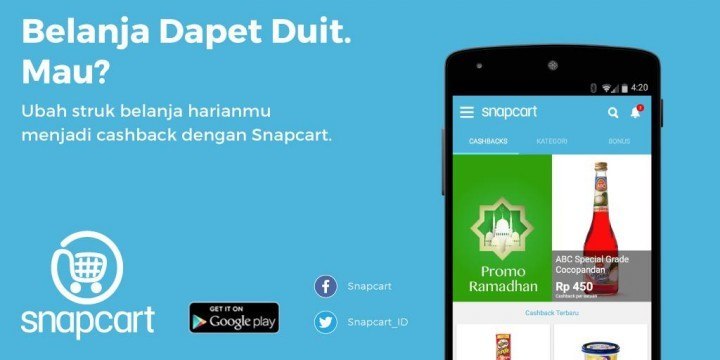
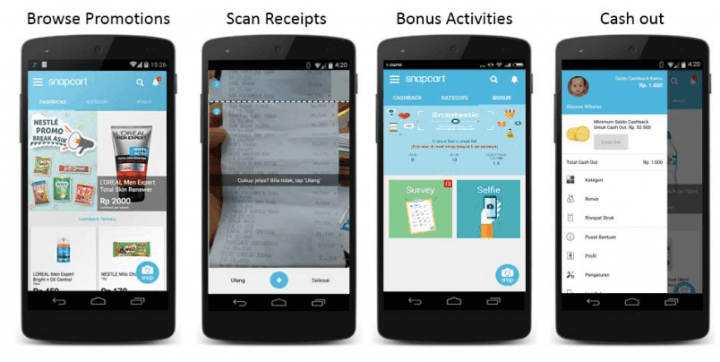
In the latest of big bets Ardent Capital is placing in the Indonesian market, the Thailand-based VC today unveiled its new company Snapcart. The app bills itself as the first in Indonesia to allow shoppers to get cash back when they submit photos of their receipts. Snapcart users can also grab rewards through other in-app activities like filling out consumer surveys and taking selfies with specific products.
The money back mechanism is supported by participating brands. According to Ardent, users win because they get money back in their wallets for being loyal customers. Brands win because they get direct access to real-time consumer analytics across the country. They can then use that information to target shoppers with personalized and location-based offers and marketing campaigns. Ardent did not disclose the amount of its investment for the app in Indonesia, but Snapcart says it will be raising a series A investment by Q3 of next year.
“Snapcart is the most promising big data business in Southeast Asia we’ve seen so far,” claims Ardent Capital CEO Adrian Vanzyl. “It has a no-brainer consumer value proposition: buy stuff you already buy, get money back. And for brands, it is data they’ve fantasized about, but never had any practical way to actually collect, so this business wins on both fronts.”
See: Ardent Capital CEO Adrian Vanzyl has big plans for IndonesiaThe company is headed in Jakarta by Reynazran Royono, a former project leader for Southeast Asia at Boston Consulting Group. Royono also held several prior positions at Procter & Gamble before joining Snapcart and the Ardent crew. “I learned the importance of being shopper-focused, but the lack of in-depth and timely shopper insights created some marketing pains,” says Reynazran of his time at P&G. “It wasn’t until after working with a major telco as a consultant and gaining hands-on experience leading the online classifieds site Berniaga that I learned how to leverage big data to impact shopper behavior in a positive way.” Reynazran was the deputy general manager of Berniaga before its merger with OLX.
Snapcart has several big-name brands on board in Indonesia including L’Oreal, Garnier, Nestle, and milk firm Cimory. Ardent and Snapcart say there is no limit to how much cash consumers can get. According to a statement, users can redeem “millions of rupiah before cashing out.” However, Snapcart users may not redeem receipts that are older than seven days, and the maximum amount of time it takes for the money to appear in a user’s account is also seven days. A week is somewhat of a long time to wait, but the firm says the process will get faster over time.
Consumer data as a service
While Snapcart collects and quantifies consumer data, the company says it does not ask for credit card information. Instead, users get money via transfers to their bank accounts. Currently, the maximum amount of money users can redeem from a single receipt product is IDR 20,000 (US$1.40). At that rate, users would need to buy a great deal of products and take photos of many receipts to collect millions of rupiah as a result. Regardless, Snapcart may just have a chance of success in Indonesia, as locals are famous for their love of deals and discounts. (Update 9/2/15: The above has been updated to show that users can earn up to IDR 20,000 per product, not per receipt. This is important because it speaks to how much money Snapcart users can realistically earn from the product.)
Ardent says Snapcart accepts all bank accounts in Indonesia. As the transactions are done via simple bank transfers, the site has no need to establish partnerships with banks to operate. The Snapcart team in Indonesia currently has 12 members, and it ambitiously aims to exit the company via IPO in the future after expanding the service across multiple emerging markets in Southeast Asia.
The company admits sometimes image recognition when photographing receipts is a challenge, not because Snapcart’s AI is inaccurate, but because often some branded items have the same descriptions on receipts. This makes it difficult to know what exactly the customer is redeeming. Snapcart says the problem occurs about one percent of the time. It also says it’s constantly working to improve the product’s image recognition software.
“This is a complex tech challenge. We are building an ecosystem that processes thousands of receipt formats, where AI and Big Data are the key components,” says Laith Abu Rakty, Snapcart’s CTO. “This gives us the ability to better understand the consumer and their behavior through collected information, something not possible before.”
Snapcart has been operating under the radar in Indonesia since June 2015 with no marketing efforts, it claims. Currently, it has more than 12,000 downloads.





Stay updated on the go with our mobile app.
Get latest insights with smoother, more personalized experience through TIA mobile app.








📅 Upcoming Events
22 October 2026
Payoneer x CSPN Summit 2026