Meghna Rao · · 4 min read
Can a network of levitating pods change how urban India travels?
SkyTran, a personalized rapid transit system (PRT), recently got the go-ahead from Google chairman Eric Schmidt. He invested an undisclosed amount in the NASA-partnered startup through his fund, Innovation Endeavors.
SkyTran implements a network of computer controlled, levitating vehicles that operate above a magnetic strip in order to transport passengers through surface traffic. It hopes to change the face of public transport across the world. The first public experiment is being built in Tel Aviv, Israel and SkyTran plans to expand to ten countries including the United States, Pakistan, and Saudi Arabia.
SkyTran in India
In the following video, SkyTran CEO Jerry Sanders describes the possibility of the entrance of the PTR into India.
Ankur Bhatnagar, Vice President of SkyTran India, today said he expects the personal rapid transit system to be operational in parts of the country within the next two years. He believes India will be SkyTran’s biggest market. SkyTran is currently in negotiations with the Indian government and plans on introducing the service in parts of Jaipur, Bihar, Jharkhand, and Kerala.
According to Bhavnagar, if SkyTran was implemented in Delhi, it would significantly ease existing pressure on public transport infrastructure. The current commute between Gurgaon and Noida, two major hubs in Delhi, would decrease from 90 minutes to less than 25. The pre-booked pods would use magnetic levitation to travel on personalized routes and traffic would be separated into small vehicles. Passengers would use a numerical system to indicate their desired destination upon entering a pod.
PRT has been tried before in India
This is not the first time that India has been interested in establishing a personalized transit system.
In 2011, ULTra Fairwood got a contract to develop India’s first pod transport system in Amritsar. ULTra’s PRT system has already successfully completed its millionth mile at the London Heathrow Airport.
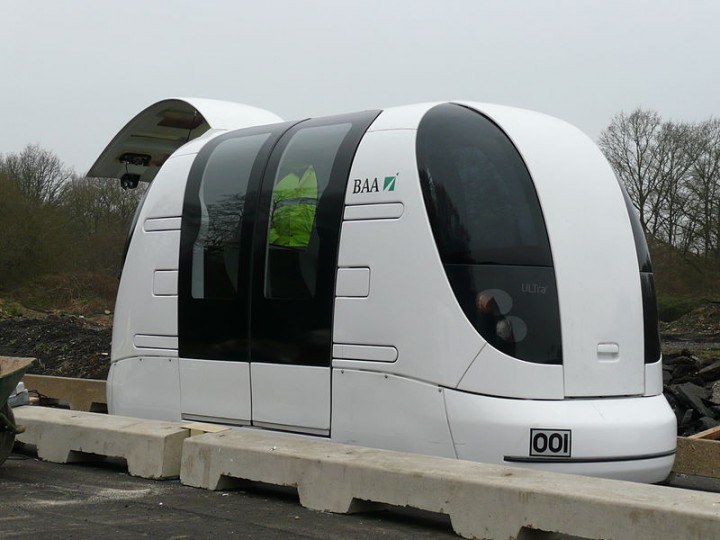
An ULTra PRT vehicle on a test track at Heathrow Airport
ULTra planned to carry up to 100,000 passengers daily and hoped to be the largest PRT network in history. Fares would be comparable to local taxi and auto rickshaw prices (INR 40-50 or US$0.60-.75 a seat) and would run between airports, train stations, and Amritsar’s heavily-trafficked Golden Temple. A single pod would have the ability to carry four passengers, each with luggage in tow. Travel times would be cut by 30 minutes and the zero emission vehicles would use a third of the energy that a car would.
However, the plan was scrapped for multiple reasons. Historians and cultural enthusiasts explained that it would spoil the look of the ancient city and block views of Amritsar’s famous sites like the Golden Temple. Shopkeepers that worked in the midst of the route complained they would have to relocate and, as the Amritsar government explained, it was difficult to find a reliable company to carry out the construction.
A large criticism of the PRT system was that the frequency and limited capacity of the pods would not be able to match the pace of India’s transportation and traffic.
Large scale transportation systems are a necessity
The popularity of other major projects have proven the necessity of efficient transportation systems in India.
A prime example of this is Delhi’s expansive metro system. The subway has 139 stations sprawled across the city and is reported to move 2.5 million customers every day. Its riders voted it the second-best metro system in the world and became the second transportation system globally to get a certification of environmentally friendly construction. It has reduced greenhouse gas emission by 630,000 tons every year and includes thoughtful features like “women only” cars.
Smart cities need smart transportation





Stay updated on the go with our mobile app.
Get latest insights with smoother, more personalized experience through TIA mobile app.