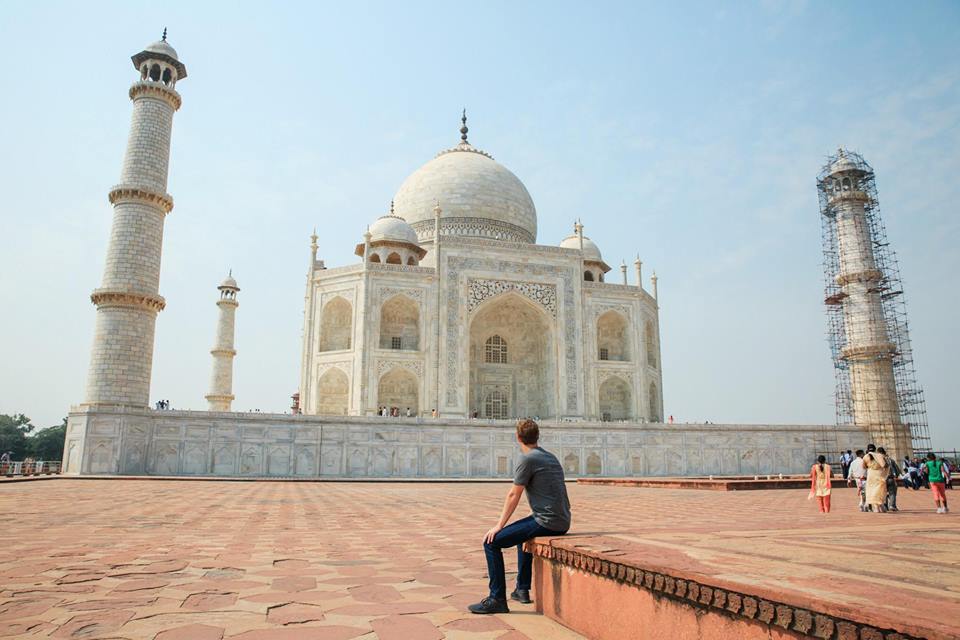
Facebook’s Mark Zuckerberg at Taj Mahal
I remember vividly the day my family decided to ‘purchase’ the Internet. I had spent a rainy morning at a friend’s birthday party at a theme park. We were having a raucous and enjoyable session aboard rickety bumper boats, which nowadays regulators would doubtlessly have forbidden children from riding on.
Suddenly, a hard knock hit my head down onto the steering wheel. Whiplash. Smashed porcelain tooth enamel. Crumbly white porcelain on black plastic is permanently etched into my memory. Horror, recoil and disgust.
The theme park staff’s primary concern was that they were not legally liable to pay for my injuries. They didn’t bother to offer any serious medical attention. My friend’s parents didn’t give a shit either, taking me back to their house and leaving me alone to wait for my own family to pick me up.
In a pre-cell phone era, the not-giving-a-shit friend’s family couldn’t reach my family. They were out. Waiting for my folks to get home and hear their answer phone messages, shock gradually wore off as agonising pain kicked in.
I can’t imagine my life today without the Internet: it would be less rich in experience.
Later, as the dentist began painstakingly reconstructing my front teeth, my parents very kindly offered to buy me something in return for my rather traumatic day. I told them I wanted the Internet.
My father decided to go with a well-regarded ISP called Voyager. When we eagerly inserted floppy disks Voyager sent over to ‘install the Internet’, we waited on a a loading screen that looked like an early 90’s computer game interstitial. A crudely pixelated epic rocket launch. Tragically, the loading screen repeatedly got stuck at 99%. A pain those familiar with computing of that era will understand.
I don’t remember when we first heard the dial up sound, but it changed my life.
The Internet taught me to code, play exciting games with my friends and allowed me to chat with girls after school.
It later enabled me to lead activist movements, move countries and gave me a career that has lasted nearly a decade.
I can’t imagine my life today without the Internet: it would be less rich in experience.
My story is not unique among those of us lucky enough to be born financially better-off, most likely in developed countries or large cities. Like any other new innovation, fatigue has set in on the revolutionary power of the Internet among existing users. For those of us who have benefitted so greatly from the Internet, we owe it to the world to make this technological privilege into a human right.
The importance of this mission comes into focus when we learn 90% of people in the world’s least developed countries do not have Internet access. While we debate manspreading & mansplaining on Twitter, hundreds of millions of women in the developing world are being left behind by a growing digital gender gap.





Stay updated on the go with our mobile app.
Get latest insights with smoother, more personalized experience through TIA mobile app.