Frank Hersey · · 4 min read
I spent a week in a Beijing startup, here’s what I learned

Beijing has a burgeoning startup scene, but what’s it like on the ground in these companies? How does the culture compare to startup hotspots elsewhere? I decided to go in and find out.
I spent a week at Grabtalk, a new WeChat and app-based personal assistant service that helps foreign tourists and expats in Beijing who don’t speak Chinese to do all those little things in life that are suddenly almost impossible. They arrange cars, buy things on Taobao and TMall and do anything else that crops up.
Grabtalk’s three founders are Chinese nationals two of whom got PhDs in computing in the States, the other in China, but chose Beijing as the location for their startup. They helped their first user in June 2015.
Arriving at the office on the 22nd floor of a smart tower in Beijing’s fashionable, foreigner-friendly Sanlitun area, I’m met by a roomful of young ladies. Some are recent graduates, some have several years’ work experience in various fields, but all are now trying out a startup. I recognise one, an operator with the handle ‘Hiatus’, from her WeChat photo. No fake profiles then.
It’s still quite early, meaning the foreigners of Beijing are not yet getting themselves into difficulty so the office is quiet. I’m shown around by one of the founders, Qian Haiyang.
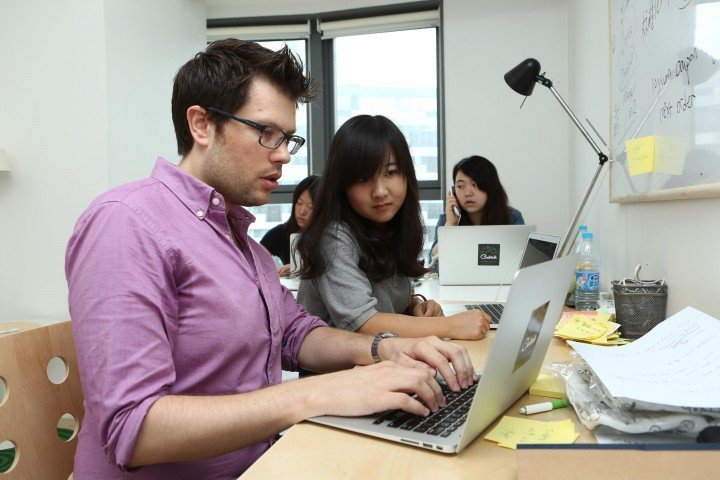
The aesthetic is familiar: white walls dotted with vinyls of Space Invaders, a statement sofa, an abundance of post-it notes. One thing stands out – rather than the Google-style chefs serving up West Coast fads, Grabtalk have a Henanese housekeeper, already busy on lunch. Qian Haiyang explains that there are two reasons. One: they wanted to recreate some of that Bay Area magic for workplace energy and sense of collaboration. Two: the restaurants around the office serve an oily mess.
Other startup-style little perks include a fridge packed with soft drinks, a couple of shelves of booze and a table laden with snacks. Facebook staff might not be sipping on cartons of sour plum juice or crunching through bags of jack fruit crisps, but who even uses Facebook anymore?
Why Beijing? Qian Haiyang explains “Because we see the expats suffering in their lives, especially, because we can feel that pain as we all have experience living abroad. And we are more familiar with Beijing”.
Most of the team work across several departments even joining the customer service operators when things get busy. We have a marketing meeting and everyone who’s not busy solving queries is invited. Gathered around the whiteboard it turns out that almost the whole team has studied abroad, so they’re equipped for dealing with foreigners’ whims.
After lunch the housekeeper sweeps under my feet as operator Chrissy takes me through website developments. Keeping up a constant monologue, the housekeeper refers to everyone as ‘children’ as she cleans up around us. She then gets on with making a mound of steamed buns as part of dinner – staff stay late to deal with Beijing’s lost, hungry and lonely foreigners.
I spend the next day with the customer operators, learning the ropes. Everyone works in pairs.





Stay updated on the go with our mobile app.
Get latest insights with smoother, more personalized experience through TIA mobile app.