C. Custer · · 3 min read
Wikileaks Cables Reveal China Upset By US Embassy’s Twitter Account
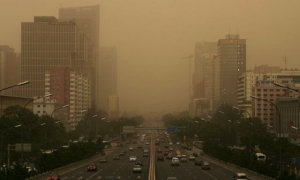
Ah, Beijing!
Back in June of 2009, Twitter was still unblocked in China. So when the US Embassy decided to release its own reports on the quality of Beijing’s air, Twitter seemed like a natural option. @BeijingAir was born. The service is familiar to almost all foreign residents in Beijing because it includes information about small particles in the air (PM 2.5) that can be very harmful to your health and is updated hourly. Official Chinese statistics are publicly updated less frequently, and do not include PM 2.5 readings.
According to a US Embassy cable from 2009 released by Wikileaks, China’s government was upset with the service because it conflicted with the official Chinese statistics, which was causing “confusion” and undesirable “social consequences.” From the cable:
According to Wang, the existence of the machine and the openness of the Twitter site are “not fair” to the Beijing EPB. He cited that the Twitter site’s consistent characterization in recent days of Beijing air quality as “unhealthy” or “very unhealthy” takes credit away from “all the progress” Beijing EPB has made in recent years in improving the city’s air quality. Wang added that the fact that the Embassy’s air quality data is not based on the Chinese-approved standards for measuring air pollution is not only confusing but also insulting, citing that the U.S. government would be similarly incensed if the Chinese Embassy in Washington were to do the same. Wang concluded by again urging that if data could not be limited to Americans only, the Embassy should identify a “compromise.” Ultimately, MFA would “hate to see” the bilateral environmental cooperation or even the overall relationship negatively “affected by this issue.”
The US Embassy responded to this request for “compromise” with diplomat-speak for “We’ll stop posting our data publicly when your public data stops sucking”:
[…] the Embassy’s primary interest is to make the information collected by the air monitor as easily-accessible by Mission personnel, family members, and Americans residing and traveling in Beijing as possible. Therefore, the Embassy has no position on non-American citizens also having access to the data, nor is the Embassy concerned with how others choose to interpret the information found on the Twitter site. The Embassy does, however, have a strong interest in “setting the record straight,” and ensuring that the public understands that mission health has always been and remains the primary motivation for the program. Furthermore, because the Embassy’s monitor only collects data in one location, it cannot replace or negate the information provided by the Beijing EPB. Finally, since the Embassy collects data on PM 2.5 and Beijing EPB on PM 10, and each is indexed differently, the two indices cannot and should not be compared. Therefore, until the Beijing EPB begins publishing PM 2.5 data (which they already have the equipment to collect) on a real time basis, the Embassy is not able to discontinue its program for monitoring PM 2.5 onsite
Needless to say, no compromise was made, and a month later, the issue became moot when Twitter was blocked in China, along with a host of other Western social networking sites. There was, of course, a larger reason for the mass blockages, but one wonders if this little incident didn’t also play a role in tipping the scales against Twitter.
Anyway, perhaps Twitter being blocked in China is for the best. If the government gets this upset about Beijing’s air being called “unhealthy”, we can’t imagine what their response would have been one day in 2010 when the pollution level exceeded the US Embassy’s measurement scale and caused @BeijingAir to tweet that the air in Beijing was “crazy bad”.





Stay updated on the go with our mobile app.
Get latest insights with smoother, more personalized experience through TIA mobile app.