- Insights This article was written by a TIA community member. Insights pieces undergo the same rigorous editorial process that newsroom-produced articles have.
 Pandu Sjahrir · · 6 min read
Why India and China could show the path for Indonesia to hit net-zero goals
Pandu Sjahrir is the Founding Partner of AC Ventures, a Southeast Asian venture capital firm investing in early-stage startups focused on Indonesia and ASEAN.
I recently visited Shenzhen and Bangalore, back to back. It was illuminating to see how the energy transition has been unfolding in these two major cities in Asia Pacific.
Both have a higher-than-average GDP per capita compared to their national averages. The GDP per capita of Shenzhen was US$25,000 last year, while China’s national average was around US$12,700 – local economists told me that Bangalore’s was over US$25,400 while India’s national average approached US$2,400.
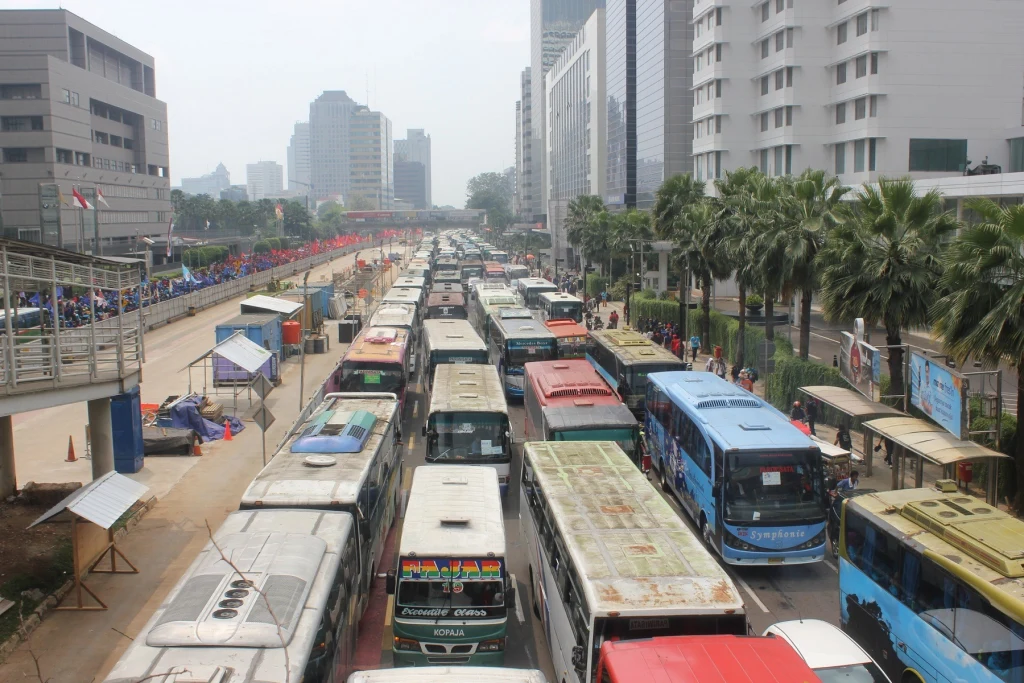
Traffic jam in downtown Jakarta / Photo credit: ajriya/123rf
Both cities also have rather special dynamics regarding electric vehicles. Bangalore, the wealthiest city in India, is expected to have 2.3 million EVs by 2030, up from 75,000.
Meanwhile, as of the end of 2021, Shenzhen boasted 20,000 electric buses, 24,000 electric taxis, and over 60,000 privately owned EVs. In fact, EVs made up 25 percent of the total private vehicles, with more than 250,000 on the roads. This number is projected to soar to 750,000 by 2025.
Jakarta, on the other hand, has a GDP per capita of about US$19,000, whereas Indonesia’s national average stood at almost US$4,800. The country’s EV penetration rate is a mere 0.2%, the vast majority of which is concentrated in Greater Jakarta.
Indonesia’s figures point to a huge opportunity, as the country gears up for a sweeping national energy transition. The country aims to achieve net-zero carbon emissions by 2060, an immense but not insurmountable goal.
Investments and directives
On the trip, I learned that while investments significantly influence the speed and direction of the energy transition, government directives are just as critical. This includes not just subsidies but also support for R&D. More importantly, it also includes restrictions on non-EV businesses to push adaptation on a societal level.
Although the Indonesian government has enacted a regulation for the early retirement of coal power plants, renewable energy accounted for only 15% of power generation in 2022.
In the transportation sector, while EV adoption has been on the rise, Indonesia is still far from reaching its target of having 400,000 electric four-wheelers and 1.8 million battery-powered motorbikes by 2025.
China emerged as the top country for renewable-energy related investments after spending US$546 billion in 2022 alone. As for India, it looks to allocate US$4.3 billion for the country’s energy transition, with more than half (US$2.4 billion) directed toward hydrogen production to reduce fossil fuel use.
Identifying linchpins
Indonesia has made steps in developing its domestic carbon markets, but significant efforts and more regulatory clarity are still required, including setting up a national carbon accounting ecosystem.
Such challenges pose a clarion call for entrepreneurs and aspiring founders to play an active role in helping Indonesia’s net-zero targets. But it’s not just about the founders – investors also need to recognize renewable energy, coal alternatives, carbon capture, and storage, carbon regulation and trading, and decarbonized transportation as industries of the future.
R&D incentives
Increase coverage of tax exemption for VCs in clean energy
Carbon trading implementation is key
Sticks and carrots





Stay updated on the go with our mobile app.
Get latest insights with smoother, more personalized experience through TIA mobile app.







📅 Upcoming Events
22 October 2026
Payoneer x CSPN Summit 2026