Cohan Sujay Carlos and I are hunched over his laptop at a coffee shop. At the end of a short USB cord sits a small green and black Arduino board.
The Arduino is processing the code that we’ve typed into his computer as input. Once we run the code, a few LED lights on the board flicker on and off. That Arduino can be connected to another object for the output to have different effects, like a bicycle jacket with arrows that light up when a driver signals left or right.
It’s not an odd sight for Bangalore, where metro stations double as labs for tinkerers. Arduinos, open source and affordable, can be an easy way to teach children about electronics. Artists use them to create interactive exhibits, and many use Arduinos to hack away at their own devices at home.
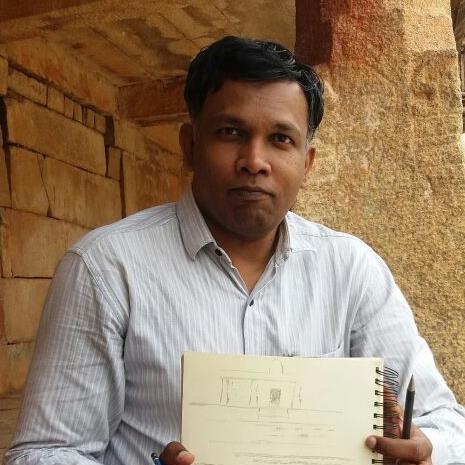
Cohan Sujay Carlos, founder of Aiaioo labs.
There is something a little different about what Cohan and I are doing, though. We’re communicating with the Arduino in Kannada, the native language of Bangalore.
Type bari in the curly Kannada script to generate the command for “write”. Ankiya replaces the command for “digital”. Users can also type in Hindi and Tamil. For Cohan it’s a project – one of many with his company, Aiaioo labs. But the project is a small step toward answering a larger question: how can those who don’t speak English keep up with programming?
A work in progress
The idea was sparked during a visit Cohan made to Tamil Nadu in 2009. There, he met a small startup that was using Arduino to teach children about robotics and electronics. The founder brought up an interesting point: most children didn’t speak English, making it difficult to grasp basic programming knowledge.
Cohan couldn’t get the conversation out of his head. When he returned to Bangalore, he worked with his team on a research paper on the matter. Then, they went in search of someone who would give his team money to work on the project. “Nobody would fund us,” he laughs.
Money did find its way into Aiaioo’s hands, but in Bangalore’s often casual fashion. While sipping chai at his favorite tea stand, Cohan saw a man wearing an Arduino shirt.
“I said, hey – are you a hacker or something?,” he recounts. “He said – I’m setting up an office in Bangalore.”
The two met up a few more times, and Cohan eventually got around to telling him about his work. “After hearing it, he said he’d be happy to help.” The Arduino team helped Aiaioo break and build out a code that fit the Arduino programming language.
Cohan describes the challenges they faced as necessary stepping stones to understanding how to translate code between languages. One – while words for the internet, computers, and coding descriptors have easily found their way into English, they’re still vague in languages like Kannada.
Take the command “analogWrite”. Running it will send an analog value to a pin, which can light up an LED on an Arduino board, or run a motor.
In Kannada, figuring out the word for “analog” was tough. There was ankiya, which meant digital. The natural inclination was to reverse it to make anankiya – as in “anti”-ankiya, or analog.
Before its time?





Stay updated on the go with our mobile app.
Get latest insights with smoother, more personalized experience through TIA mobile app.










📅 Upcoming Events
22 October 2026
Payoneer x CSPN Summit 2026