Pearl Lee · · 3 min read
How inbound marketing powered HubSpot’s journey from startup to scaleup

Silicon Valley is the cradle of many world-class startups and companies, but HubSpot’s humble beginnings came when Brian Halligan and Dharmesh Shah met as graduate students in Massachusetts Institute of Technology. They observed that consumers were becoming more intelligent at identifying and blocking out traditional marketing and sales tactics, such as cold calls and mail. Outbound marketing by companies was increasingly seen as spam rather than valuable information for consumers.
A new paradigm of marketing
HubSpot was created to solve this problem. Brian, who had been assisting venture-backed startups with their go-to-market strategy, identified that potential customers could go to companies when content is relevant and interests them. Brian is known as the “chief pothole prevention officer” in HubSpot for his skill at identifying problems in early stages. Rather than fighting for a potential lead’s attention (which is scientifically shorter than a goldfish’s), HubSpot’s philosophy is to let the leads come to you.
What is inbound marketing?
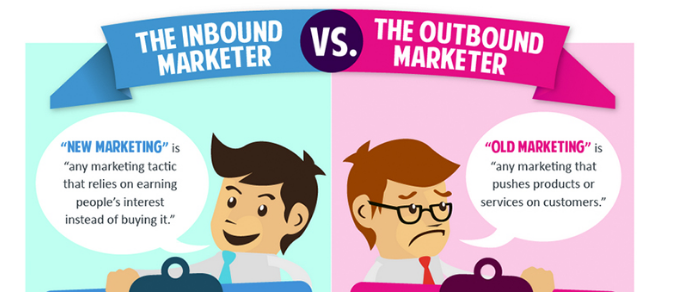
Photo credit: Voltier Digital .
Inbound marketing refers to content that anticipates and answers a prospect or a customer’s basic questions and needs. This content is then shared on channels permitted to disseminate this information – a marked shift away from interruption-based marketing like cold calls.
As the content is of high quality and aligns with the target market’s interest, companies are then able to convert an infinite number of prospects into leads and then, into loyal customers. This method has been proven effective. According to Gartner, the right inbound marketing tactics are 10 times more effective for lead conversion, compared to outbound methods. For example, by automating their lead nurturing cycle, companies are able to see over 10 percent increase in revenue within 6 to 9 months.
Inbound marketing can also double the average website conversion rate from 6 to 12 percent. Such leads cost 60 percent less than outbound leads, showing that it focuses on what customers want and therefore minimises waste.
Now, almost half of B2B marketers have a documented inbound marketing strategy. This shouldn’t come as a surprise, as 80 percent of business decision-makers prefer to be educated via a series of articles, i.e. content marketing, rather than an advertisement.
Impressive growth
Brian, a huge fan of naps and working from home on Wednesdays, has seen HubSpot from ‘start-up’ to ‘scale-up’ mode. HubSpot started in 2006 with just 3 customers. They grew its customer base to 10,595 customers (more than 3,500 times!) in a span of seven years. The growth was maintained in 2015: total revenue was US$181.9 million, up 57 percent compared to 2014.
HubSpot’s global expansion
HubSpot has five offices globally, with its recent launch in Singapore in Q4 last year. Brian believes in taking the time to “get the first office right”. Expansions were made responsibly but rapidly. With a growing reach in Asia, as well as extensive work experience in Asia (flying into Hong Kong at the age of 25 to grow a US$100 million business), Brian has unique insights on what makes businesses in Asia tick.
Hear from the inbound guru
And here’s your chance to meet Brian Halligan in the flesh at Tech in Asia Tokyo 2016. He’ll be speaking on Day 2 (Sept 7) at the Main Stage. In this session, learn how he built such a successful company, his marketing philosophy and his take on business opportunities in Asia.
Brian will be joined by other international superstars such as Jeff Jordan, General Partner at a16z, Dave McClure, Founding Partner of 500 Startups, Vinnie Lauria, Managing Partner at Golden Gate Ventures, and more.
Tickets to Tech in Asia Tokyo are currently on an extended 10 percent discount, only until 26 August. Use the code tiatokyo10 upon checkout – don’t miss your final chance!

Stay updated on the go with our mobile app.
Get latest insights with smoother, more personalized experience through TIA mobile app.
Recommended reads
 Zimplistic flips to a profit in 2021 after troubles
 10 predictions for SEA’s healthtech in 2023
 Market insights startup nets $1.5m seed money
 SEA food delivery spending tops $16.3b in 2022: report
 Don’t play nice: guerrilla marketing for SaaS startups
 Vietnamese B2B platform bags $1m in Touchstone-led seed round
 Why ‘too expensive’ is just a decoy for leaving customers
 Exclusive: RedDoorz breaks even in Indonesia, Philippines
 Yahoo to cull 20% of staff amid ads biz restructure
 Nasdaq-listed Freshworks posts 26% rise in Q4 revenue





Editing by David Corbin and Cheong Hui Min
(And yes, we’re serious about ethics and transparency. More information here.)