 Pledging itself as an easy-to-use home monitoring system, HomeCamera was borne out of M1’s R&D lab. Since then, the two founders Varun Arora and Li Yi have spun off the company into Pechora Technologies to commercialise HomeCamera. They have since raised about 200k so far and are looking to raise another round. We managed to grab Varun for an interview.
Hi Varun, thanks for agreeing to this interview by SGEntrepreneurs. What project(s) are you working on now?
For the next year or two, we’re 100% focused on building and enhancing HomeCamera. Our vision is to be recognized as the most pervasive, secure, and easy to use monitoring system in the world, and everything we’re doing now is towards the realization of that vision. We wake up in the morning and ask ourselves “what are we doing to ensure HomeCamera works with an ever-increasing set of devices and that it’s available to an ever-increasing set of users”.
How and why did the idea of HomeCamera come about?
It’s a story of recessions (2 of them!), serendipity, luck… ingredients for a Bollywood flick except that we didn’t have any ladies so we couldn’t quite run around trees and break into song… Unfortunately, the story’s as long as a Bollywood movie (hopefully it’ll have a happy ending too!).
The genesis of HomeCamera was during our days with M1. Li Yi (who’s our co-founder and CTO) and I used to work at Wireless Intellect Labs, which was an R&D subsidiary of M1. When MMS was being discussed – prior to its commercial introduction – someone at M1 said “it would be nice if a childcare centre operator – who doesn’t understand technology but hopefully understands something about children – could set up a webcam that parents could then access using SMS and MMS”.
We thought that was a clever idea, built a proof of concept that won us an award at a code camp in Beijing, and realized we were onto something. Our business model then was to build the core technology and license it to third parties for deployment. The dotcom bust happened around then (recession #1) and we found no one was willing to build on other people’s technology, given it was difficult enough for them to sell their own. So we generally put this aside, did some other work for a few years mostly on backend telco technologies.
Then, in 2007, we found that what we’d created in 2005 was still the easiest system out there! Blogs and AdWords were fast making it possible for a small company to build a global brand at an infinitesimal percentage of what it used to cost, so we said let’s build this, put it out there, and see what happens. We built an early alpha, made it available to folks, people started signing up, and we concluded HomeCamera had legs and was worthy of serious pursuit.
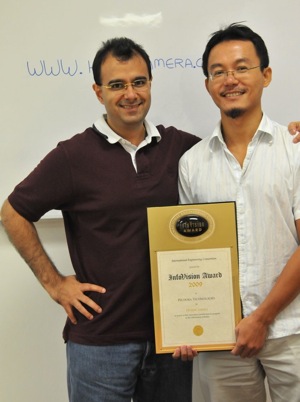
HomeCamera founders. From left: Varun and Li Yi.
What makes HomeCamera different from other home surveillance systems?
First, HomeCamera is -not- just a home surveillance system. While home users constitute the majority of our current target market, at its core, HomeCamera is a software as a service that makes it easy and affordable for non-technical “everyday” Internet users, worldwide, to monitor what’s important to them using the webcams they already own. Today, subscribers in 180 countries use the service to watch over their homes and families, their businesses, their children’s creches, and more.
The system is easy to setup (no technical knowledge required, no fussing about with the router), easy to use (we have retirees who’ve mastered the system), and very affordable, since it doesn’t require you to go buy a new $200+ camera. Just use the webcam you already own. And with over 250 million webcams in the market, that’s an awfully large addressable market. Especially when you factor in the freemium business model – our intention is to keep a Basic service offering free, always, to enable as many people around the world to benefit from HomeCamera as possible, while charging a very affordable sum (US$ 29.95 per year) for the Premium service with all the bells and whistles.
When you now put together ease of use and low adoption costs, you take away the adoption friction and enable all kinds of applications, from the serious to the marginal. With our technology rapidly getting to where we want it to be, the game is increasingly going to be about channels and distribution. Which is another area where we differentiate. While most people follow a Web-only distribution model, we think that’s not only suicidal but it also leaves WAY too much money on the table. The reality is, any business that’s Web-only faces serious threats from other Web-only startups that are absurdly well funded (and even in this economy, it COULD happen…).





Stay updated on the go with our mobile app.
Get latest insights with smoother, more personalized experience through TIA mobile app.