- Insights This article was written by a TIA community member. Insights pieces undergo the same rigorous editorial process that newsroom-produced articles have.
 Jeffrey Towson · · 6 min read
Huawei is digging in for a long fight, and it’s probably going to win
This was first published on the author’s blog. The article is a combination of parts three and four of a four-part series and has been heavily edited. Read more here.
Here are more of my takeaways from my visit to Huawei’s headquarters in Shenzhen. I got to talk with members of the company’s management team and tour some facilities, but the key event was the press conference where Huawei released its post-US export ban financials.
The firm put out its half-year revenue and operating profit numbers (no, they didn’t hide Q2). There have been a lot of press summaries on these, so I’m not going into the details. Essentially, 2018 had amazing growth in almost every geography. Q1 was great, and then Q2 was a pounding for international smartphone sales.
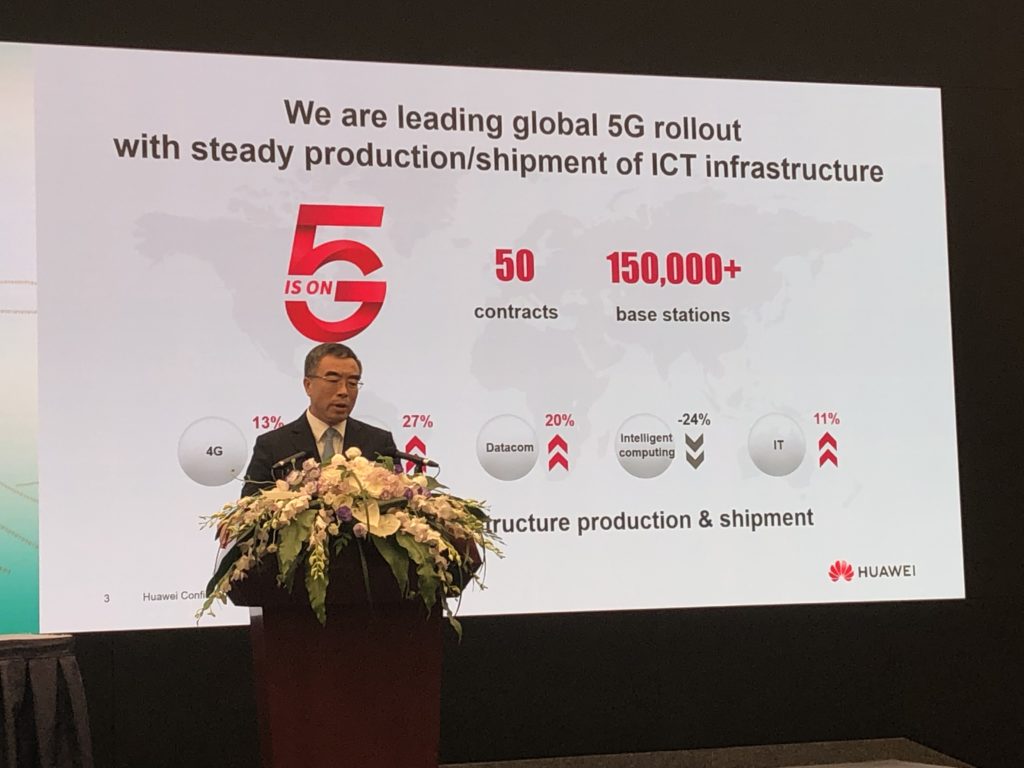
Huawei chairman Liang Hua presenting the numbers
The impact of the US export ban will become clear in the second half of 2019
I think it’s just too early to tell what the impact will be right now, as there are too many important things still in motion. This is going to mostly play out over the second half of the year.
But I do give Huawei’s management a lot of credit for its response to the US ban. The issue punched holes in the company’s supply chains – both for its carrier and consumer businesses – and created a lot of uncertainty with its customers. A sudden ban for all US technology was a big hit, and Huawei management has been rapidly working on the supply chain and customer trust issues.
The company has done what people hope all management does in such situations: it didn’t hide or downplay the problem or disappear and go silent. Huawei has spoken openly with all its stakeholders and the press about the situation and about what it’s doing as a response. That’s the most you can ask from management under fire.
Just 45 days after the ban, Huawei also released its financials, which it had no legal obligation to do as a private company. It stuck to its release schedule, had a press conference, and took questions live, which I believe it has never done before.
How many other companies would have done this? Do Chinese state-owned enterprises act this way? Did Wells Fargo do this after its fraud issues? Has Facebook ever behaved this way during any of its endless scandals? Huawei management should be applauded for how it’s responding to this problem.
I summarized my assessment of its business right now in four points:
Point 1: The carrier business appears to be doing fine in terms of customer trust, contracting, and supply chain.
The carrier business is the engine of Huawei, as consumer and enterprise businesses leverage the technology, stability, and cash flows of carriers. While smartphone sales are pretty volatile, and it’s a tough industry in general, it’s a nice business to sit on top of a more stable carrier.
At the press conference, Huawei management didn’t talk much about the carrier business. It said that 5G contracts are still being signed post-entity list, and the company is leading Ericsson and Nokia in 5G rollout.
Huawei founder and CEO Ren Zhengfei has since said that its production capacity for base stations will be lower in August and September (about 5,000 per month) as the company resets parts of its supply chain. But Huawei should be able to produce 600,000 5G base stations this year and at least 1.5 million next year, which means enough capacity for the global market.
Huawei is digging in for a long fight, and it’s probably going to win





Stay updated on the go with our mobile app.
Get latest insights with smoother, more personalized experience through TIA mobile app.








📅 Upcoming Events
22 October 2026
Payoneer x CSPN Summit 2026