 Minghe Hu · · 2 min read
Huawei, China Unicom to deploy 5G travel system at Beijing’s new airport
Huawei Technologies, China Eastern Airlines, and China Unicom have teamed up to jointly introduce a 5G-based smart travel system at the new Beijing Daxing International Airport, which is scheduled to begin operations at the end of this month.
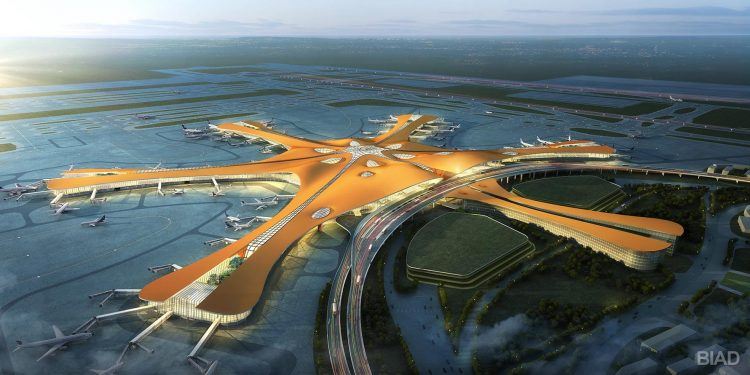
Beijing’s new Daxing International Airport / Photo credit: MA Long
Based on Huawei 5G technology deployed by China Unicom, the smart travel system will enable facial recognition for check-in and security clearance and provide a paperless luggage service. Field tests showed that the 5G speed exceeded 1.2 gigabit per second, about 100x faster than the current 4G system, according to a Huawei press release.
Passengers traveling with China Eastern Airlines can use face scanning to check in their luggage, clear security, and board the aircraft – all without the need to show an ID, hold tickets, or scan QR codes.
To use the paperless luggage tracking service, passengers apply for reusable RFID luggage cards that they use with their smartphones to log flight numbers and destinations before physically dropping off their bags. Travelers can then track the status of their baggage using the airline’s app.
“These services, delivered through the use of 5G, AI, and AR, set the standard for the new generation of smart airports. This makes the airport a new model for utilizing a 5G gigabit network in the civil aviation industry,” Huawei said in the press release.
The new Daxing airport will feature advanced surveillance technology to ease bottlenecks in security and immigration screening.
It is expected that identity verification will be carried out by cameras that match the user’s appearance to a national ID database. Using computer vision, airport authorities will also be able to match users to their belongings so unattended baggage can be identified and assessed for security risk.
China is pushing for the adoption of smart city infrastructure as it seeks to improve the quality of urban life and ramps up competition in AI technology with the US. In 2017, there were more than 500 Chinese cities using AI technologies in transport, security, and finance, according to state media Xinhua.
Huawei, the world’s largest supplier of telecom equipment and a pioneer of 5G technology, has taken part in more than 60 smart-city projects in China where 5G, cloud computing, and internet of things technology were deployed, according to the company’s 2018 annual report.
Daxing airport is expected to become the world’s busiest airport, with the capacity to handle 45 million passengers by 2021, scaling to 72 million by 2025, and 100 million by 2040. Located south of Beijing, the airport site encompasses 47 square kilometers (18 square miles).
The airport was designed by legendary Iraqi-British architect Zaha Hadid, who died in 2016 before she was able to see the project come to fruition.
Visit SCMP.com for the latest China tech news.
Copyright (c) 2019. South China Morning Post Publishers Ltd. All rights reserved.





Stay updated on the go with our mobile app.
Get latest insights with smoother, more personalized experience through TIA mobile app.









📅 Upcoming Events
22 October 2026
Payoneer x CSPN Summit 2026