 Terence Lee · · 8 min read
Cynical investors balked at accelerators in Asia. Here’s how JFDI got started anyway

A few names come up when you think about startup accelerators in Asia. In the region’s two biggest countries, we have India’s GSF Accelerator and Chinaccelerator in Shanghai.
Southeast Asia’s flagbearer is the Joyful Frog Digital Incubator (JFDI). The accelerator has accepted 38 teams so far, and over 60 percent of its teams from the first batch went on to raise an average of US$550,000 within six months of the program ending.
But not long ago, JFDI was just another idea percolating in the minds of two guys: Hugh Mason, a Briton from the broadcast media world, and Meng Weng Wong, an eccentric geek with a string of startups to his name.
They did not hop right in. Hackerspace.sg, a coworking space and enclave for geeks started by Wong and a few other guys, served as a sort of proof-of-concept and nurturing ground for JFDI.
Wong believed that Singapore’s tech community cannot grow to a critical mass without a physical space for engineers to mingle and collaborate.
“The conversations we had and the fantastic friends we made [at Hackerspace] were hugely important in giving us the courage to try doing an accelerator,” writes Mason in JFDI’s discussion forum. The duo incorporated JFDI as a company in January 2010.
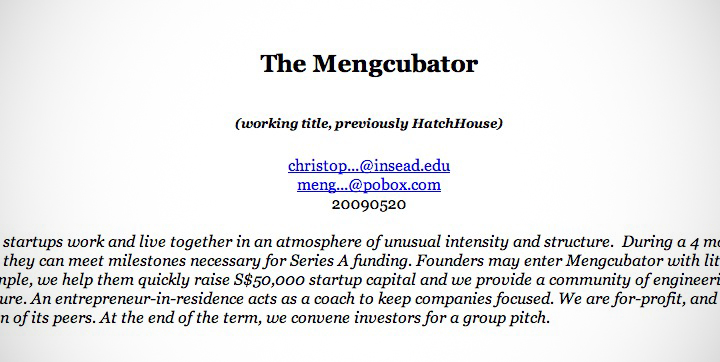
An early discussion on a proto-JFDI. Click to view.
Accelerator? What’s that?
The pair struggled with fundraising from the onset. Few people knew what an accelerator was, and Asian examples weren’t forthcoming. Call it a classic case of bringing a Western business model to the Eastern frontier, with all the usual worries about supply and demand (are there enough quality startup teams?), timing (is the market ready for an accelerator?), and localization (would a Techstars model work in Asia?).
Yet scaling an accelerator poses challenges. While software startups have little marginal cost for every copy of an app produced, shaping a group of naive dreamers into startup warriors is bone-crushing and labor-intensive work.
“Investors were rightly cynical about an unproven, complicated model – they could see that it had a hell of a lot more moving parts than just bunging some startups in a shitty old space and throwing in pizza once a week with a speaker,” says Mason.
Other challenges threatened to torpedo the idea. Mason and Wong were unsure if they could “match world-class mentors with great local teams and to create enough engagement to make that worthwhile for both sides”.
Identifying mentors is easy, but figuring out if enough potentially great entrepreneurs exist in Asia is harder. Given Singapore’s tiny population of six million, the duo made JFDI a regional play from day one. But Asia is a big, mysterious land. Mason says:
Guiding star
Boom time
Infants
Too early?





Stay updated on the go with our mobile app.
Get latest insights with smoother, more personalized experience through TIA mobile app.







📅 Upcoming Events
22 October 2026
Payoneer x CSPN Summit 2026