 Vanessa Tan · · 13 min read
App Annie: Growing a Beijing startup into a global brand in 3 years

If you ask what’s a startup to watch here in China, I gotta admit App Annie is one of the first that comes to mind. It is probably one of the few companies founded in Beijing by a group of expatriates that has yielded impressive results, and gone global within three years. In fact, my colleague Paul and I were at the China-Axlr8r’s Beijing 10×10 event, where one of the speakers shared in his slides that many of us might not even realize that App Annie first started in Beijing.
We all know simply starting a business isn’t a bed of roses, never mind navigating China and getting it out into the international market. So how did App Annie do it? We spoke to the company’s VP of marketing, Oliver Lo, who is part of the founding team at the mobile app data company.
Tell us a bit about how the company has developed since it opened up shop in 2010?
Oliver: Our vision at App Annie has always been to create the ultimate business analytics and intelligence platform for executives in the apps and digital goods industry. We launched the first free store analytics product of its kind and have been very aggressive with our freemium business model, offering most of our services completely for free. As you can see from our milestones below (see addendum), the direction of our growth has been to launch more products and features across all the commercially viable app stores. We’ve also opened new offices in all the regions where our customers exist so that we can provide a truly global service with local experts, in terms of analysts and customer success managers.
What were the major challenges?
Oliver: I think most entrepreneurs always find scaling the biggest challenge and the area where you need to invest the most in order to succeed. This takes place in a few ways:
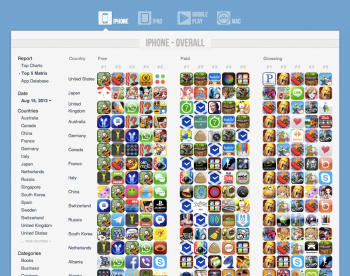 First, scalable technology is of utmost importance to us at App Annie. As a data company, you sometimes [have] to pick between launching new features versus scaling your platform. And even when the temptation is to go with a new feature every time (because of the instant gratification you get as a product manager for launching a new feature to users), we’ve invested a significant amount of our resources to make sure we have a scalable platform, best-in-class technology, excellent performance, and the most rigid security within our space.
Second, scaling quality talent is tough wherever you are. We’ve opened up offices all over the world to make sure we can get the best talent wherever they are. However, I’d say sourcing talent at high quality and sufficient velocity has been our biggest challenge. The one or two times we’ve ever lowered our bar, we’ve instantly regretted it, and so we’ve kept that bar high, which in some cases can mean we’re wading through a lot of candidates before making a hire. For some positions we have as high as a 200 to 1 candidate-to-hire ratio.
Third, scaling infrastructure and process is vital. When you’re a 10-person startup, you’re unstructured and nimble, and it works well because you all sit in this one room making products and high-fiving each other when you ship something. By the time you’re 100 people across three continents, you need to have developed efficient working processes, team responsibilities, IT infrastructure, project management tools, and HR benefits amongst other things. And you know that if you don’t invest in these things, your business’s growth cannot accelerate. We’ve made larger investments here than most, partly because we’re a global startup and rely on global infrastructure.
How did the team overcome setbacks and challenges?
Oliver: I think we’ve been relatively fortunate compared to most high-growth companies – our growth has been fairly straightforward because we hit the right space, early on, when there was a clear demand for our products. I’d say the biggest challenges and setbacks have always been in hiring. There were some positions early on where we missed out on candidates or were recruiting for a role for many many months. Outside of the business itself, recruiting has been one of the most important things we’ve focused on. And now we’ve built a much more scalable hiring infrastructure – but early on, yes it was real tough.
So the success behind App Annie and its rapid expansion efforts is getting it right in scalable technology, quality talent, and infrastructure?





Stay updated on the go with our mobile app.
Get latest insights with smoother, more personalized experience through TIA mobile app.








📅 Upcoming Events
22 October 2026
Payoneer x CSPN Summit 2026