 Glenn Kaonang · · 6 min read
The hidden data crisis in robotics
Welcome to The Prompt, your Monday dive into the world of AI that puts Asia front and center. From Big Tech’s power players to the region’s scrappy disruptors, we cover it all. Want full access to all our AI reporting? Subscribe to us here.
Hello reader,
Think about the last time you grabbed your coffee cup. You didn’t consciously calculate the distance, lighting conditions, or grip strength needed, did you? Your brain just … did it.
Vision isn’t something that’s learned – it’s something that many are already born with.
Now imagine teaching a robot to do the same thing. Suddenly, grabbing that cup becomes incredibly complex: What if the room’s lighting changes? What if there’s a shadow? What if someone left the window open?
Engineers at Hand Plus Robotics in Singapore learned this the hard way. They were filming training videos for visual language models (VLMs) – the robotic AI equivalent of large language models (LLMs) – when an open window let in morning sunlight. The shadows it cast completely “blinded” the robot they tested the data on.
In the end, the entire dataset had to be scrapped.
That’s the challenge that robotics companies face today, and it’s far messier than anyone expected, as my colleague Scott Shuey details in this week’s top AI feature from us. Teaching robots to do a basic manipulation task requires up to 50,000 images, with that number going up when multiple objects are involved.
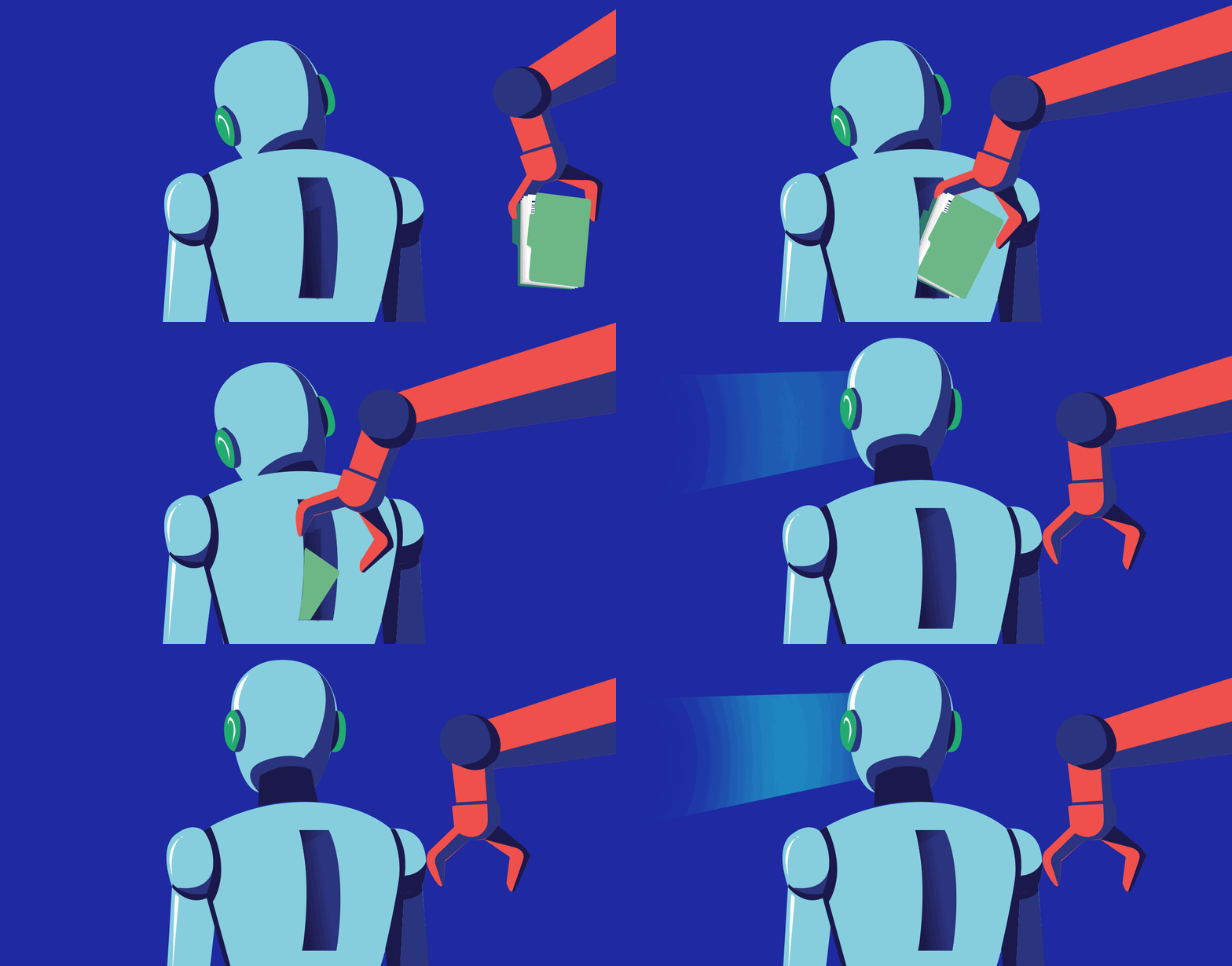
Image credit: Arsal Ysfin
But not all robot tasks need to be that sophisticated to be useful.
This edition also features QuikBot, a Singapore startup that has found success by keeping things simple. Their delivery robots don’t need dexterous manipulation. They just need to navigate buildings, call lifts, and drop off parcels at smart lockers, with human staff still handling the tricky bits such as loading the parcels.
Also in this issue: a laundry-folding humanoid robot and OpenAI’s push to turn ChatGPT into a super app. Plus, new research shows that a tiny AI model can outperform billion-parameter LLMs by thinking recursively instead of scaling up.
From robots struggling to see shadows to tiny models outthinking giants, one thing is clear: AI’s hardest problems aren’t always solved by throwing more compute at them.
Glenn Kaonang, journalist
TOP AI READS FROM OUR DESK
WHAT WE THINK
STANDOUT AI DEALS
RESEARCH SPOTLIGHT





Stay updated on the go with our mobile app.
Get latest insights with smoother, more personalized experience through TIA mobile app.








📅 Upcoming Events
22 October 2026
Payoneer x CSPN Summit 2026