- Premium Content It takes our newsroom weeks - if not months - to investigate and produce stories for our premium content. You can’t find them anywhere else.
 Jamille Tran · · 4 min read
AI race in Vietnam heats up as more tech giants join the bandwagon
Almost everyone around the world has heard of ChatGPT, the large language model developed by US-based OpenAI that can generate human-like text based on the inputs given to it.
Over in Vietnam, a new generative model series called PhoGPT is making waves. Named after the traditional noodle dish, it is pre-trained specifically for the Vietnamese language.
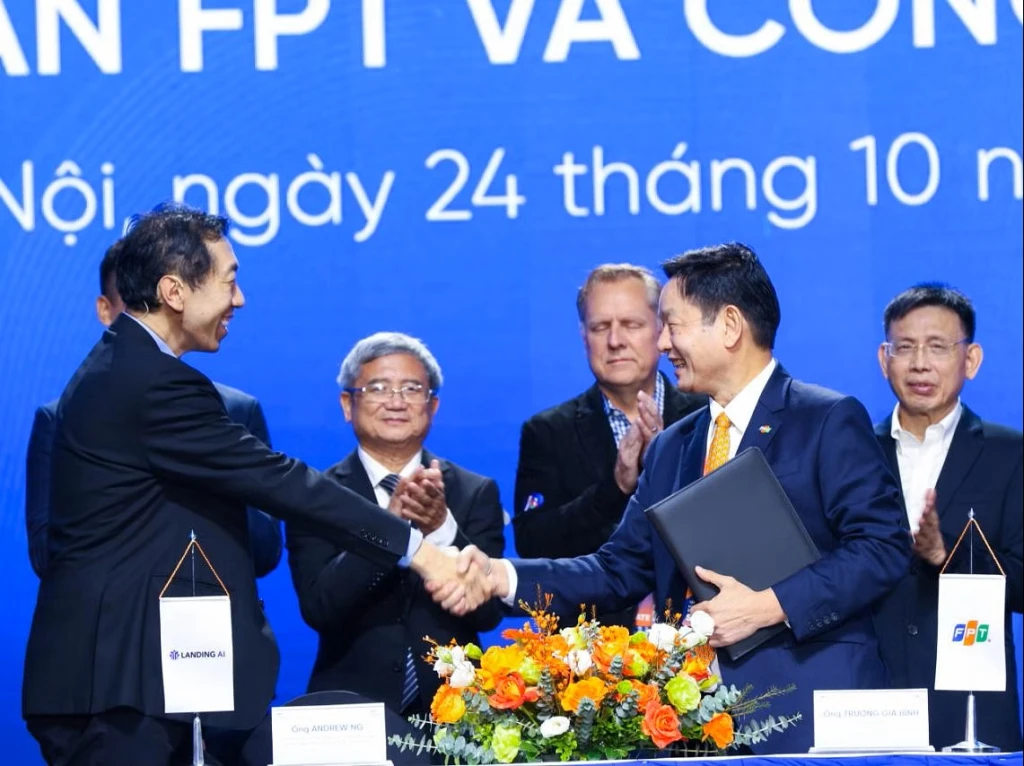
Vietnam’s FPT has been collaborating with US software firm Landing AI to implement computer vision solutions for global clients in industries such as automotive and manufacturing. / Photo credit: FPT
PhoGPT – introduced on November 7 by VinAI, the AI research arm of private conglomerate Vingroup – is the latest example of how Vietnamese companies are riding the global AI bandwagon.
Earlier this year, VinBrain – an AI healthcare software company also funded by Vingroup – announced partnerships with Stanford University and Microsoft to train and cross-validate AI models to increase the accuracy of diagnostic imaging for patients.
IT services provider FPT, consumer conglomerate Masan Group, and tech unicorn VNG are among the other Vietnamese names also betting big on AI.
In February, Masan announced an investment of up to US$105 million in Trust IQ, the Singapore-based firm that owns credit scoring platform Trusting Social. The investment is part of Masan’s goal to expedite its application of AI in the retail and consumer space.
As for VNG, the company in a US Securities and Exchange Commission filing in August said that its building large language models specifically for Vietnamese users. These are based on open-source codes from US tech firms.
Meanwhile, FPT has been working with US-based computer vision platform Landing AI to create models that can implement domain-specific solutions for industries such as manufacturing and automotive. In October, the two firms announced a new strategic partnership that aims to train Vietnam’s AI workforce.
Capital-intensive industry
The AI race in Vietnam is one that analysts believe only a handful of companies can realistically compete in, given how it requires extremely deep pockets and the ability to handle large amounts of data.
For instance, VNG owns the popular messaging app Zalo, which is used by about 75 million people in the country – more than Facebook Messenger. VNG itself has about 150 million users globally across its range of services and products, which includes game publishing, music sharing, and mobile payments.

Image credit: Timmy Loen
Even with this advantage in large data sources and user bases, VNG chief executive Le Hong Minh said last month that AI projects are costly endeavors and carry “significant financial risk.”
Open-source software is key
Stay ahead in Asia’s tech landscape
This is premium content. Subscribe to read the full story.
Analysts believe that only a handful of companies can compete in the AI race in Vietnam as it needs large capital and data handling requirements.
We know this is not ideal. ⌛ Sign up in 20 seconds. Cancel anytime.
Our subscriber community includes professionals from these companies:





Stay updated on the go with our mobile app.
Get latest insights with smoother, more personalized experience through TIA mobile app.