 Winston Zhang · · 6 min read
What it’s like to be the head of people in a fast-growing Southeast Asian startup

This article is part of “Women in Focus,” Tech in Asia’s campaign for International Women’s Day 2021. Through this initiative, we’re shining the spotlight on women making waves in Asia’s tech and startup ecosystem.
Southeast Asia is an incredibly diverse region. With a population of over 670 million people, hundreds of ethnic groups and languages exist.
In the context of business, however, a Boston Consulting Group study found that only 58% of companies in the region have put diversity and inclusion (D&I) programs in place, compared with a global average of 96%. More than half of all employees surveyed also indicated that they would consider leaving their companies for a more inclusive one. The estimated cost of replacing those workers is more than US$25 billion a year.
Add that to the fact that greater diversity has been correlated with better overall business performance and it’s particularly imperative for businesses in Southeast Asia to establish D&I policies.
“When you’re working in a more diverse group, the dynamics are great and the ideas just flow so much more easily,” says Melody Chen, head of people at Singapore-headquartered fintech startup Aspire. “Through my various experiences doing my MBA, working at McKinsey, and being an entrepreneur, I’ve interacted with people from over 50 different countries and learned about so many different viewpoints I’d never thought of before.”
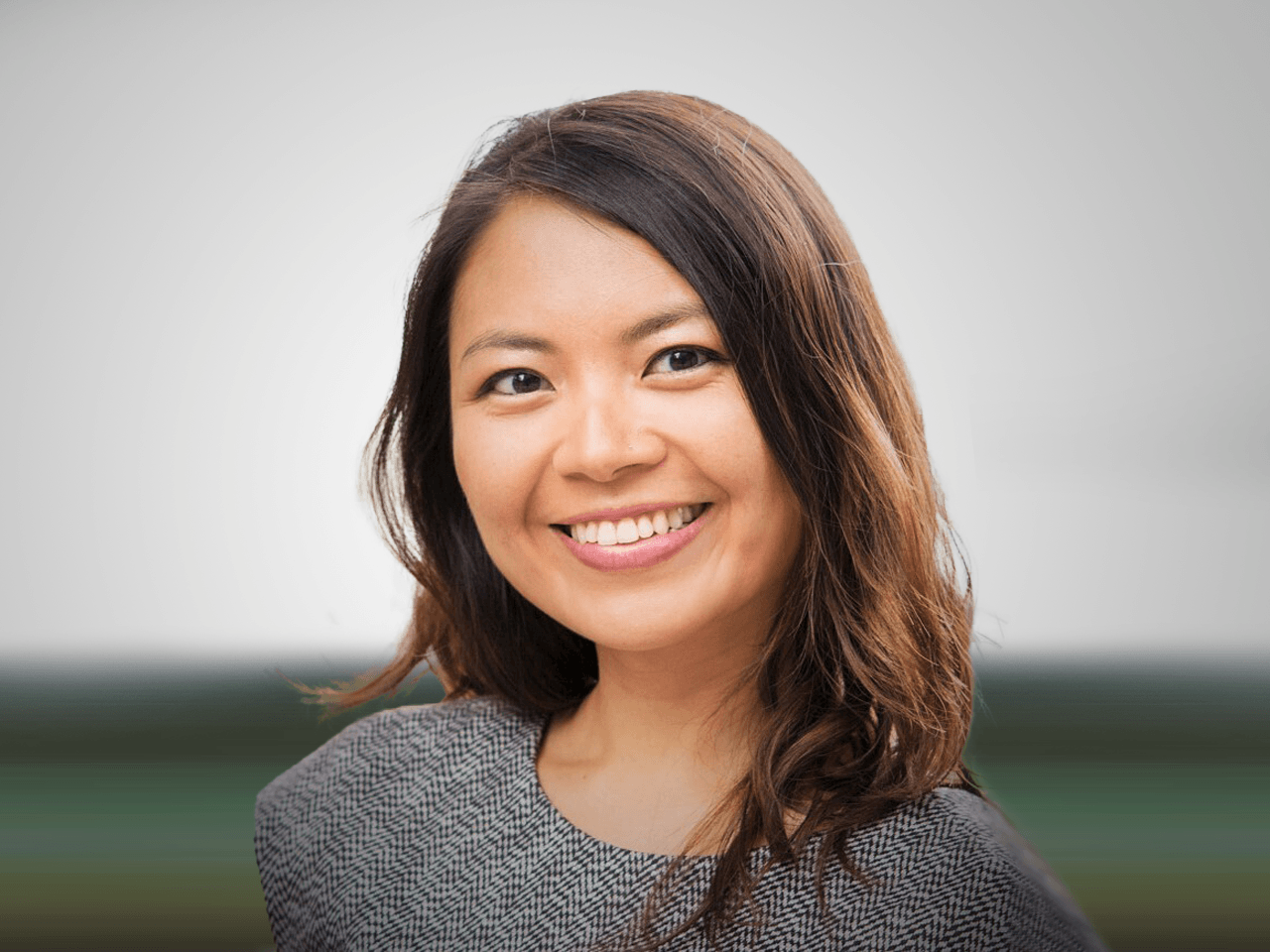
Melody Chen, Head of People at Aspire / Photo credit: Aspire
Chen, who has had over a decade of experience in the human resources field, says that it’s important to create an environment where people feel comfortable and encouraged to share their thoughts, adding to the diversity of ideas and spurring innovation. This is something that she’s working to encourage and maintain at Aspire, and it’s the product of many daily responsibilities.
Here’s a look at what those day-to-day activities look like from Chen’s point of view.
A day in the life
7:00 a.m.
“I have to start each day with a coffee,” says Chen. “Then, I try to fit in a short workout. Usually, it’s yoga and some meditation, which really helps to refresh my mind.”
She follows that with a quick check of the agenda for the day or week ahead – prioritizing tasks is a priority.
9:00 a.m.
The start of the work day is the beginning of what is usually a gauntlet of meetings for the head of people. “Typically, my day will consist of a lot of calls with the team and candidates – I do a lot of hands-on work in hiring, especially for the senior roles,” she says.
Aspire puts an emphasis on hiring individuals who have an entrepreneurial spirit, which means that it gets a lot of candidates from non-traditional backgrounds. As a result, the hiring process is often focused on having conversations with applicants to really find out more about them, instead of just ticking off a list of skills and experiences.
“By not taking a ‘check the boxes’ approach to interviewing and hiring, it gets our people to have an open mind about how the candidate can help the company,” says Chen. “In this way, it encourages hiring managers to discard some subconscious biases.”
She also has regular meetings with various crews from across the organization, ranging from her own team to the product and engineering departments. “It’s an ongoing process to understand the various aspects of the business, as well as to keep tabs on how people are feeling,” Chen explains. “Additionally, having a female viewpoint is very important to help add awareness and diversity to every discussion.”
12:00 p.m.
Lunch is obviously important, but since Aspire has employees based in Indonesia, Vietnam, Thailand, and other locations, time differences mean that some meetings may take place during this time as well.
“With the hybrid remote working setup we have, we’re working on initiatives to build and maintain bonding despite the geographical distance between team members,” Chen says.
1:30 p.m.
As part of their initiatives, Chen and her team also work on projects to further the cause for diversity at Aspire and create a better experience for its employees. One example is the “CEO Coffee Chat” program, which gives staff a chance to speak casually with leadership. Chen is also investigating how the company can upgrade its benefits, such as leave policies, across the region.
Opening the door to speak informally with management is part of a larger push to encourage employees to speak up and share their views – an issue that many women in the workplace face.
Aspire also provides speaking opportunities to its employees at its regular town hall meetings. “I’ve found that, once [people] have that experience of speaking in front of their colleagues, it lowers the barriers and they don’t feel it’s that difficult to speak up anymore,” Chen says.
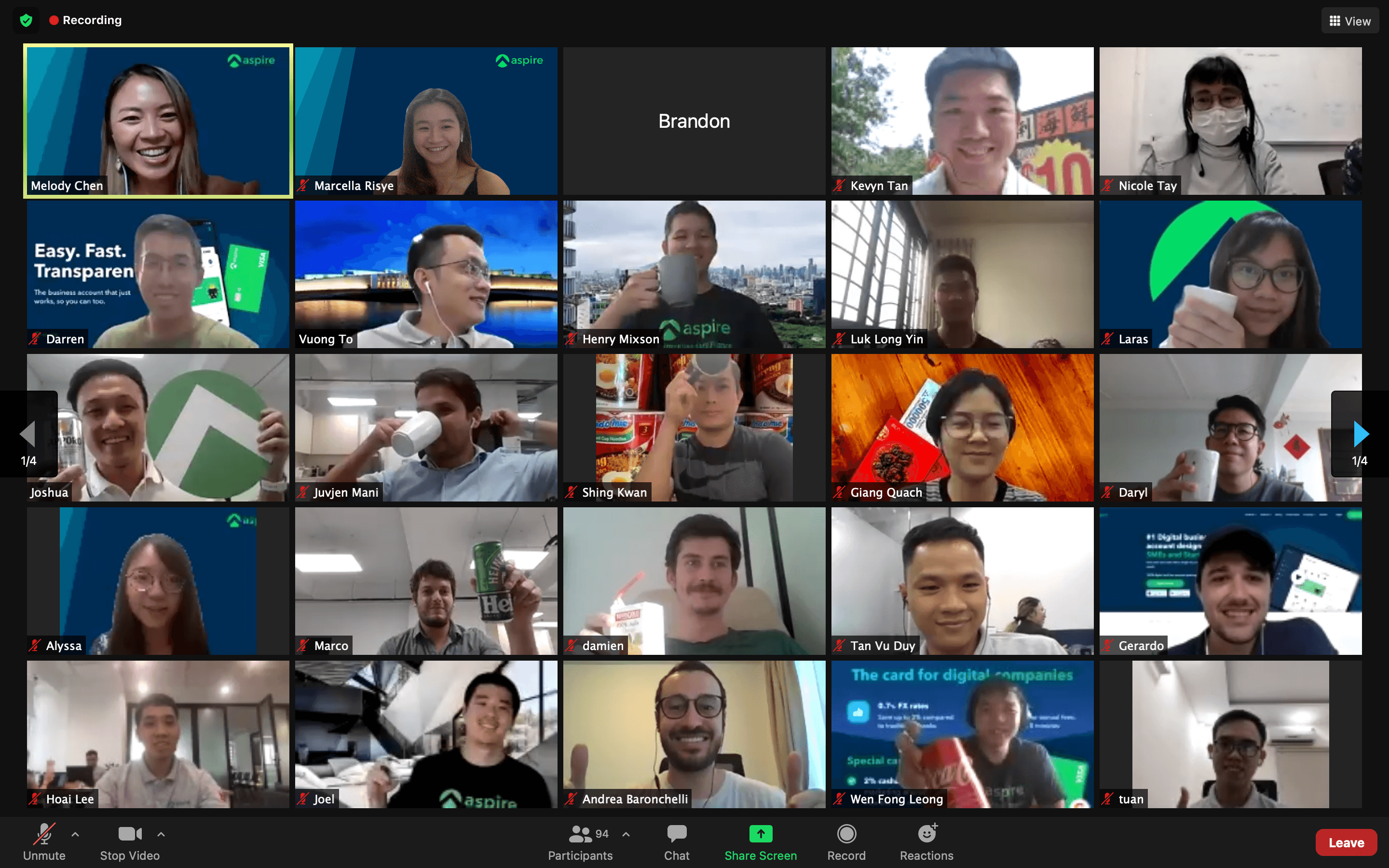
Chen spends a lot of her day on team calls / Photo credit: Aspire
She and her team are now working on a guide on how to manage people in the startup context – something that’s important, as founders and leaders of startups in general have different work cultures from most corporate setups. People management, while not disregarded entirely, isn’t usually a top priority.
“For example, hiring the right people that meet the needs of the company, regardless of gender, in an environment where the supply of female talent is low is something managers need to learn more about,” says Chen, referring to the relatively low number of women taking tech majors in university. “There’s also a need for guidance in areas such as having difficult conversations with employees. We want to raise awareness and shape certain behaviors through this guide.”
The document is currently tailored to Aspire’s needs, but if it proves useful, Chen has plans to adapt and share it with the wider startup community.
6:00 p.m.
After work, Chen participates in hobbies such as dance and capoeira classes 2x to 3x a week.
On other days, she takes the time to coach people from the younger generation and give them some guidance on what they’d like to do in their careers.
“In discussing diversity, I think it’s important to encourage people to do what they like. If a woman wants to go into a STEM field, they should pursue that passion,” Chen says. “It’s key to provide them with role models to look up to and let them know that they can play any and all roles they wish to.”
10:00 p.m.
Chen ends the day with another quick check of what’s on the agenda before trying to get some reading done. However, between her hobbies and mentoring, she’s usually back home too late to do so. “I typically go to bed around 12:00 a.m. or 12:30 a.m.,” she says.
A multilayered problem
Having worked in the startup scene for the last couple of years, Chen has observed that the diversity issue in tech startups is the product of several different factors. In the first place, attracting and retaining good talent iis difficult due to the lack of brand name or monetary compensation that startups can offer. For these companies, time is also of the essence, so there’s usually a rush to quickly bring in anyone who can do the job.
With the tech talent pool largely populated by men, hiring for gender diversity becomes even tougher. However, Chen remains optimistic. Although it might take a bit more time, she doesn’t feel that there’s a conflict between hiring quickly to solve business problems and building a diverse workforce.
“It’s important to have the awareness to start with. I think that’s really the key or the foundation to any change,” she says. “If we’re consciously aware that we want and have to have a diverse staff, then this pushes us slowly in the direction we want to go. The challenge is not small, but I think eventually, in this way, we can get there.”
Aspire provides business owners in Southeast Asia with the financial tools to solve their cash flow management and working capital needs. It believes that if it can empower business owners to be successful, they can go on to make an impact on the communities that everyone is a part of.
Find out more about how Aspire helps startups in the region on its website.
This content was produced by Tech in Asia Studios, which connects brands with Asia’s tech community. Learn more about partnering with Tech in Asia Studios.
Stay updated on the go with our mobile app.
Get latest insights with smoother, more personalized experience through TIA mobile app.
Recommended reads
 Building a human capital operating system for students
 A startup’s guide to labor laws and compliance for remote teams
 A startup’s guide to performance management in a remote-work environment
 A startup’s guide to establishing an efficient remote-working culture
 I shut down my Web3 startup. Here’s what I learned (part 2)
 Crypto.com slashes 20% of global workforce
 Pandu Sjahrir, Indonesian tech’s power broker, on his next act: energy transition
 What it’s like to work at one of the world’s best retirement systems
 AppLovin CPO on how renting AI can be a waiting game
 A startup’s guide to recruiting and retaining remote talent




Editing by Nathaniel Fetalvero and Jaclyn Tiu
(And yes, we’re serious about ethics and transparency. More information here.)





📅 Upcoming Events
22 October 2026
Payoneer x CSPN Summit 2026