 What’s next for Groupon after rejecting Google’s $6 billion mouth-watering offer? ‘More expansion’ is the answer. Groupon has recently acquired 3 group-buying sites based in Singapore and Taiwan and is looking to expand to larger markets in Asia.
“We’ll continue to expand geographically and on the subscriber front,” Rob Solomon, Groupon president and chief operating officer, told Ad Age. Mr. Solomon says Groupon is analyzing the best way to enter China, India and Korea and that the Middle East is also a likely region.
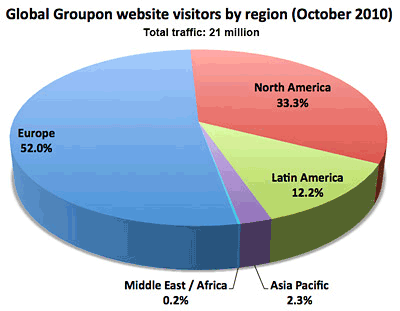
The decision to focus on Asia is largely motivated by its lack of presence in the East. According to comScore data, Asia Pacific only accounted for 2.3 percent of Groupon’s web visits in October. At 0.2 percent, Middle East contributed least to the pie chart.
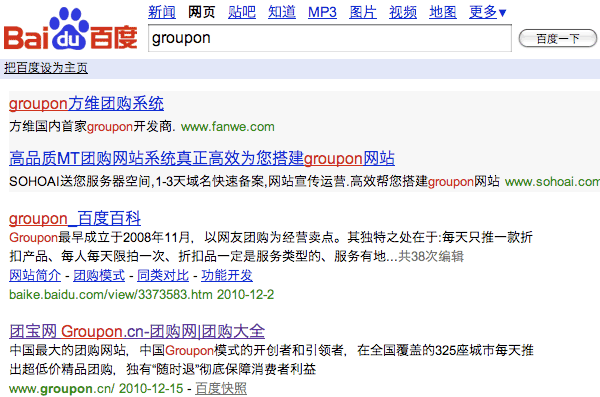
Moving fast and establishing itself early in these markets is also a way to curb the ever-growing number of copycats found in Asia. Groupon.cn, for example, had blatantly copied Groupon’s name and design. If you were to conduct a ‘Groupon’ search on Baidu (China’s most popular search engine), Groupon.cn appears second on the search results. Groupon.com is nowhere on the list.
As you would have guessed, Groupon.cn isn’t the only group-buying site. Taobao is another popular group buying site in China. A couple of months ago, Benz ran a campaign on Taobao, which saw them sold 200 cars within 4 hours. The campaign also attracted more than 300,000 visitors. Looking on the bright side, these copycats proved that Groupon’s business model works in China.
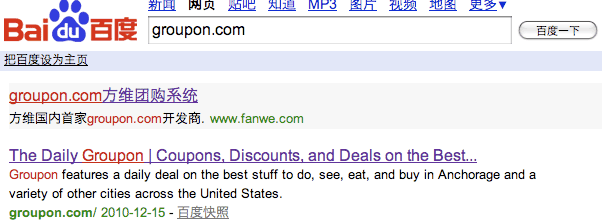
Another positive note for the team is that Groupon.com isn’t banned in China. As shown above, Baidu still indexes the Chicago based website. Compared to Facebook and Twitter, which both are banned, Groupon is one step ahead to capturing the China market. Groupon probably agrees with Google that China is sooner or later the heart of the Internet.





Stay updated on the go with our mobile app.
Get latest insights with smoother, more personalized experience through TIA mobile app.











📅 Upcoming Events
22 October 2026
Payoneer x CSPN Summit 2026