Paul Bischoff · · 12 min read
WeChat’s growing empire: Here’s everything Tencent invested in or acquired in 2014
Tencent is China’s second-biggest internet company, recently stripped of its number one spot by Alibaba. It’s also one of the country’s most active venture capitalists. While Alibaba made headlines with massive investments into big established companies, Tencent got down and dirty with early stage investments into nascent startups.
Not that Tencent didn’t get its fair share of eye-popping deals. Tencent participated in nearly three dozen funding rounds this year alone, about half of which were seed, series A, or series B rounds. That’s an average of three investments per month. Here they are, in roughly chronological order according to ITJuzi‘s database and our own archives:
Futu
This fintech startup makes real-time trading apps for stock market investors, a financial news site, and forums for financial experts. Futu received a vague “tens of millions of RMB” from Tencent in January.
China South City
This Hong Kong-listed corporation develops and operates large-scale logistics and trade centers throughout China. It moves everything from raw materials to finished products. Tencent invested huge sums in China South City twice this year: HKD 1.5 billion (US$193 million) in January and HK 800 million (US$103 million) in September. Tencent now owns a 13 percent stake.
Didi Dache
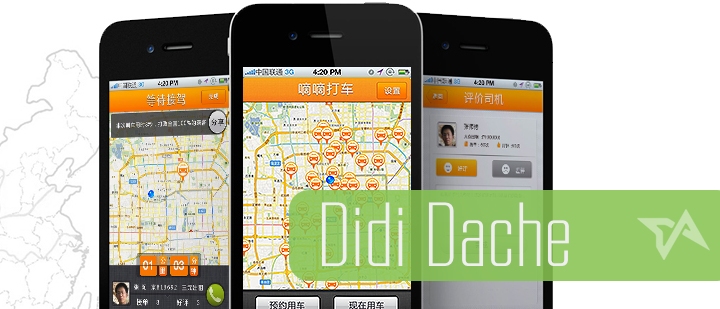
This series C funding in January was also the first of two huge consecutive investments this year. The taxi-hailing app secured US$100 million to power it in a ferocious battle with Alibaba-backed rival Kuaidi Dache to win over the Chinese market. Neither has backed down, and Tencent just injected another US$700 million in December, making Didi the second-most-funded taxi app in the world after Uber.
Renrendai

Trustbridge Partners and Tencent split the cost of this peer-to-peer lending site’s US$130 million series A funding round in January. That’s right – series A – the biggest series A in China for the entire year that we know of. Dozens of competitors like Edai, PPDai, and Dianrong have since come out of the woodwork to try and grab a slice of China’s lucrative and fast-growing P2P lending market, but Renrendai remains one of the biggest.
Linktech Navi
Tencent acquired Linktech Navi around the same time Alibaba offered to buy a majority stake in Autonavi. The online mapping and navigation firm was purchased by Tencent for an undisclosed sum in January.
Mob Arts
QQ and WeChat might be the more prominent social products in Tencent’s portfolio, but it has a legacy as China’s biggest gaming company as well. Tencent invested “tens of millions of RMB” into Mob Arts in January, then the game studio was acquired by Qunxing Toys in July for RMB 1.44 billion (US$232 million). It has three titles in its mobile game portfolio, with another in development.
Xinyi Network
Xinyi Network makes several tools for smartphone owners, but its flagship product is an app for rooting Android phones and installing different versions of the OS. Tencent sunk “tens of millions of RMB” into a series B round for the startup in February.
Ly.com
Ly.com, also known as 17U, is one of China’s biggest travel and tourism booking sites. After leading its series B round in 2012, Tencent also led an RMB 500 million (US$80.7 million) series C round into 17U in February. Ctrip, China’s leading travel site, then funded the company’s US$200 million series D two months later.
Dianping
JD
Maimaibao
CJ Games
Leju
Navinfo
175Game
Whisper
58.com
Picooc
Edaixi
Scaled Interface
Kuakao
Wanda
eJiaJie
AltspaceVR
DXY
Woqu
Sinopec
Red Dot
Guahao
CLS
Koudai
Blink
Huayi Brothers
Renren Kuaidi
4:33 Creative Lab
Dots
Aiming
WiWide
Kamcord





Stay updated on the go with our mobile app.
Get latest insights with smoother, more personalized experience through TIA mobile app.