Osman Husain · · 4 min read
Worried about getting hacked? This app may have an answer for you

Photo credit: The Preiser Project .
The estimated annual losses caused by global cybercrime is an eye-watering US$100 billion. And that’s not just from scams targeting large corporations or wealthy celebrities. Stuff like credit card fraud and social media hacks, which affect people like you and me, is included in this tally.
Think about it. Has your account ever been compromised? Do you recall how difficult and cumbersome it was to recover the password? Who even remembers answers to the security questions you put in place several years ago. The only recourse is to try and prove you’re the rightful owner of that email handle by remembering when you last logged on or who you messaged.
It’s certainly something you’d rather avoid.
Uri Bison, the CEO of LogDog, is fighting back against those dark forces. His startup protects accounts from being hacked by understanding the pattern of their online behavior. What this means is that the app will create a usage pattern which ascertains how often users log on, the devices they use, and their geographical location. It further cross-references this between Facebook, Gmail, and Dropbox with the Android version also supporting Twitter and Evernote.
A quarter of all online accounts fall victim to hackers.
If the app notices any suspicious activity it’ll immediately alert the owner, along with steps on how to secure the account. It does not store login passwords on its own servers but keeps them encrypted on users’ devices.
But that’s exactly what Facebook and Gmail do anyway, right? If you login from a new device or a different geographical location, they’ll notify you and check whether it wasn’t a hack. Uri explains existing protection services have limitations as they only look at one account exclusively and do not check a user’s overall online presence.
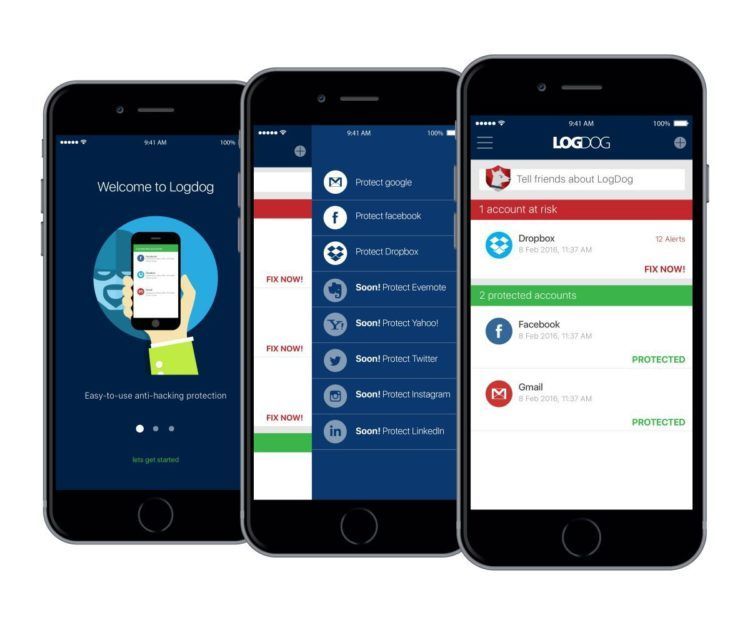
“For example, Facebook only sees activity on Facebook; it alerts you when your account is logged into in a different location or country. LogDog, however, not only looks at Facebook, but sees your online accounts together,” he outlines.
“If you are logged in to Gmail and Dropbox at home and then, suddenly, your Facebook is logged into at your office, LogDog alerts you immediately. If there is a login on your accounts at a time when you usually do not use your online accounts – LogDog will let you know.”
Personal frustration
The idea for LogDog came after Uri went through what he describes as a “painful process” to recover his wife’s email account. The hackers did substantial damage, downloading things like photos, personal documents, and bank statements. He realized how sensitive email accounts have become and set about to engineer a solution.
Uri points to the fact that one in four online accounts falls victim to hackers and says existing solutions don’t do enough for the likes of you and I.





Stay updated on the go with our mobile app.
Get latest insights with smoother, more personalized experience through TIA mobile app.