 J.T. Quigley · · 5 min read
These 3 startups are using technology to shake up the fashion and retail industries
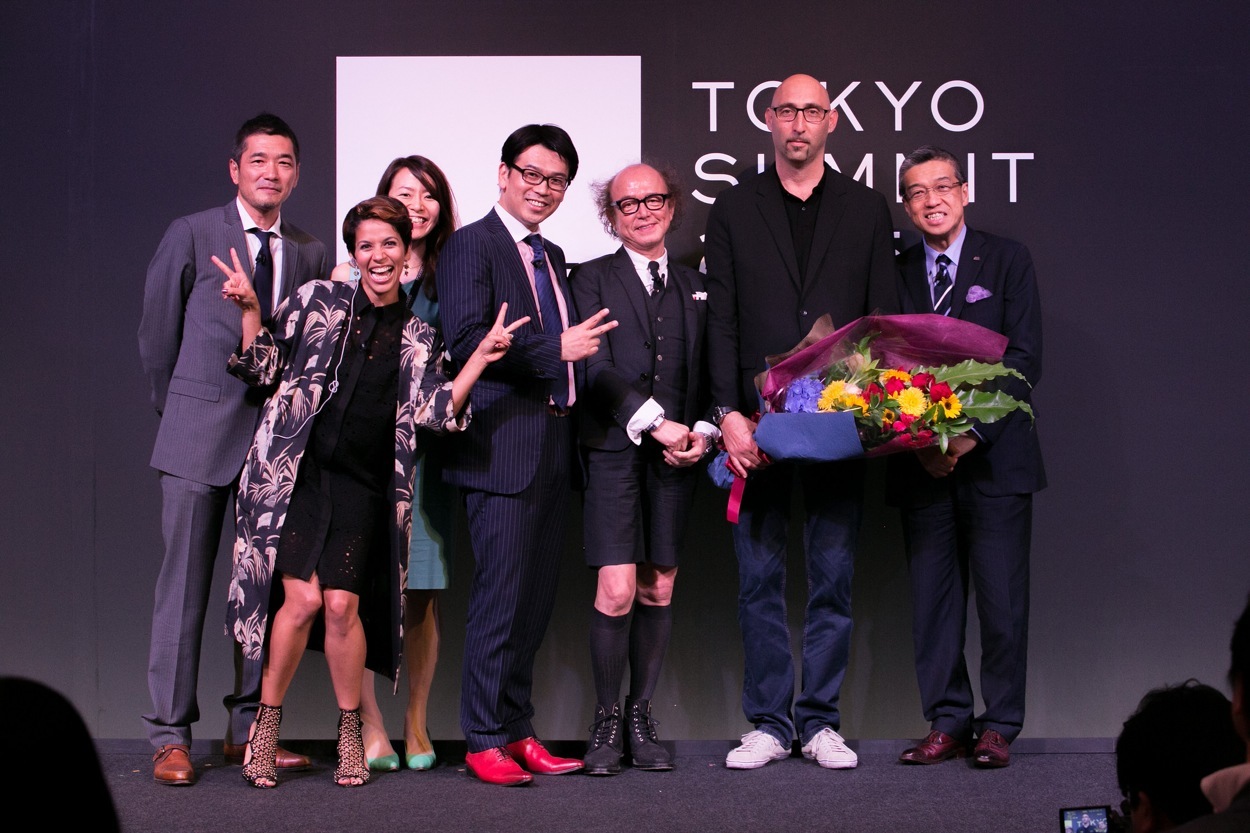
Decoded Fashion hosted its first Asian summit in Tokyo last week, bringing local and international startups face-to-face with Japanese fashion and retail executives. Five of the startups in attendance also pitched their product or service for a chance to show it off at Isetan, the famed luxury department store that started as a kimono shop in 1886.
Japan’s first fashion-meets-tech pitch contest was judged by a panel of eight industry heavyweights, including Isetan CEO Hiroshi Ohnishi, Decoded Fashion founder Liz Bacelar, Conde Nast Japan president Jun Kitada, and the chief editors of Vogue Japan, GQ Japan, and Wired Japan. Competing startups included two from Japan, two from the US, and one based dually between the two countries. Each was tasked with showing how their product or service could enhance Isetan’s in-store experience.
In the end, the judging panel was unable to choose just one winner. The group decided to award three startups, as chosen by the most vocal support of each. Additional prizes were announced on the spot.
Did Japan have the home field advantage, or did the overseas contenders draw the most attention? Read on to find out.
Third place: Abeja
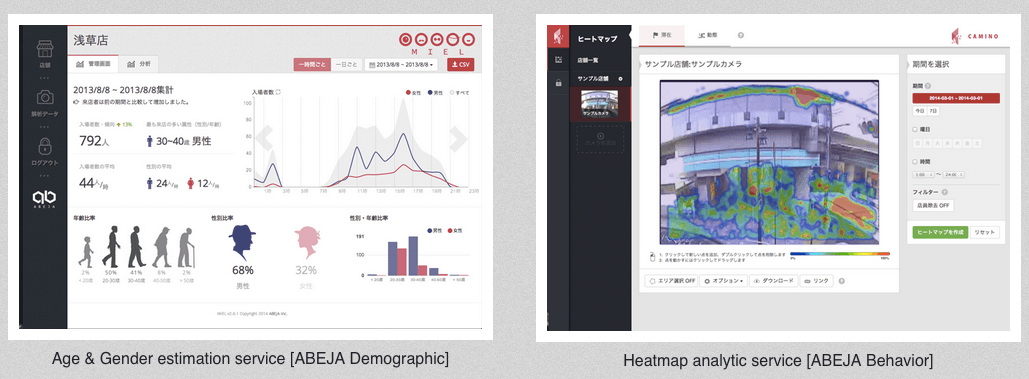
Abeja, based in Tokyo, calls itself a Google Analytics for brick-and-mortar retailers. The startup deploys several technologies to gather data on shoppers: facial recognition cameras estimate the age and gender of each person that enters the store, indoor and outdoor cameras capture heat maps to determine where shoppers spend the most time, and digital signage allows passersby to interact with advertisements.
Abeja also believes that facial recognition can replace the physical wallet, even electronic wallets like Apple Pay. One example the startup proposed was a customer taking a selfie and sending it to a store they plan on visiting ahead of time. The staff would then be able to recognize them for a more personalized greeting and eventually use a facial scan to validate their payment before they leave, all without digging through their purse or pockets.
“The challenge with Japanese startups is not a lack of ideas,” Bacelar tells Tech in Asia, citing Abeja as a prime example. “It’s that founders lack an understanding of how to pitch their idea in a global context – and they struggle to justify [return-on-investment] in an enticing way.”
Abeja was Kitada’s top choice, and the Conde Nast Japan president promised to send Wired Japan’s editor in chief to write about the startup personally.
Second place: Electroloom

Inspired by the nascent 3D printer movement, San Francisco-based Electroloom has created the world’s first 3D fabric printer. Using CAD or Illustrator, people can design custom garments that the machine creates by blasting a liquid fabric solution (mostly using cotton and polyester) against a mold. The nanofibers in the solution, guided to their target by an electric field, then bind together to create seamless garments – no sewing required.
The startup admits that its current capabilities are quite limited: it’s been used to make simple skirts, tank tops, beanies, and child-sized dresses thus far. But, like ordinary printers and their 3D counterparts, the technology is likely to improve over time in both quality and speed (at present, garments take between eight and 16 hours to complete).
In the future, the startup hopes that retailers will employ Electroloom in-store to give shoppers the opportunity to design and print a custom piece of clothing on the spot. They also hope to promote sustainability in the clothing manufacturing process, as Electroloom doesn’t waste any fabric in the printing process.
Despite being founded in the US, Electroloom does have a direct connection to Asia: it’s currently being incubated by HAXLR8R in Shenzhen, China. It also had a successful call-to-action campaign on Kickstarter (check the video below to see Electroloom in action).
Masafumi Suzuki, the editor in chief of GQ Japan, was blown away by Electroloom and insisted that they not leave Japan empty handed. He promised to feature the startup in GQ and even convinced the Isetan executives to include them at the retailer’s upcoming exhibition alongside the grand prize winner.
First place: MemoMi
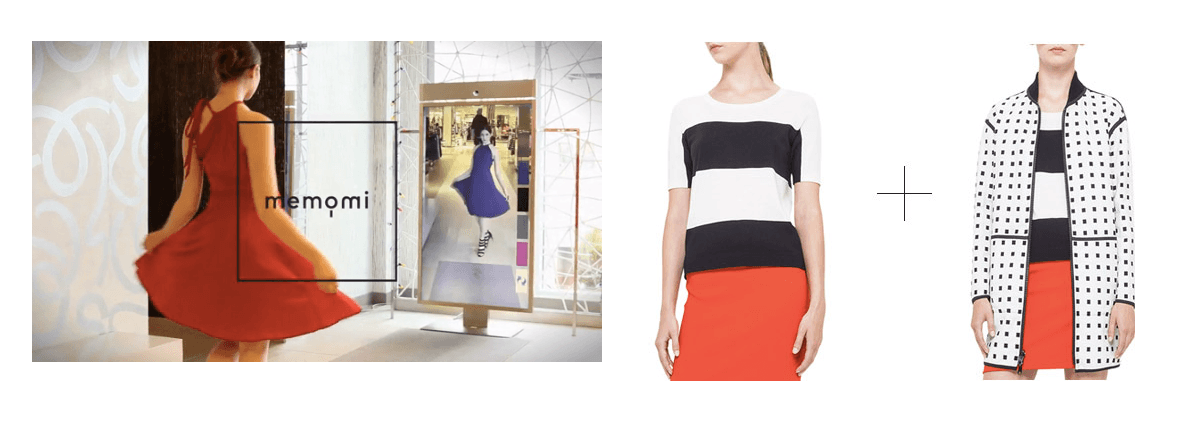
As far as the pitches themselves went, Memomi stole the show. The startup – with offices in Palo Alto, Washington DC, and Tokyo – produces a smart mirror called “MemoryMirror” that allows users to virtually try on outfits. The device’s tracking technology makes it appear that the garment is actually being worn – not just superimposed on top of them. It can also change the color and pattern of something already being worn, so that a shopper doesn’t need to physically try on multiple variations of the same thing. The startup says its color-changing algorithm is “pixel-by-pixel,” so that wrinkles and folds appear as realistic as possible.
One problem with regular mirrors is seeing how something looks from the back. MemoryMirror can capture both real and virtual fittings, up to eight seconds long, and send them to a user’s smartphone. Images and videos can then be shared with friends or loved ones to get advice on which color or style to purchase. The startup is also offering online checkout via its companion app, useful when someone decides they don’t want to carry a shopping bag or when a specific style is out of stock. Retailers can send recommendations to shoppers based on what they tried on in-store, and alert them when similar styles arrive.
MemoryMirrors are already being deployed at three Neiman Marcus department stores in the US, with the retailer boosting that number to 20 over the next three months. The startup is also offering smaller versions to eyewear retailers and hair salons and has tied up with Corning Glass to make transparent displays for storefront windows.
Memomi received the most positive overall feedback from the judging panel, but it was Ohnishi who ultimately crowned them the grand prize winner. The startup will be invited to take part in Isetan’s annual “Irodorisai” festival, held each August, which turns one of the retailer’s locations into an interactive art gallery. It will also be featured in Vogue Japan, GQ Japan, and Wired Japan.
“[Memomi] is exactly what Isetan was looking for,” Bacelar says. “It’s a technology that makes shopping more fun and exciting in an omnichannel way, while also being a powerful data gathering tool for the merchant to provide a personalized shopping experience.”
Tech in Asia was the official media sponsor for Decoded Fashion’s Tokyo Summit.
Stay updated on the go with our mobile app.
Get latest insights with smoother, more personalized experience through TIA mobile app.
Recommended reads
 Discomfort is the real growth hack
 Asia’s AI video gold rush
 The perfect finale to your conference experience
 These are Asia’s most active investors in AI
 An insider’s look at Vietnamese ecommerce from one of the sector’s pioneers
 Singapore AI startup obtains $5m in Square Peg-led seed round
 Founders, we’re looking for more potential ESG unicorns
 KKR-backed data center provider opens first facility in Korea
 Milk tea’s emotional rise over coffee
 Probe exposes flaws in crypto exchanges





Editing by Terence Lee, top image courtesy of Decoded Fashion
(And yes, we’re serious about ethics and transparency. More information here.)






📅 Upcoming Events
22 October 2026
Payoneer x CSPN Summit 2026