Sitting in the very heart of Beijing, surrounded by two miles of majestic crimson walls, is the historic Forbidden City – one of the world’s most well-preserved ancient palaces. It was here, on a crisp October afternoon, that Xiaomi’s Lei Jun let go a rhetorical punch against unnamed rivals, defending a principle he’s held dearly for the last eight years.
“Other phone makers sell exorbitantly expensive handsets, but expensive phones aren’t necessarily the best,” he said.
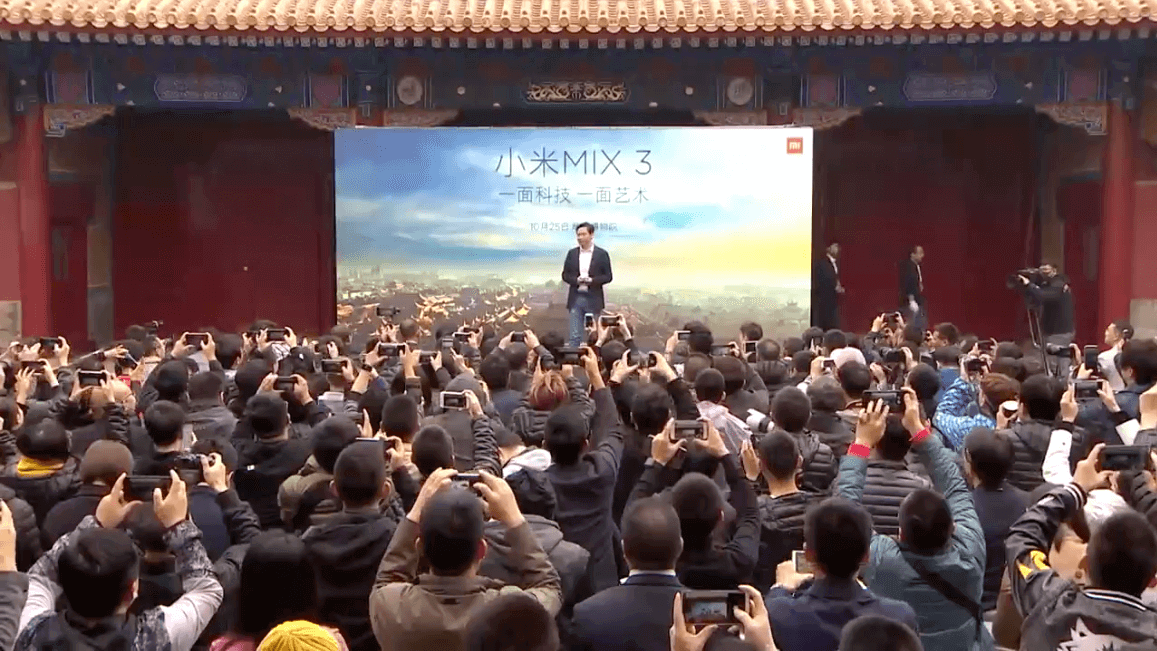
Xiaomi founder Lei Jun unveiled the Mi MIX 3 smartphone on October 25, 2018. / Photo credit: Xiaomi via Weibo
It was Lei’s third major phone launch this year, and the CEO is under a lot of pressure. In February, he set a lofty goal: in two and a half years, Xiaomi wants to recapture its former glory as China’s best-selling smartphone brand.
Lei only has 20 more months to achieve that. Yet the latest scorecard shows how hard it will be. Xiaomi sold 15 percent fewer phones in the last quarter compared to a year ago. Huawei, which launched a flagship phone just a week before Xiaomi, saw double-digit growth.
Some analysts say Huawei’s success comes down to putting high-end features into affordable handsets, giving consumers value for money – a strategy that Xiaomi also prides itself on. At US$420, the Mi 8 smartphone gives you 6 GB of RAM and 128 GB storage with a strong processor – not a bad deal at all. But somehow, it didn’t fly off the shelves.
“To people from that generation, there are more features on a smartphone than they actually use. Meanwhile in their minds, the image of Xiaomi is just too tawdry,” said Meishigenzheluan, a Zhihu user.
He described an encounter his mother had at a meeting: “People asked her, ‘Why are you using Xiaomi? Use a Huawei at least.’”
Accurate or not, it’s the impression that’s often heard when people in China are asked to describe Xiaomi smartphones. To understand why, you have to go all the way back to August 16, 2011, when Xiaomi unveiled its very first handset in Beijing.
Wearing jeans and a black T-shirt, Lei carefully went through the specs of smartphones from four competitors – HTC, Samsung, Motorola and LG. (The names change over the years, but Xiaomi has kept the habit of comparing itself with rivals at every launch event.) In the end, he invited the audience to guess the price of the Mi 1.
“5,000 yuan,” one man shouted.
People laughed. And so did Lei.





Stay updated on the go with our mobile app.
Get latest insights with smoother, more personalized experience through TIA mobile app.












📅 Upcoming Events
22 October 2026
Payoneer x CSPN Summit 2026