This article was co-authored by Celine Wong and Yuan Chuan Kee.
Tech in Asia’s mission is to serve the region’s tech and startup community by connecting people through our events, bridging talent gaps via our Jobs platform, and offering insights into this exciting and evolving landscape through news, analysis, and contributions from the community.
We’ve talked about how we’re going to chart this journey by using our data to synergise our three products through the Concept Graph. Now, we’re excited to share with you our first step towards that goal: our News Feed feature.
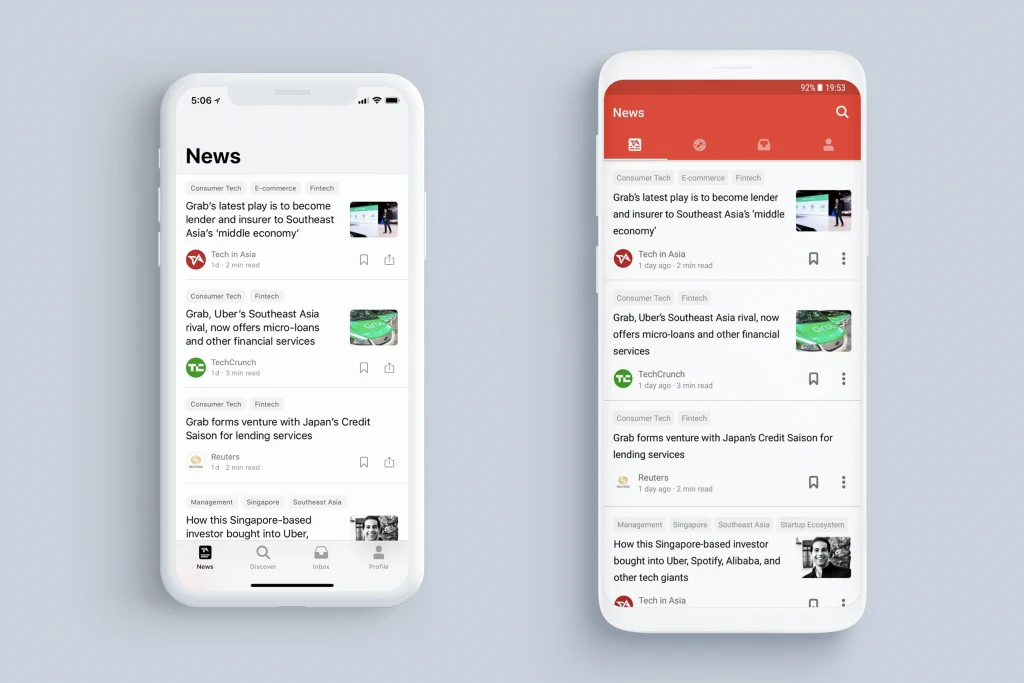
Through News Feed, we will provide readers with time-variant content that focuses on what our editors and writers cover, together with curated content from other sources – such as TechCrunch, Reuters and Recode for starters – that cover the tech scene in Asia and beyond, instead of a traditional list that orders the content in a reverse chronological manner. Fundamentally, we want our readers to have a meaningful engagement with our products – we’d like to give you access to content that covers topics that you’re interested in and care about.
Today, we’re excited to release News Feed on our Android app. Right now, this is exclusively available on our Android app, but we’ll be rolling it out progressively on our iOS app and web application in the near future.
Why do we do this?
We are driven by our readers’ needs, so we’re constantly finding ways to serve you better. From readers’ surveys and research, we learned that our readers wanted more content and more depth in our articles.
Our readers are hungry for more analysis and insights. Drawing from these findings, our team has worked tirelessly to make this happen.
We ran several experiments such as briefs, an article format where we summarized and shared links to great stories from other news sources. We also shared good content from other publishers on our social media channels. The goal was to deliver more quality content to our readers. As we concluded these experiments, we found out that summaries and content from other publishers were well received, and our readers derived value from the additional content.
That led us to think, how can we further scale this and deliver the most value to our users? We eventually came to an epiphany: Tech in Asia could be more than a newsroom – it could be a news distribution platform.
With the help of machines, we can curate and deliver more newsworthy content. That frees up our editorial team to dedicate itself to craft more in-depth content – something that the machines cannot create. This combination powers our News Feed, allowing us to give our readers a holistic view and deeper understanding of Asia’s tech ecosystem.
How do we do this?
Manual curation is inevitable here. However, we have devoted significant product and engineering efforts to make sure that our hardworking editorial team is not alone in this endeavor. We’ve adopted machine learning techniques to process content and establish the relationship and context among the articles using topic modeling – an unsupervised learning algorithm – that’s commonly used for understanding text and deriving higher-level insights. Using humans with domain expertise and an algorithm, we’re able to ensure that our content is relevant to readers.
How does the topic model work in the News Feed?
Topic model is a form of dimensional reduction technique that reduces high dimensional data to lower the number of dimensions with context about each of the derived dimensions. It decreases the words’ frequency in documents to clusters that are defined by the words. In this application, we’re able to derive a specified number of clusters of articles that have contextual relationships.
With the topic model, it enables us to identify topics such as “Ride-hailing Services” which talks about “Uber”, “Grab”, and “Didi” as well as “Blockchain Technology” which covers “ICOs”, “Bitcoin” and “Cryptocurrencies”. Meanwhile, “Data”, “Machine Learning”, and “Analytics” are some of the elements that fall under “Artificial intelligence”. These topics are used to associate our articles with others, so you’ll see articles that are closely related to each other appear together in the feed.
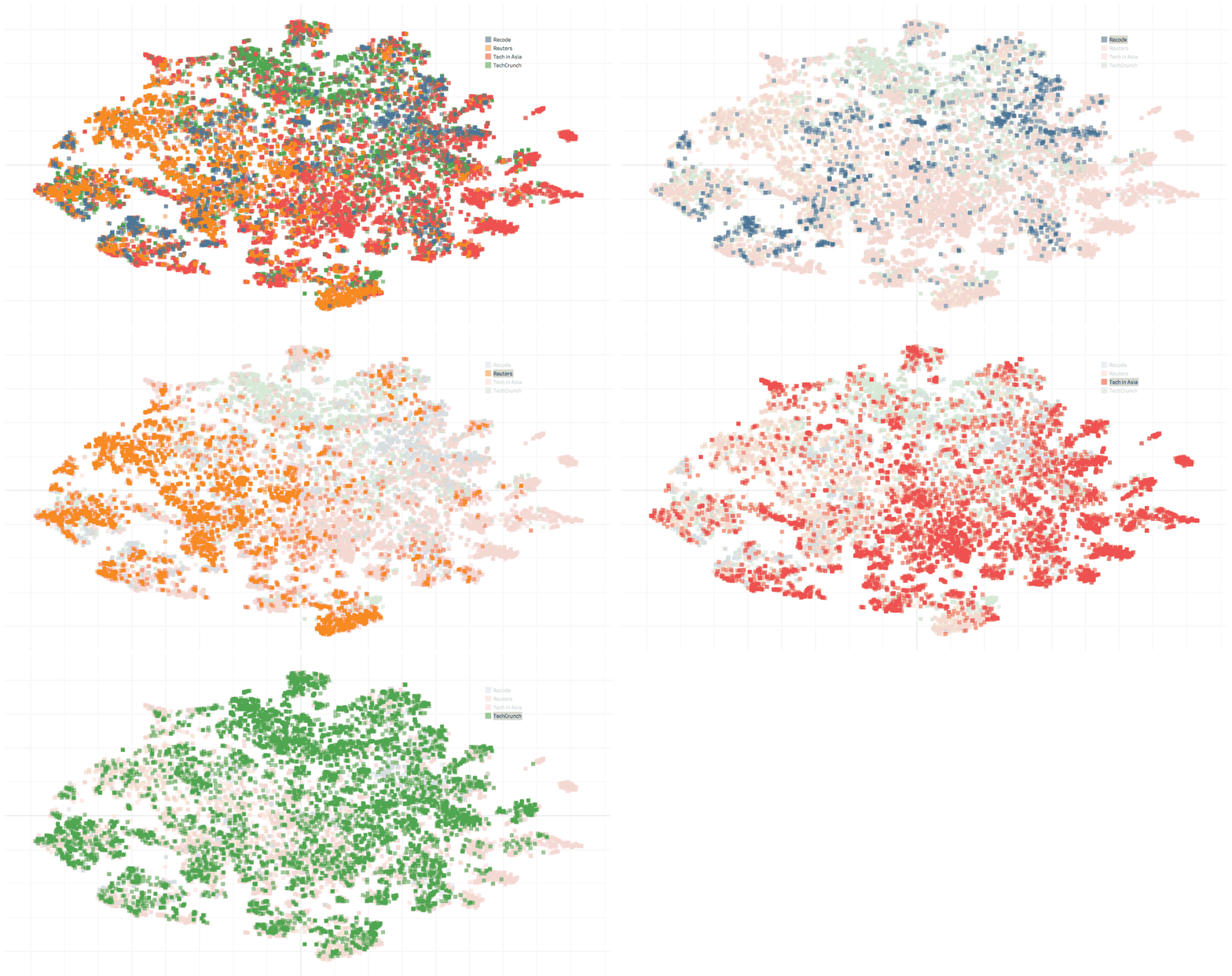
Visualisation on how content from each source is covered by the topic model in planar form
The curated content have their topics derived from the model we developed and we associate them with our own articles based on how similar they are and how closely they are published together. Apps such as Flipboard have used topic models as well to achieve similar objectives.
Moving Forward
First of all, we want to understand how our editors curate content. Although we’re working on aggregating related content for the News Feed, its by-product is data on how editors select content that they think might be interesting and relevant to our readers.
As content evolves with time, the topic model should evolve as well. We’ve just scratched the surface at this point, and we’re developing capabilities such as visualisation and human-based evaluation techniques to assist us in building models that can help teams grasp what’s happening around the world and use it as a catalyst to drive content strategy.
We’re also planning to develop a personalized feed based on your interests and reading habits. This will allow you to navigate through the streams of content easily and improve your content discovery experience.
We hope that you will find this feature useful, and we look forward to hearing your feedback as we work towards building a better product for you.
Download the app and try out our News Feed today!

Stay updated on the go with our mobile app.
Get latest insights with smoother, more personalized experience through TIA mobile app.
Recommended reads
 Life’s a game, and AI agents are Animoca’s new play
 Indonesian AI startup goes global
 Forrest Li on scaling Sea, building smarter bots, and founder grit
 An AI assistant that joins sales calls and scores team skills
 Beyond the check: Why VCs need more than capital
 SGX’s CEO says it doesn’t need a unicorn to win
 SMEs want AI too, but not the kind Big Tech is selling
 Oatside’s alt-milk rise hits a profitable gear
 Alibaba’s financial health in 12 charts
 Asia’s telcos bundle AI into mobile plans. Will it pay off?





Editing by Eileen C. Ang and Willis Wee
(And yes, we’re serious about ethics and transparency. More information here.)