Nathaniel Fetalvero · · 5 min read
An inside look at the life of a global business’ APAC manager

Since 2012, David Grainger had been working for business-to-business telecommunication service provider Arkadin, starting as its sales director in Singapore and eventually heading the company’s Southeast Asian sales operations.
That was until October 2017, when Arkadin’s leadership group decided to create its own startup, Spoka, which was designed to serve small- and medium-sized businesses with a convergence platform for telephony, online meetings, and collaboration. Spoka was a departure from how its parent company provided highly customizable but expensive telephony services for larger corporations, and Grainger was the person chosen to lead its Asia-Pacific endeavors.

David Grainger was chosen to lead Spoka’s Asia-Pacific endeavors / Photo credit: Spoka
“My first reaction was ‘this is a terrible idea, we shouldn’t do it,’” he jokes.
But what eventually convinced Grainger to accept the offer to join Spoka was its ecommerce business model – something that he considers uncommon among telecommunication service providers.
“People buy online now. If I think about it, I even buy shoes online, which is crazy because I don’t even get to see them,” he says. “I’m absolutely convinced that the ecommerce strategy, which Arkadin never had, is the future. That got me pretty excited.”
A day in Grainger’s life
Managing regional operations for a global company isn’t easy, but Grainger makes it work.
To give Tech in Asia’s readers a peek into his life, he walked me through his daily schedule.
5:50 am
Grainger starts his day early with a few minutes of meditation, followed by a run or some yoga.
“It gives me some time to do stuff before my kids are up and about,” he says. “This really helps me set my day up in the right way.”
After that, Grainger takes 15 minutes to jump on Slack, email, and LinkedIn to get centered on what he needs to focus on for work, but all that stops at 7:00 am.
7:00 am
By now, Grainger’s two young children are up for breakfast. This time spent with his kids and wife are very important to him.
“My kids are three and four years old and changing so much, so making time for this hour before work is important,” he says. “I firmly believe that maintaining a healthy work-life balance is a huge help.”
After breakfast, he sends them to school and gets ready for work. On his way, he listens to a BBC News podcast to catch up with what’s been going on with the world.
9:00 am
Grainger’s online by 9:00 am, whether he’s in the office or – if he “really wants to focus on something” – working from a cafe or from home. All the way until lunch, most of his time is spent speaking with his team around the Asia Pacific region.
“My whole day is pretty much punctuated with short meetings, either one-on-one or with a team,” Grainger shares.
He explains that frequent, short bursts of communication are crucial, especially when working with teams across several countries, and he recommends video conferencing as a mode of communication.
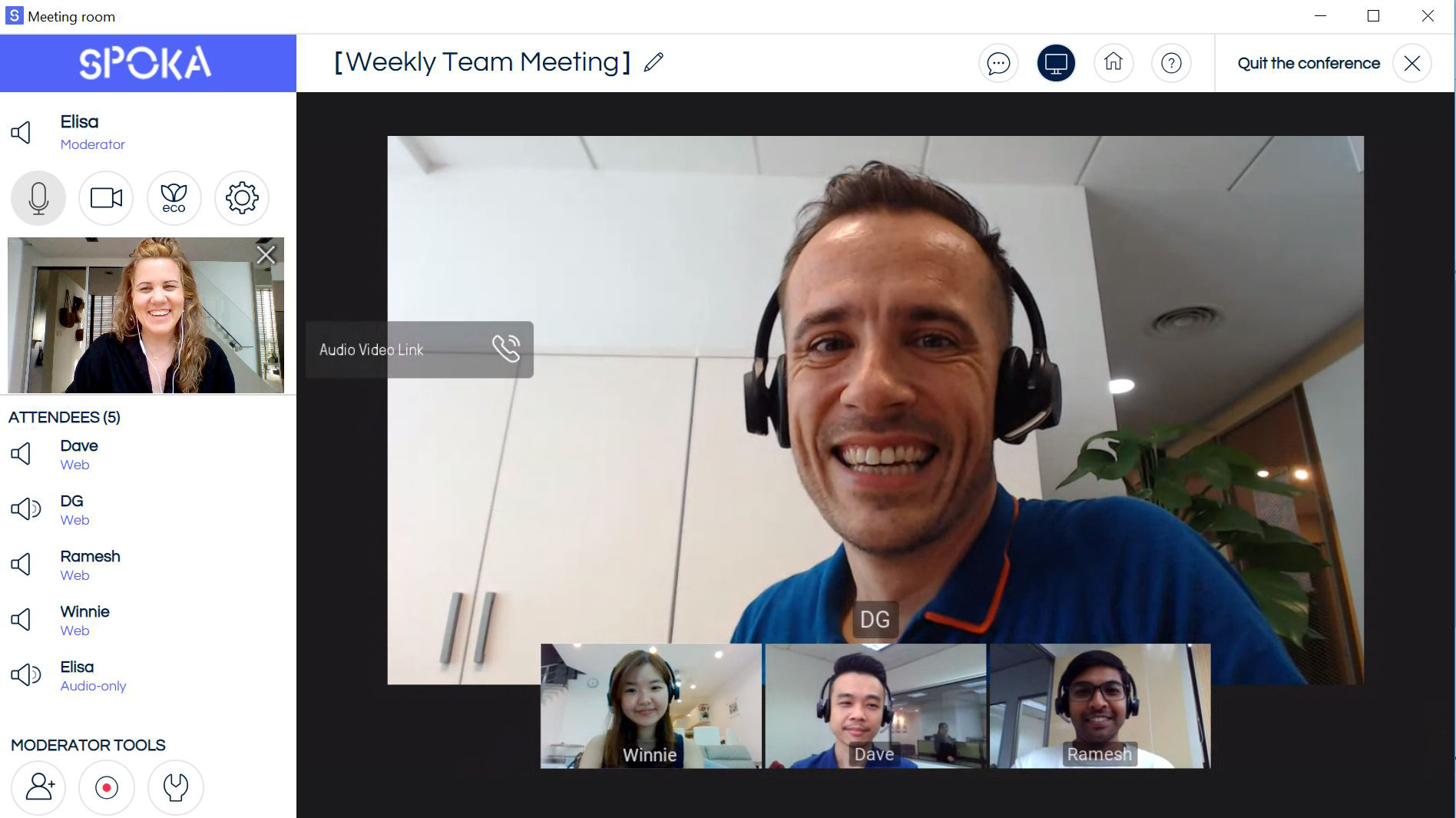
Most of Grainger’s time is spent on short video calls with his team / Photo credit: Spoka
“You can’t discount the level of relationship that builds just by being in the pantry at the same time, getting a cup of coffee, or taking the lift at the same time, or going to those once-a-month drinks after work,” he says.
“I think what happens with the remote teams is they still have their meetings, but they don’t have the rest. So, maybe we’ll only need five minutes on video, but doing that regularly to get as close as we can to that sort of water cooler chat that you get when you work in the same office is important.”
12:00 pm
No matter how busy his day is or how much time he has to spare, Grainger always has lunch out.
“The food in Singapore is awesome,” he explains. “The day would be wasted if I just have a sandwich at my desk.”
2:00 pm
Grainger spends the afternoon on calls with Spoka’s teams in Europe, where most of the startup’s staff is located, and in the US. Because he’s part of Spoka’s management, most of his calls at this time are with other managers, and they discuss details about the bigger business.
“It could be about working with the other departments to fix some operational issues, or doing work on some research and business planning for a potential new market that’s a bit complicated. It really varies,” he says.
Regardless of his to-do list, Grainger religiously leaves the office at 6:00 pm to pick up his kids from childcare.
6:00 pm
6:00 pm to 7:30 pm is strictly kids time again.
“I live, I work, and they go to school all within walking distance of each other so that I never need to make the choice between family, work, and social activities,” says Grainger.
9:00 pm
Being part of a global team, Grainger occasionally has video meetings even up until 9:00 pm. However, he doesn’t let these meetings drag on for too long.
“I try to keep it to a few minutes and head to bed by 10:00 pm or 10:30 pm,” says Grainger. “My brain doesn’t work past then.”
Establishing a culture across borders
Though it is difficult to keep tabs on his staff when they’re not all working in the same office, Grainger isn’t worried about the quality of their work.
“If you look at the way businesses operate, there’s a general default understanding that your employees will do the minimum they can to get their money, then they’ll go home, and that’s it,” he says. “I’ve never been comfortable with that. I really believe that if employees have the right environment, the right coaching, the right support – the right love, if you like – they will flourish well above anything you can get with financial incentives, rules, checking, inspections, and so on.”
Unless our people are happy and engaged and really want this business to work, it won’t work.
When he was handling sales at Arkadin, Grainger subscribed to a different management philosophy: driving and pushing his team. But eventually he realized that it only worked “up to a certain degree.”
As he explains, “It’s not self-sustaining, and it’s impossible to do remotely. It’s like blowing on a fire. When you’re blowing on a fire, the flames grow, but when you stop, the fire goes out.”
Now, Grainger’s advice for managers is to focus on providing a good working environment for their employees.
“It’s all about the people,” he says. “We can have good products, we can have a good brand, we can have the dollars to invest. But unless our people are happy and engaged and really want this business to work, it won’t work.”
Spoka is a new cloud communications platform from Arkadin and NTT group. It provides telephony, video conferencing, and collaboration solutions that are tailored to startups and small businesses.
Sign up for a 30-day free trial on Spoka’s website.
Stay updated on the go with our mobile app.
Get latest insights with smoother, more personalized experience through TIA mobile app.
Recommended reads
 Vibe Check: Mental health in the startup world
 Vibe Check: The lonely, stressful entrepreneur life
 Vibe Check: Coming back from the brink of oblivion
 Korean crypto influencer Maeuknam’s tips on profiting during crypto winter
 A startup’s guide to labor laws and compliance for remote teams
 A startup’s guide to recruiting and retaining remote talent
 Vibe Check: What Grab is doing to help employees with their mental well-being
 4 things to keep in mind when building MVPs
 A startup’s guide to establishing an efficient remote-working culture
 For our loved ones who are never mentioned in our pitch decks





Editing by Dante Gagelonia and Eileen C. Ang
(And yes, we’re serious about ethics and transparency. More information here.)