
The Covid-19 pandemic has had far-reaching effects, bringing the global economy into its deepest recession since the Second World War. The crisis has forced organizations big and small to impose hiring freezes, pay cuts, and other cost-cutting measures in an effort to keep afloat.
That said, the front lines of this fight against the pandemic continue to be in the healthcare sector – and adjacently, in the insurance industry. Resources are spread thin for organizations in these spaces as they deal with supercharged demand that’s putting immense pressure on systems that have often seen slow and minimal technological advancement.
With no signs of slowing down, the pandemic has forced these players to upgrade and advance on the fly with very little room for error.
Pre-existing and new conditions
“These legacy organizations have existed for many years, and over all that time, they’ve defined and developed many specific procedures to make sure they could scale and execute,” says Harel Tayeb, CEO of robotic process automation company Kryon Systems. By focusing on these processes, many of these firms now don’t have the time or effort to enhance their core solutions, he adds.

Harel Tayeb, CEO at Kryon Systems / Photo credit: Kryon Systems
Dealing with disruptive tech startups who provide alternative solutions and more flexibility for their users has also become a challenge for these long-time players. “[The legacy companies] have a lot of experience and information but need to be more agile,” Tayeb says.
These fundamental issues have been brought to light by the novel coronavirus, but new problems have also surfaced. The unique nature of the virus means that existing testing, tracking, and database solutions have become inadequate, requiring healthcare companies to adapt to new circumstances and build and scale new solutions quickly.
Meanwhile, insurance companies have had to rethink their call center operations as employees are made to work from home due to lockdown measures. This a significant and disruptive change, yet one that has to be made with minimal – if any – adverse effects on customer experience.
In the current climate, businesses have had to conduct layoffs, reduce costs, and generate more revenue, despite having less demand. As such, “any tech that can help them keep the core business running and executing at a lower cost without adversely affecting the customer experience is needed,” Tayeb notes.
The CEO believes that robotic process automation (RPA) is the answer.
RPA uses AI technology – including computer vision and machine learning – to automate business processes. These types of applications are governed by structured business logic and input and can be configured to perform a variety of functions.
As Tayeb puts it, it’s “like a virtual assistant – one that [has] the ability to take any action or thought that human beings can do but faster, around the clock, and at scale.”
Kryon itself offers an RPA solution that it dubs Full Cycle Automation. As the name suggests, the platform takes an all-around approach to helping clients, from discovering and mapping processes to optimization, development, automation, and continual analysis. According to Tayeb, it’s applicable for any kind of organization and allows them to scale up or focus on the business instead of having to maintain behind-the-scenes processes.
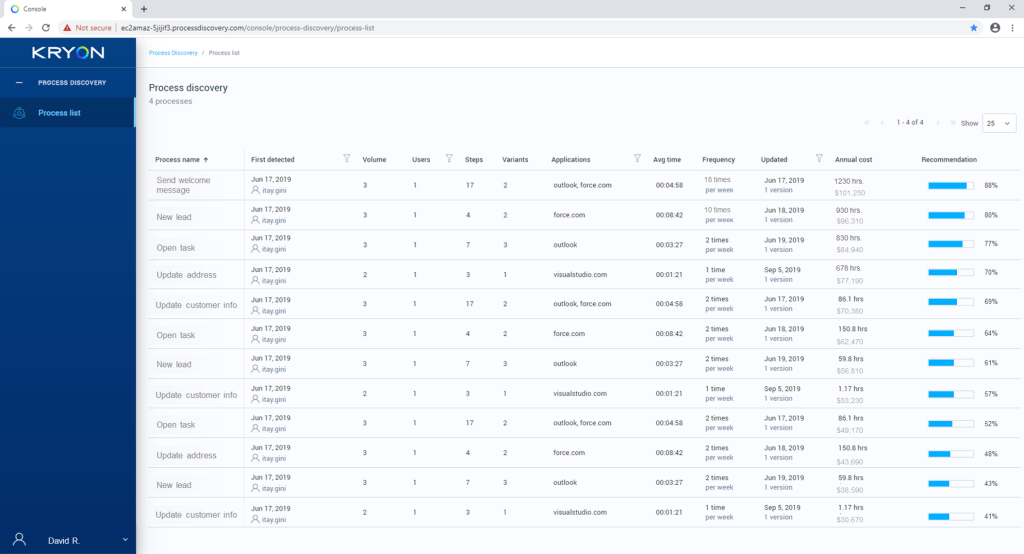
Photo credit: Kryon Systems
Kryon has wasted no time in putting its solution to work in helping with the pressures that Covid-19 has brought. Israeli healthcare provider Maccabi Healthcare Services for one has used the company’s RPA platform to automate downloads of virus test results directly from the Israeli Ministry of Health into its own database, speeding up the process from weeks to minutes.
Within 48 hours, Kryon was able to build a bot capable of handling Maccabi’s request, a task that would have usually taken months to complete, Tayeb says. “During these pandemic times, if we had to wait a few months, the impact on the economy and, more importantly, the people would have been disastrous,” shares the CEO.
Insurance companies, on the other hand, can also benefit from Kryon’s technology. The company’s Attended Automation solution can be used to solve much of their problems in call center decentralization by guiding employees through the process of performing a given task and even automating these functions.
Besides reducing or even removing the need for supervision from a manager, this also helps clients ensure that their call center and customer service standards remain top-notch despite the pandemic.
“If RPA can handle the back-end processes, then humans can put more time, energy, and effort into the front-facing, communication-centric duties that they do best,” Tayed shares.
In this together
Ultimately, Kryon aims to use its solutions to help as many businesses and people as possible make it through the pandemic – a mission that apparently extends beyond its existing clients.
According to Tayeb, when the company identifies new prospects who are facing a dire cash crunch, it offers its products to them for free for three months.
“As the CEO of an automation company, my mindset is to support any other company, regardless of industry,” Tayeb says.
Find out more specifics on how RPA can help organizations with cost savings and other business benefits by reading the Forrester Total Economic Impact report that’s available on Kryon’s website.
This content was produced by Tech in Asia Studios, which connects brands with Asia’s tech community. Learn more about partnering with Tech in Asia Studios.
Stay updated on the go with our mobile app.
Get latest insights with smoother, more personalized experience through TIA mobile app.
Recommended reads
 Inside OpenAI’s public-first bet on medical AI
 From data to durians: H2O.ai’s journey to AI-led accessibility
 TiDB is engineering the infrastructure for AI’s agentic future
 Escaping the LLM bubble: AMI Labs goes the physical AI route
 How AI agents will be the new software buyers
 Will cars drive the future of AI? This Chinese company thinks so
 The hardware secret that gave OpenAI the edge on Anthropic
 Freeze headcount until AI becomes the true production line
 Nvidia CEO urges rethink of corporate structure
 How AI is breaking SaaS where trust matters most





Editing by Nathaniel Fetalvero and Jaclyn Teng
(And yes, we’re serious about ethics and transparency. More information here.)








📅 Upcoming Events
22 October 2026
Payoneer x CSPN Summit 2026