Michael Tegos · · 4 min read
Grab brings its digital wallet to Malaysia through tie-up with the country’s largest bank
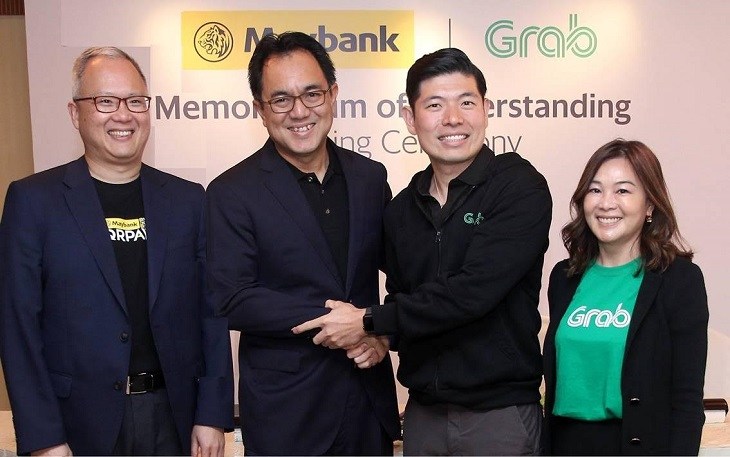
Photo credit: Grab
Grab is bringing its GrabPay digital wallet to Malaysia, it announced today. It’s the first expansion out of Singapore for Grab’s cashless payments platform.
To make it happen, the company has partnered with Maybank, Malaysia’s largest bank by total assets (US$164.1 billion) and market capitalization (US$20.7 billion).
Customers will be able to use the digital wallet at GrabPay’s partner merchants first, and eventually within Maybank’s network of merchants as well. They will also be able to top it up through Maybank’s online banking service.
At the same time, Maybank users will be able to use their bank’s QR-code payment system at GrabPay merchants.
Grab received a license to operate cashless payments in Malaysia in December 2017.
In Singapore, Grab rolled out its in-store cashless payments product last November. The company hit the 1,000-merchant mark on time but would not disclose the current number of merchants signed up.
The ‘toothbrush test’
Malaysia presents a unique opportunity for digital wallet services because it combines the needs of developed and developing markets, thinks Varun Mittal, ASEAN fintech lead for Ernst & Young.
Parts of the country, particularly urban centers, are ripe for digitizing transactions that happen through banking or credit cards. On the flip side, rural areas will be more fertile ground for financial inclusion and serving the unbanked. “You have two challenges to fight, which means two opportunities to win,” he says.
Wallets that work through QR codes can acquire merchants more easily, he adds. Smaller businesses have difficulty installing credit card equipment because of the costs involved – which is not the case with a QR-code sticker.
For any digital wallet to get ahead in the race, it has to pass what Mittal calls “the toothbrush test” – whether the service can keep customers coming back to it twice a day or more.
This can mean using the wallet to buy coffee in the morning and a meal in the evening, pay off a bill, top up with phone credit, or take a taxi. “Can you master the art of high-frequency, low-value use cases? Whoever manages that is in the best position to win,” Mittal points out.
It will be a bit of a different story in “frontier markets” like Cambodia or Myanmar where Grab hopes to expand GrabPay. “You have to look at how many people are consumers of your anchor use case,” Mittal says. For Grab, this would be transportation. The challenge there, then, would be to get users to use Grab’s app more frequently than they use, say, a chat app that incorporates a digital wallet.
This can be done by enabling as many diverse use cases as possible. “The journey will be to get new adopters [of digital wallets] to your master use case,” he adds.
Keen on mobile payments, wary on security
A busy market





Stay updated on the go with our mobile app.
Get latest insights with smoother, more personalized experience through TIA mobile app.