Myanmar could be the Internet’s next great frontier. Once a closed society, internet users are finding that censorship is no longer as rampant as it used to be. It is in this context that Google Chairman Eric Schmidt is visiting the country this week on a business trip.
Officially, Google has kept mum on its plans for the frontier economy.
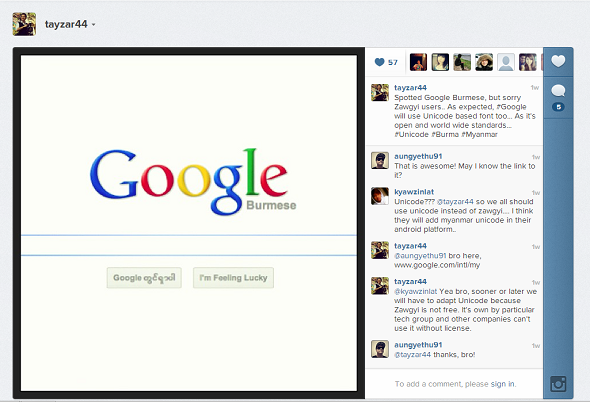
However, according to business publication Quartz, it already has several initiatives in the works, including Burmese language versions of the Google search engine, Android and other Google services, as well as access to Google Play and possibly Google Wallet, which were banned in the country.
Given the search giant’s cache, it wouldn’t have a problem negotiating with the government to remove a ban on its services.
While the developed countries are where the profit margins, ad spend, and consumer spend are highest, the next billion Internet users are expected to come from the emerging and frontier markets.
Myanmar especially could be a goldmine for internet and telecom companies since the government is set to liberalize its economy. SingTel apparently is in the running to develop the country’s telecom network.
Google is certainly right in the thick of the battle for mindshare among Asia’s rising middle class. Its cheap Android phones are enjoying deep penetration in countries like Indonesia and China where there’s a thirst for affordable smartphones.
Apple is rumored to follow suit by preparing to launch a cheaper, plastic version of the iPhone.
Google’s Free Zone initiative has also enjoyed some attention by giving free access to Google’s services in countries like Philippines, Indonesia, and South Africa.
The move is similar to Facebook Zero, a lightweight version of the social network built for feature phones where some of its features would not incur a data charge.





Stay updated on the go with our mobile app.
Get latest insights with smoother, more personalized experience through TIA mobile app.