 C. Custer · · 5 min read
Global Times Attacks Ai Weiwei, Calls For Authorities to Crack Down on “Illegal” Microblogging

Ai Weiwei
Avant-garde artist Ai Weiwei is no stranger to microblogs, or to controversy. Nor is Hu Xijin, the outspoken editor of the state-run Global Times, who was recently profiled in a piece on the Global Times in Foreign Policy. Hu also maintains an active Sina Weibo account and has over 1.4 million followers, although if the comments on his posts are much indication, plenty of them are following just to argue with his points.
Back in April, when Ai was first detained (and before authorities had acknowledged his detention or made any statement about his charges), the Global Times ran an editorial calling Ai a “maverick” and saying he would “be judged by history” and “will pay a price” for his choices. Later in the month, the same paper ran another editorial saying that labeling Ai’s arrest as political persecution was “a fallacy” and that China is “witnessing the unfolding of democracy.” Neither of these editorials included any attempt to assess the evidence against Ai — of which none has been publicly presented — nor is there any indication that the Global Times attempted to speak with Ai or any of his defenders.
It’s not difficult to imagine why Ai Weiwei might have been annoyed by that, and it turns out Ai’s latest digital mischief may be a direct response: a Sunday Twitter post the includes Hu’s cell phone number as part of a list of “leaders of the fifty cents [i.e., nationalist] army.” Apparently — and unsurprisingly — the response to this was swift and unpleasant for Hu, and today’s Global Times editorial is a response to Ai’s tweet, calling him out for “personal attacks” and calling on the government to crack down on microblogs:
If China refutes any regulation of the online world, its social morality will be damaged. The Chinese government should take measures to regulate the online order and curb the increasingly rampant violations on personal rights, including invasion of privacy and death threats. The relevant authorities should take actions to crack down on these illegal acts while safeguarding the freedom of speech.
Twitter is blocked in China, so we can only assume that this call for a crackdown is actually a request for the government to strengthen its efforts to eliminate GFW circumvention tools like VPNs.
As far as the spat between Ai and Hu goes, I think they’re both wrong. Certainly it’s pretty obnoxious to post someone’s personal contact information publicly, even on a forum that’s blocked in China, and I think that was a jerk move on Ai Weiwei’s part. That said, Hu’s assertion in today’s Global Times that the paper has “has made no personal attacks against [Ai Weiwei]” is either blatant lying or shocking self-delusion coming from a paper that ran a hit piece on the man before the government even confirmed he had been arrested.
Ai’s actions and Hu’s advocacy could have real implications for internet access in China, though. VPNs and other GFW circumvention tools may be popular among dissidents, but they’re also virtually a requirement for foreigners living here wishing to access popular web services, and businesses both foreign and domestic who need to be able to reliably access the entire internet for research, networking, sales, marketing, and more.
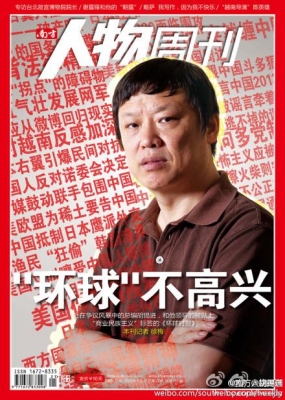
Hu Xijin is unhappy
Moreover, there have been rumblings for some time now that China’s censors were moving to implement new technology that would make VPNs impossible to use. Over the past year, users of popular VPN services in China have found their connections disrupted with increasing frequency, and administrators of these services have also suggested China is developing a new version of their censorship technology. From Forbes:
The anti-censorship and anonymity service Tor, for instance, has found that many of its “bridge nodes”–privately-placed servers around the world designed to connect users to the rest of Tor’s public network of traffic re-routing computers–have become inaccessible to Chinese users within hours or even minutes of being set up, according to Andrew Lewman, the project’s executive director. Users have told him that other censorship circumvention services like Ultrasurf and Freegate have seen similar problems, he says. “Someone will try to connect, then there’s a weird scan, and the bridge stops working,” says Lewman. “We see weird things all the time, but this is a semi-consistent weird thing, and it’s only coming from China.”





Stay updated on the go with our mobile app.
Get latest insights with smoother, more personalized experience through TIA mobile app.








📅 Upcoming Events
22 October 2026
Payoneer x CSPN Summit 2026