Jack Ellis · · 4 min read
Smart bike racks are coming to Singapore’s public housing, thanks to a startup
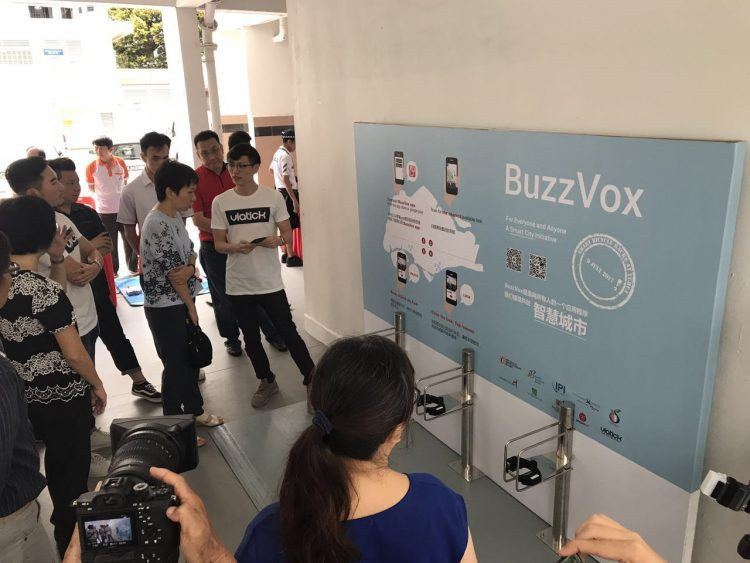
Photo credit: Viatick.
The Housing and Development Board (HDB) – the government agency responsible for Singapore’s extensive network of public housing – has teamed up with local startup Viatick to launch smart bicycle racks in the city’s residential estates.
Officially unveiled last week, these free-to-use smart racks allow anyone to secure their bikes and scooters without the need for a separate lock. Using their smartphone’s bluetooth capabilities, cyclists can lock and unlock their bike at any available smart rack.
Viatick develops bluetooth low energy (BLE) technologies for use in various settings, including healthcare, logistics, and retail. Compared to earlier incarnations of bluetooth, BLE is intended to be more energy-efficient, while maintaining the communication range of its forebear.
This project is a slight deviation from what we normally do… We saw it as a good chance for bluetooth to shine.
Using BLE-enabled beacons, Viatick’s solutions allow users to track indoor movement of shoppers, employees, and even students. This helps them to derive insights into behavior patterns that they can then use for purposes such as proximity marketing or increasing workflow efficiencies.
Louis Kent Lee, Viatick’s head of accounts and engagement, admits that working with the HDB to build smart bike racks is somewhat different from his company’s bread-and-butter. “This project is a slight deviation from what we normally do,” he says. “We saw it as a good chance for bluetooth to shine.”
HDB had a specific problem. Singapore’s local councils were spending a lot of money on maintaining bicycle racks of the more traditional type. Often, people would hog certain racks, or old bikes would be simply be abandoned while still locked to them.
BuzzVox – the app-based platform that manages the network of smart racks – collects data on users of the racks, allowing local government to keep track of who has parked in a particular spot, and for how long. It uses blockchain technology to allow for a detailed audit trail, GPS for location tracking, and artificial intelligence to recommend traveling routes to riders.
Bike sharers
At the same time, dockless bike-sharing services like homegrown Obike, and Chinese imports Mobike and Ofo, have taken off big time in Singapore. Vehicles owned by these companies carry their own locking mechanisms, negating the need for bike racks and allowing users to leave them pretty much anywhere – something that has caused more than a few headaches.
However, Lee argues that BuzzVox complements, rather than competes with, these dockless services. In fact, several of the providers active in Singapore are working with Viatick, he says. “This project seems to be competing [with them], but it’s not – it’s actually an infrastructure that stands by itself,” he says.
Dockless bike-sharing companies benefit from a system like BuzzVox because it can potentially save them maintenance costs: if users leave their hired bikes in BuzzVox docks, it is simpler and more time-efficient to locate and collect them, says Lee. In effect, it can turn these dockless services into docked ones. Lee adds that Viatick is currently in talks with Obike’s development team to explore ways of integrating its bike’s locks with BuzzVox.
Sponsor-sustained
It’s a basic infrastructure that can be accessed by anyone and everyone.
The other potential competitive barrier for BuzzVox is presented by dock-based bicycle-hire schemes, such as Taipei’s YouBike, London’s Santander Cycles, Milan’s BikeMi, and Vélib’ in Paris. Neuron recently launched a docked electric scooter service in Singapore.
However, Lee suggests that BuzzVox occupies its own niche in between these systems – which are often publicly funded – and the upstart dockless companies. “Generally, that kind of infrastructure elsewhere is owned by operators,” he says. “This is not – it’s a basic infrastructure that can be accessed by anyone and everyone. The difference here is using bluetooth to create a platform that is not tagged to any single operator.”





Stay updated on the go with our mobile app.
Get latest insights with smoother, more personalized experience through TIA mobile app.