 Paul Bischoff · · 3 min read
The next generation of chat apps will be group-centric
 Last week, guest writer Spencer Ng sent us an article asking, “Is the market for mobile chat apps saturated?” The advice he gave to messaging apps entering the market was mostly geographic: aim for markets with a low saturation of similar apps and a high percentage of daily active users.
But even in markets that don’t fit those parameters, we are beginning to see new messaging apps with a slight twist: an emphasis on groups. Within two weeks of each other, China’s Sina released WeMeet, and Korea’s KakaoTalk released KakaoGroup. Both serve essentially the same function as a platform where groups – families, meetups, company employees, classmates, conference attendees, poker clubs, gang members, political coups, you name it – can privately talk among themselves.
A gap in the market
Right now, mobile social networking is essentially split into two types of relationships: one-on-one (WeChat, Line, KakaoTalk, Viber, WhatsApp) and one-on-everybody (Facebook, Twitter, Weibo, Renren). Sure, people still make group pages on Facebook, and I’m personally in a few group chats on WeChat, but neither of these cater specifically to private groups. Group chat apps take characteristics from both these categories, but maintain an exclusive practicality all their own.

WeMeet group chat conversation.

WeMeet shared group timeline.
WeMeet, for instance, features a shared group timeline. Here, users can post announcements or share updates that everyone should see and require more than a few hours’ shelf life. This is something you can do on the one-on-everybody platforms, but not the one-on-one. It’s annoying to scroll through 100 lines of idle chatter between group members on WeChat to find the messages that actually matter to me. Conversely, one-on-everybody platforms don’t offer good mobile options to simply chat with other group members.
With WeMeet, switching between the timeline and conversation takes literally just a swipe of your finger. This is a much faster and more efficient way to manage or communicate with a group, and it’s this gap in functionality messaging app makers are looking to fill.
Get ready, here they come
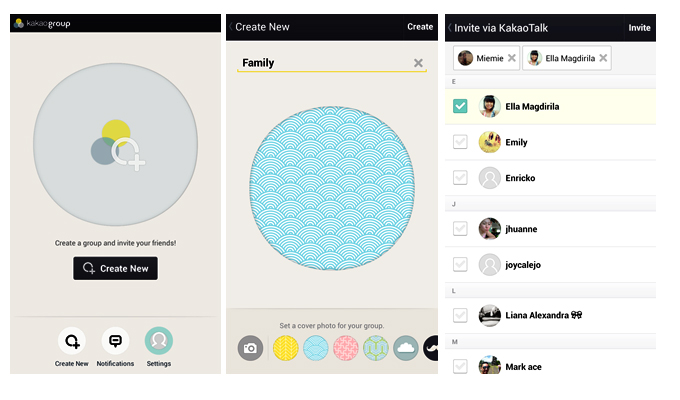
WeMeet and KakaoGroup are just the beginning. In the coming months, I predict we’ll see several more of these in-between group messaging apps pop up, both from the big players and from startups. The big players will ultimately win out due to the fact they can incorporate their existing userbases, but startups have the chance to make a buck or two if they get acquired. Opportunities will also open up for enterprise versions.
The winner will be the one that can gain and retain the most traction, but it’s far too early to call. Still, KakaoGroup and WeMeet have a chronological advantage because, as they say, the early bird gets the worm.
(Editing by Steven Millward)





Stay updated on the go with our mobile app.
Get latest insights with smoother, more personalized experience through TIA mobile app.











📅 Upcoming Events
22 October 2026
Payoneer x CSPN Summit 2026