
Apple CEO Tim Cook (via Cult of Mac)
In response to the growing brouhaha over working conditions at Apple (NASDAQ:AAPL) suppliers’ factories in Asia — not to be confused with the growing brouhaha over Apple’s iPad trademark problems in China — Apple CEO Tim Cook said this:
Apple takes working conditions very very seriously, and we have for a very long time. We care about every worker […] We believe that every worker has the right to a fair and safe work environment, free of discrimination where they can earn competitive wages and where they can voice their complaints freely. And Apple suppliers must live up to this to do business with Apple.
It certainly sounds nice, and Apple has asked the Fair Labor Association to conduct an audit of some of its major suppliers in China.
But then, Apple has taken similar steps before.
Apple and Labor in the News
Back in June of 2006, an article in the Daily Mail reported to the world that workers at an iPod manufacturing plant in China were being paid extremely low wages to work 15-hour days manufacturing the devices. Apple said that it “would not tolerate” any violations of its code of conduct for suppliers and began an investigation into the reports. Ultimately, that investigation concluded that the factory in question — which was run by Foxconn — “complies with our Supplier Code of Conduct in most areas and is taking steps to correct the violations we found.” Among the violations Apple found was that some workers were working more than 60 hours per week — the maximum stipulated in Apple’s supplier code of conduct — and not being given at least one day off per week. Meanwhile, the China Business News, which had run the original article translated by the Daily Mail, was sued by Foxconn for libel. Foxconn ultimately dropped the suit.
In 2009, Apple came under fire in the international press again when a Foxconn worker committed suicide. The man, whose name was Sun Danyong, had jumped out a window after being detained, interrogated, and allegedly beaten by Foxconn security personnel after an iPhone prototype went missing. Sun had denied taking the phone. Apple stated that it was “saddened by the tragic loss of this young employee” and that it would await the results of an investigation. Ultimately, Foxconn paid compensation of more than $50,000 to Sun’s parents, although it denied that Sun had been beaten. Apple expressed concerns but continued to work with Foxconn.
That same year, Apple supplier Wintek, which has plants in Taiwan and mainland China, was accused by its own employees of violations including sudden layoffs, forced unpaid overtime, illegally firing workers after a labor strike, and unacceptable working conditions. Apple expressed concerns but continued to work with Wintek.
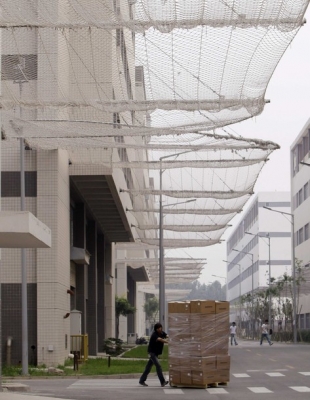
Suicide nets at Foxconn, via publicintelligence.net
In 2010, a rash of suicides brought international attention back to Apple supplier Foxconn. An investigative report in China’s Southern Weekend pointed to poor working conditions and forced unpaid overtime as contributing factors in the suicides. In response, Foxconn announced a series of pay raises, hired psychological counselors, and installed anti-suicide nets around its buildings to catch jumpers. Wintek workers were reportedly poisoned by a toxic cleaning agent that had been used in 2008-2009 (the story didn’t break until 2010). Apple expressed concerns but continued to work with Foxconn and Wintek.
In 2011, China’s IPE published a report accusing Apple of lax oversight leading to poor environmental and working conditions. At Foxconn, an explosion killed three workers and injured 15 others. Another explosion killed one and injured dozens more. Reports of labor violations also continued to dog the supplier. Apple expressed concerns but continues to work with Foxconn and Wintek.





Stay updated on the go with our mobile app.
Get latest insights with smoother, more personalized experience through TIA mobile app.







📅 Upcoming Events
22 October 2026
Payoneer x CSPN Summit 2026